 Scribba
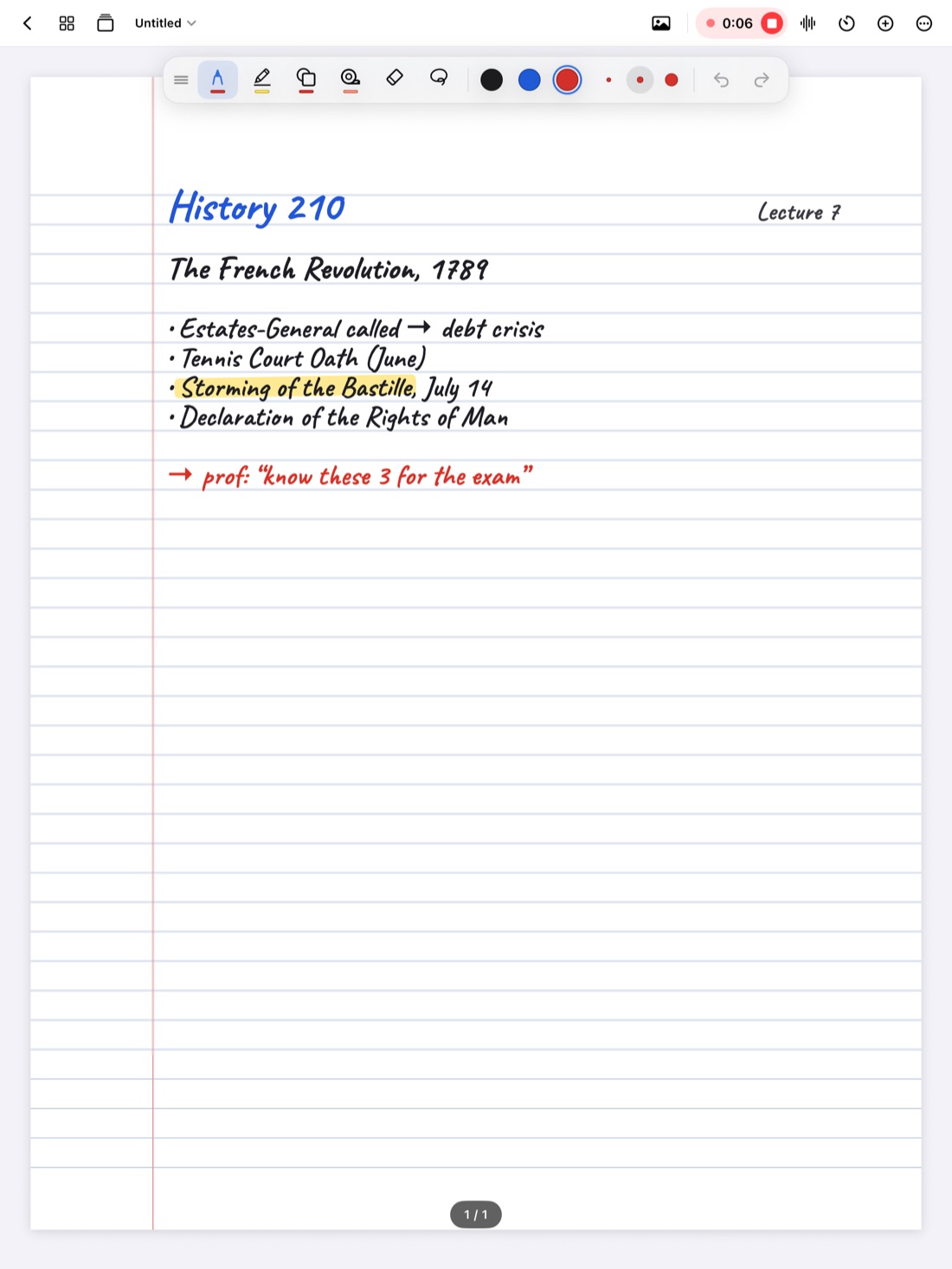
Anthropology is the study of people, and sooner or later the course asks you to study some yourself. That makes it different from most classes you'll take notes in. Some weeks you're in a lecture hall learning about kinship systems or human evolution. Other weeks you're sitting in a café, a market or a community center, writing down what people do.
So anthropology notes come in two kinds: notes about what anthropologists have found, and notes you make in the field. Both need care, and the second comes with real responsibilities to the people you write about.
Know which branch you're in
In the United States, anthropology is often taught as four fields, and each one calls for different notes:
- Cultural anthropology: ethnographies, concepts like cultural relativism and reciprocity, and case studies of specific communities. Mostly reading and discussion.
- Biological anthropology: human evolution, primates and human variation. Expect timelines, skull and skeleton diagrams, and comparisons between species.
- Archaeology: sites, artifacts, dating methods and how layers of soil record time. Expect site maps and cross-section sketches.
- Linguistic anthropology: how language shapes and reflects social life. You may write phonetic symbols and short transcripts of speech.
Many intro courses touch all four in one term. Give each unit its own section of your notebook, because the notes look so different.
Read ethnographies for the argument
An ethnography is a book-length study of a community, based on long fieldwork. It reads like a story, which makes it easy to enjoy and hard to take notes on. For each one, write:
- Who and where: the community and the time period of the fieldwork.
- The question the author is trying to answer.
- The argument, in one or two sentences.
- The evidence: two or three scenes or cases the author uses, with page numbers.
- The author's position: how they gained access, their relationship to the people, and how that might shape what they saw.
- Course concepts the book illustrates.
Exams and papers rarely ask you to retell an ethnography. They ask what it argues and how it connects to the course's ideas.
Draw kinship diagrams the standard way
Kinship charts use a shared set of symbols. Triangles usually stand for men and circles for women. An equals sign or a line below two symbols joins a married couple, a vertical line runs down to their children, and a horizontal line above siblings joins them as a group. Mark the person the chart centers on, often called "ego," with shading or a label. Write a key in the corner if your professor uses different symbols.
Draw a few by hand from memory before the exam. If you can draw the chart, you can explain the system.
Take field notes the way anthropologists do
Fieldwork assignments, from a one-hour observation to a semester project, use the same basic method.
In the moment, jot. Write short phrases, key words and quick sketches. You won't have time for full sentences, and writing heavily can make people uncomfortable.
The same day, write up. Turn your jottings into full notes while you still remember. Memory fades fast, and details you skipped will be gone by the weekend.
Keep description and interpretation apart. "Three older men sat at the corner table and nobody else sat there" is description. "The table seemed to be reserved for regulars" is interpretation. Use a separate color or a marked column for each.
Record context every time: date, time, place, how long you stayed, and who was there, described by role rather than name.
Sketch the space. A quick map of a room, with entrances, furniture and where people gathered, often explains behavior better than paragraphs.
Write about yourself too. Note how people reacted to you and how you felt. Anthropologists call this reflexivity, and it's part of honest fieldwork.
Tip: use pseudonyms or codes for people from the start, even in private notes. It's easier than removing names later, and it protects people if your notes are ever lost.
The ethics of recording people
Recording a lecture is one thing. Recording a person in the field is another. Anthropology takes consent seriously, and your notes should too.
- Ask before you record, photograph or quote anyone. Explain who you are, what the project is and what you'll do with the recording. People can say no, and that's a full answer.
- Check your course's rules. Class projects that involve interviewing or observing people may need approval from your professor or your school's ethics review board. Ask early; it can take time.
- Don't record in private or sensitive settings without clear permission, and be especially careful with children and vulnerable people.
- Keep identities out of your files where you can. Use pseudonyms, avoid filming faces, and store recordings only where your project allows.
- Delete what you promised to delete, when you promised to.
Rules on recording people vary by school and location, and this isn't legal advice. When in doubt, ask your professor. For recording your own lectures, see is it OK to record lectures?
Anthropology notes in Scribba
Field notes and interviews. If someone agrees to be recorded, tap the mic and jot as they talk. Every stroke is linked to that moment, so a jotting like "story about the flood" plays back the part where they told it. Recording keeps going if the screen locks, so you can put the iPad down and keep eye contact.
Know where your recordings go. Scribba keeps notebooks on the iPad and, if you turn it on, in your own private iCloud. Settings › iCloud has an option to leave recordings out of sync. Transcription runs on the iPad on models that support on-device recognition; otherwise Apple's speech service processes it. Check that against what you told participants and what your ethics approval allows.
Lock it. Lock your fieldwork notebook with Face ID, Touch ID or a passcode. See how to lock notebooks with Face ID.
Diagrams. Hold the Pencil still at the end of a stroke to snap a circle, triangle or line, which makes kinship charts quick to draw. Graph (mm) paper helps with site maps and floor plans.
Lectures and readings. Import ethnography chapters as PDFs and write on them. For lectures, Start Lecture adds a dated, bookmarked page and starts recording, if your professor allows it.
A note on phonetic symbols. You can write any symbol on the page, since it's ink. Handwriting recognition is built for Latin-alphabet handwriting, though, so don't count on search to find phonetic symbols.
Frequently asked questions
Should I take field notes on paper or an iPad?
Either works. Some people find a notebook less noticeable in the field. An iPad lets you link jottings to a recording, if your participants agree to one.
Do I need permission to interview someone for a class project?
Always ask the person. Many schools also require approval for projects involving people, so check with your professor before you start.
How fast should I write up field notes?
The same day if you can. Jottings make sense for a few hours, then they turn cryptic.