 Scribba
Psychology looks like a reading class, but it's really a vocabulary class with a lot of people in it. A single chapter can introduce dozens of terms, a handful of theorists, several classic studies and a diagram or two of the brain. Then the exam asks you to apply all of it to a scenario you've never seen.
Good psychology notes keep those pieces apart so you can learn each one, and connect them so you can use them. Here's how to set that up, with ideas that work on paper or on an iPad.
Set up your notebook
Use one notebook for the course, with a few kinds of pages that repeat for each chapter or unit:
- Lecture pages for what happens in class.
- A vocabulary page for the chapter's terms.
- A people and studies page for theorists and research.
- A diagram page for anything you need to draw and label.
Keeping the same structure every unit means you always know where to look, and review becomes a routine instead of a search.
Keep a vocabulary page for every chapter
Most of what you'll be tested on starts with a term. Write each one on a vocabulary page with three parts:
- The term, spelled out fully.
- A short definition in your own words.
- An example from real life, ideally your own.
The example is the part students skip, and it's the part that matters most. Psychology exams often describe a situation and ask which concept it shows. If you've already connected "classical conditioning" to something that happened to you, you'll recognize it in a new scenario. Our guide to memorizing vocabulary faster has more ways to make terms stick.
Tip: put easily confused pairs on the same line or next to each other, with a note on how they differ. Psychology has a lot of terms that sound alike and mean different things.
Track theorists and their ideas
Psychology is full of names, and exams like to ask who proposed what. A dedicated page for people saves a lot of flipping.
For each theorist, write:
- The name and the area of psychology they're known for.
- Their main idea in one or two sentences.
- The key terms that come from their work.
- How they differ from others who studied the same thing.
Grouping theorists by perspective, such as behavioral, cognitive, biological, humanistic and psychodynamic, helps you see how their ideas fit together and where they disagree.
Take notes on studies the same way every time
Your textbook and lectures will describe experiments and studies. Rather than copying whatever the professor says, use the same short template for each one:
- The question. What were the researchers trying to find out?
- The method. Who took part, and what was done?
- The finding, in a sentence.
- Why it matters. Which concept or theory does it support?
- Limits and ethics. What are the criticisms? Would it be allowed today?
Using one template means you can compare studies at a glance, and it covers the questions exams usually ask about research. Ask your professor how much detail they expect you to know.
Draw the diagrams
Psychology has more drawing than people expect. A few you'll likely meet:
- The brain. A simple side view with the lobes and a few key structures labeled. It doesn't need to be anatomically perfect.
- A neuron. Dendrites, cell body, axon and terminals, with an arrow showing the direction of the signal.
- Memory models. Boxes for each stage of memory, with arrows showing how information moves between them and where it can be lost.
- Stage theories. A timeline or staircase showing each stage of development in order.
- A normal curve for the statistics unit.
Drawing it yourself, then redrawing it from memory a few days later, teaches you more than looking at the textbook figure.
In Scribba: hold the Pencil still at the end of a stroke and it snaps into a clean rectangle, circle or arrow, which makes memory models and flowcharts quick to draw. The Shape tool snaps every stroke. Then drag study tape over the labels on your brain or neuron diagram, name each part, and tap to peek. See the study tape guide.
Use Cornell notes in lecture
The Cornell method fits psychology well. Take notes in the wide column during class. Afterward, fill the narrow cue column with questions like "What's the difference between these two terms?" or "What did this study test?" Then write a short summary at the bottom. Learn the method in how to take Cornell notes on iPad.
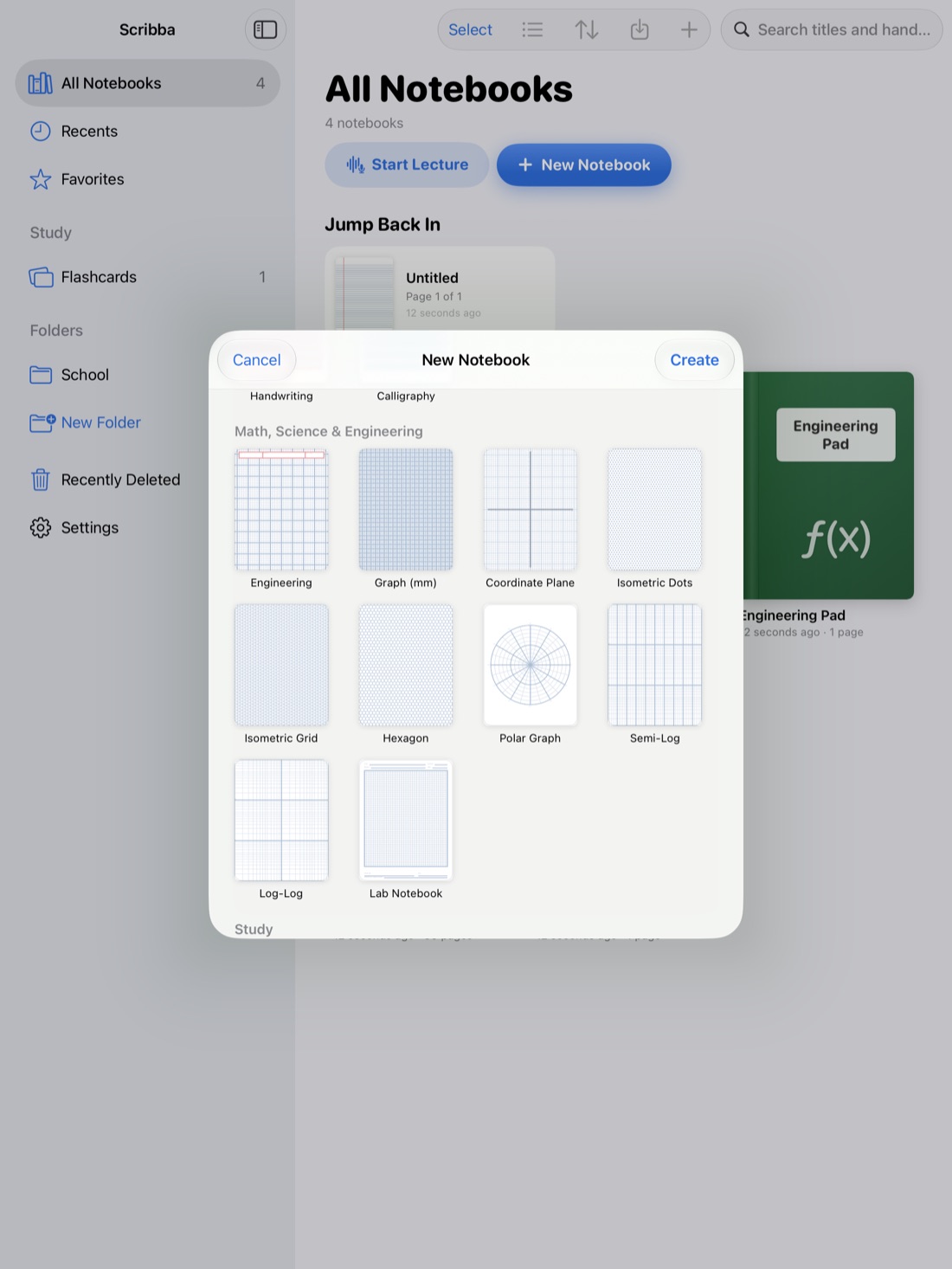
In Scribba: Vocabulary and Cornell Notes paper are both in the paper picker. Scribba reads your handwriting and turns each vocabulary row or Cornell cue into a flashcard, without needing Apple Intelligence. Check the words it read, then study with spaced repetition.
Record lectures for the examples
Psychology professors often teach through stories, demos and examples, and those are hard to write down while they're happening. They're also exactly what helps on scenario questions.
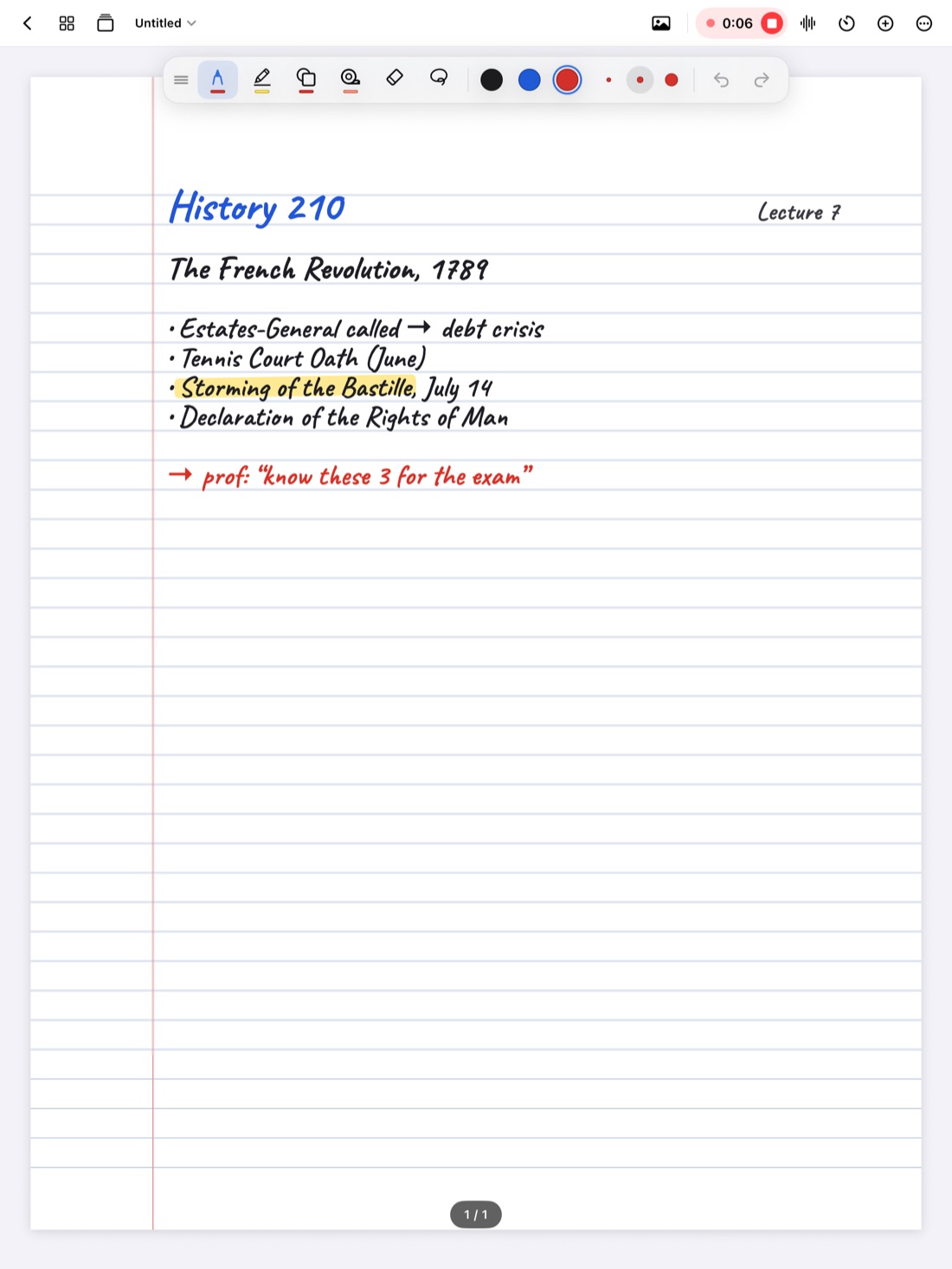
In Scribba, tap the mic and take notes as usual. Later, tap any line you wrote to hear what your professor was saying at that moment. Recordings are transcribed after class, so you can search for a term you never wrote down. More in how to record lectures on iPad.
On iPads that support Apple Intelligence, with it turned on, Scribba can also write a lecture's key points and show what your notes left out.
Ask before you record. Policies vary by school, professor and location, and students with accommodations may be able to record as part of them. See is it OK to record lectures?
Frequently asked questions
What paper is best for psychology notes?
Ruled or Cornell paper for lectures, Vocabulary paper for terms, and dot grid paper for diagrams. You can mix all of these in one notebook.
How much do I need to know about each study?
Usually the question, the general method, the main finding and why it matters. Your professor's review sheet is the best guide to how much detail they expect.
Can I make psychology flashcards without Apple Intelligence?
Yes. Write terms on Vocabulary paper or questions in a Cornell cue column, and Scribba turns them into flashcards on any iPad that runs it.