 Scribba
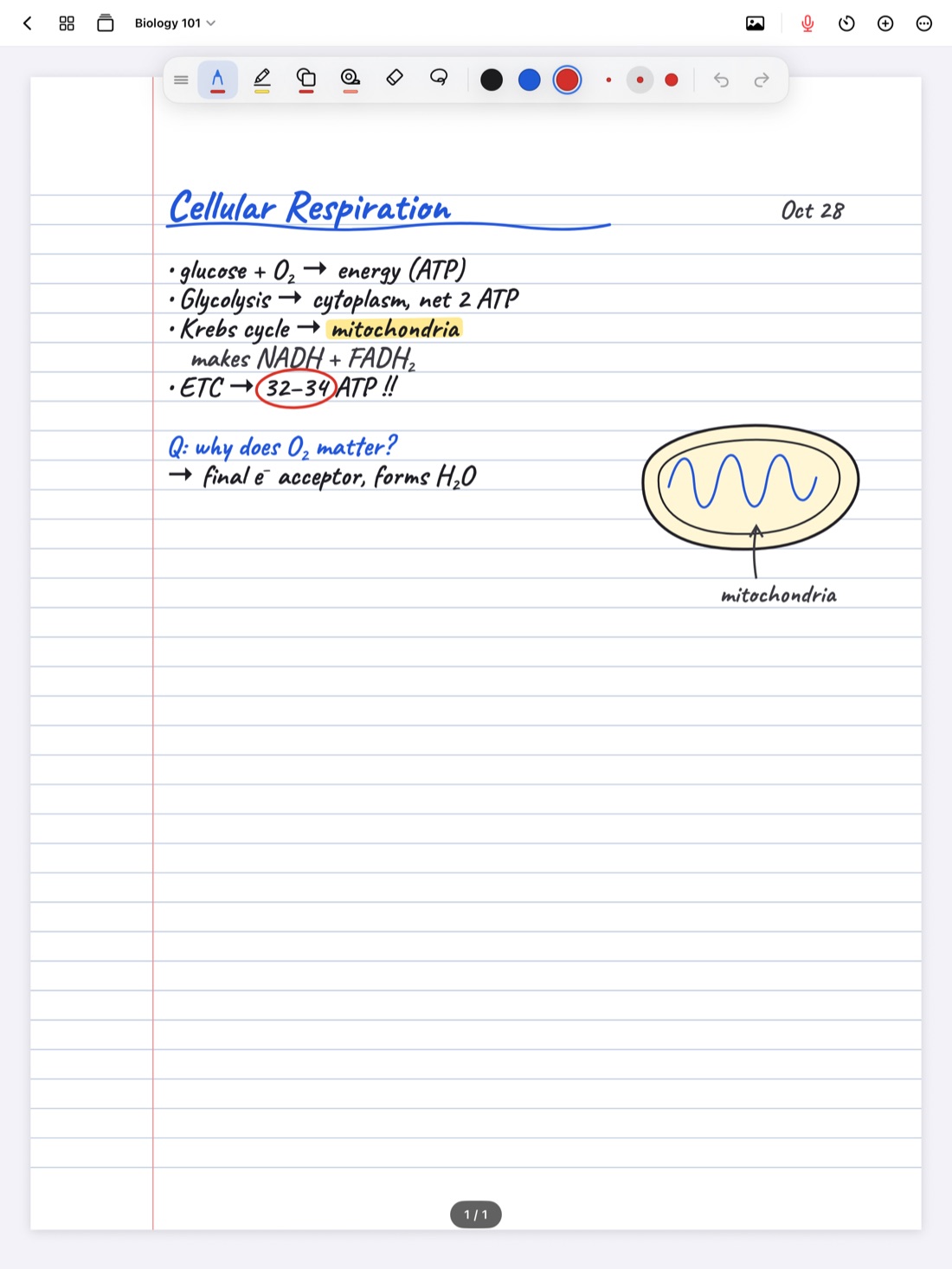
Microbiology is a catalog course with a lab attached. In lecture, you meet dozens of organisms, each with a Latin name, a shape, a staining result, a way of growing and a way of causing trouble. In lab, you learn aseptic technique, stains and biochemical tests, and often finish the term by identifying an unknown organism from your own results.
The challenge is that organisms blur together. By midterm, three Gram-positive cocci sound the same. Good micro notes are built to compare: every organism recorded the same way, so the differences stand out. Here's how to do that.
Give every organism the same profile
The single most useful habit in micro is a fixed set of fields for each organism. Decide on them in week one and fill them in the same order every time. A typical profile:
- Name, written in full, genus capitalized, both parts underlined or italicized as your course requires.
- Gram reaction, shape and arrangement, for example Gram-positive cocci in clusters.
- Oxygen requirements and any special growth needs.
- Key structures, such as a capsule, spores or flagella.
- Disease or role, and how it spreads.
- Distinguishing tests, the one or two lab results that separate it from look-alikes.
- Virulence factors your professor emphasized.
Leave a field blank if lecture didn't cover it. The gap itself tells you something, and you can fill it in from the textbook.
Fixed fields pay off at exam time. Questions like "Which of these is catalase positive?" become a matter of scanning one line across your profiles. The approach is a version of the charting method, which works well for any class that compares many similar things.
Profiles in Scribba
Scribba's Index Cards paper is a page of card outlines, which suits one organism per card. A Grid page works if you'd rather build a comparison chart with organisms down the side and your fields across the top. Keep a separate notebook section, with a bookmark, for profiles, so they don't get lost between lecture pages.
Draw the cycles and structures
Micro has a few drawings you'll make again and again. Learn to draw them simply and fast:
- Cell walls. Gram-positive and Gram-negative walls side by side: one thick layer versus a thin layer plus an outer membrane. This explains the Gram stain, so it's worth knowing cold.
- Viral replication. Attachment, entry, replication, assembly and release, as a loop of numbered arrows. Draw the lytic and lysogenic cycles next to each other so you can see where they split.
- Immune responses, if your course covers them, as a flowchart from recognition to response.
In Scribba, hold the Pencil still at the end of a stroke and it snaps into a clean circle, ellipse or arrow, which is most of what these drawings need.
Plot growth curves on log paper
The bacterial growth curve has four phases: lag, log (exponential), stationary and death. Because bacterial numbers grow exponentially, the curve is usually plotted with a log scale on the population axis, which turns exponential growth into a straight line. If your lab asks you to graph growth or calculate generation time, plotting by hand on log paper makes the idea click.
Scribba has Semi-Log paper: a log scale on one axis with three cycles. Mark your time points on the regular axis, plot population on the log axis, and label each phase on the curve. For more on these papers, see log graph paper on iPad.
Lab notes: procedures, results, unknowns
Write procedures as steps you could follow
Stains and tests come in a strict order. The Gram stain, for example, runs crystal violet, iodine, decolorizer, safranin. Write each procedure as a numbered list with the reason for each step next to it. Knowing why the decolorizer step matters is what lets you explain a bad result.
Record results the same way every time
For each test, write the test name, what a positive and negative look like, and your result. A consistent format makes your unknown report much easier to write.
Map your unknown identification
Unknown identification is a process of elimination: Gram stain first, then tests that split the remaining candidates. Draw it as a branching flowchart, with each test as a fork and your result circled. When you're done, the path through the chart is your argument for the final answer.
Scribba's Lab Notebook paper has TITLE, BOOK NO., PROJECT and PAGE fields at the top, a grid, and SIGNATURE, DATE and WITNESSED & UNDERSTOOD BY fields at the bottom. It's good for writing up procedures and results neatly. See lab notebook on iPad.
Tip: follow your lab's rules about electronics. Many micro labs keep phones and tablets away from the bench. If so, write results on paper during lab, then copy them into your notes and add photos of your plates afterwards, if photos are allowed.
Learn the names by hearing them
Latin names are easy to misspell and easy to mishear. If your professor allows recording, tap the mic in Scribba and take notes as usual. Every stroke is linked to that moment, so you can tap a half-written name and hear the professor say it again. Recordings are transcribed, so you can search for an organism you didn't catch. Ask before you record and check your school's policy.
Study by comparing, not by listing
Studying organisms one at a time feels productive, but exams ask you to tell them apart. Mix them up when you review. Take two similar organisms and write what separates them. Quiz yourself on a random organism from any unit, not just this week's. This is interleaving, and it's well suited to a course full of look-alikes.
Flashcards help with the details. Write cards that ask for a difference ("What test separates these two?") as well as for facts. In Scribba, a Vocabulary page turns each row into a flashcard: put the organism in the TERM column and its key features in the DEFINITION / EXAMPLE column. Scribba reads your handwriting; review and fix any misread words first, because Latin names often need a correction. This doesn't need Apple Intelligence. Decks use spaced repetition, coming back after 1, 3, 7, 14 and 30 days. You can also drag study tape over fields on your profile cards and quiz yourself by tapping to peek.
Frequently asked questions
What paper is best for microbiology notes?
Ruled or Cornell paper for lecture, Index Cards or Grid for organism profiles, Semi-Log for growth curves and Lab Notebook for lab write-ups. You can change the paper on any page from the page sidebar.
How do I keep all the bacteria straight?
Use the same profile for every organism, and spend more of your study time comparing similar organisms than reviewing them one by one.
Will Scribba read genus and species names correctly?
Handwriting recognition is built for Latin-alphabet handwriting and works best on English, so unusual names may need fixing. Scribba lets you review and correct each card before you study.