 Scribba
Neuroscience covers an unusual range. One week you're tracking sodium ions across a membrane. The next you're following a pain signal from a fingertip to the cortex, and the week after you're reading an experiment on memory in rats. The same course asks you to think at the level of molecules, cells, circuits, brain regions and behavior.
Students who struggle with neuroscience often know plenty of facts but can't place them. Which level is this? What does it connect to above and below? Good neuroscience notes make those connections visible. If you're coming from intro psychology, the psychology notes guide covers the basic brain and neuron sketches; this one goes further.
Label every lecture by level
At the top of each lecture page, write which level it's mostly about: molecular, cellular, circuit, systems or behavioral. It takes two seconds, and it changes how you read your notes later.
Then, at the front of the notebook, keep a levels map: one page with a column or band for each level, where you add a few words for each big topic as the term goes on. When the professor connects receptor desensitization to drug tolerance, you'll see a line running from molecular to behavioral. Those connections are exactly what essay and application questions ask about.
In Scribba, bookmark the levels map so it's always at the top of the notebook's table of contents. Named bookmarks live in the page sidebar.
Graph the action potential until you can draw it blind
The action potential is the foundation of cellular neuroscience, and it's a graph: membrane voltage over time. Learn to draw it from memory, then annotate it:
- Label both axes with units: membrane potential in millivolts, time in milliseconds.
- Mark the resting potential and threshold as horizontal reference lines.
- Name each phase: depolarization, repolarization, hyperpolarization, return to rest.
- Write which channels are open at each phase, and which way ions are moving.
- Shade the refractory periods.
Once you can do that, related graphs (postsynaptic potentials, summation, channel currents) are variations on a picture you already own.
Scribba's Grid paper keeps a graph's proportions honest, and the Coordinate Plane paper has x and y axes through the center with tick labels if you prefer printed axes. Hold the Apple Pencil still at the end of a stroke and it snaps into a straight line, which is handy for the threshold and resting lines. Use a different color for ion movements so they stand out from the curve.
Trace pathways, synapse by synapse
Sensory and motor pathways are some of the most tested material in neuroscience, and they're hard to learn from text. Draw them instead:
- Sketch a simple stack: cortex at the top, then thalamus, brainstem and a slice of spinal cord. Keep the outline the same every time.
- Draw the pathway as one colored line from receptor to cortex, or cortex to muscle.
- Mark each synapse with a dot and number the neurons in order.
- Put an X where the pathway crosses the midline.
- Write one line beside the drawing: "Damage here causes symptoms on the ___ side."
That last step is the payoff. Lesion questions ("a patient loses pain sensation on the left below the waist...") come down to where a pathway crosses.
Reuse the same outline for every pathway so you can compare them. In Scribba, draw the outline once, then duplicate that page from the page sidebar before you add each new pathway.
Draw brain sections in three planes
Brain anatomy shows up in sections: coronal, sagittal and horizontal. Structures look different in each, and exams often show an unfamiliar slice. For each major structure, sketch where it appears in at least two planes, and always write the plane and orientation (anterior, dorsal) beside the drawing.
If your course has a brain model or atlas images in lab, and photos are allowed, add a photo to the page from the camera or photo library and label it with leader lines. Then drag study tape over each label. Name the structure, tap to peek, and move on. See study tape on iPad.
Keep neurotransmitters in one chart
Neurotransmitters and their receptors get scattered across many lectures. Collect them on one running page with the same fields for each: the transmitter, where it's made, its main receptor types, whether those receptors are ionotropic or metabotropic, its general effect, and any drugs or disorders your course linked to it.
A Vocabulary page in Scribba can double as this chart: transmitter in the TERM column, the details in DEFINITION / EXAMPLE. Scribba reads your handwriting and turns each row into a flashcard, with no Apple Intelligence needed. Review and fix any misread words before you study. Decks use spaced repetition, with cards coming back after 1, 3, 7, 14 and 30 days.
Read experiments for their logic
Upper-level neuroscience leans on experiments: lesions, recordings, imaging, genetic knockouts. For each one your professor presents, write four short lines: the question, the method, the result, and what it shows. Note what the method can't tell you too, since exams like to ask about limits. If you read papers as PDFs, you can import them into Scribba and write on them directly; see annotating PDF readings.
Review across the whole course
Neuroscience finals are usually cumulative, and later topics depend on earlier ones. A weekly review that redraws one graph, one pathway and one section from memory keeps the foundations solid.
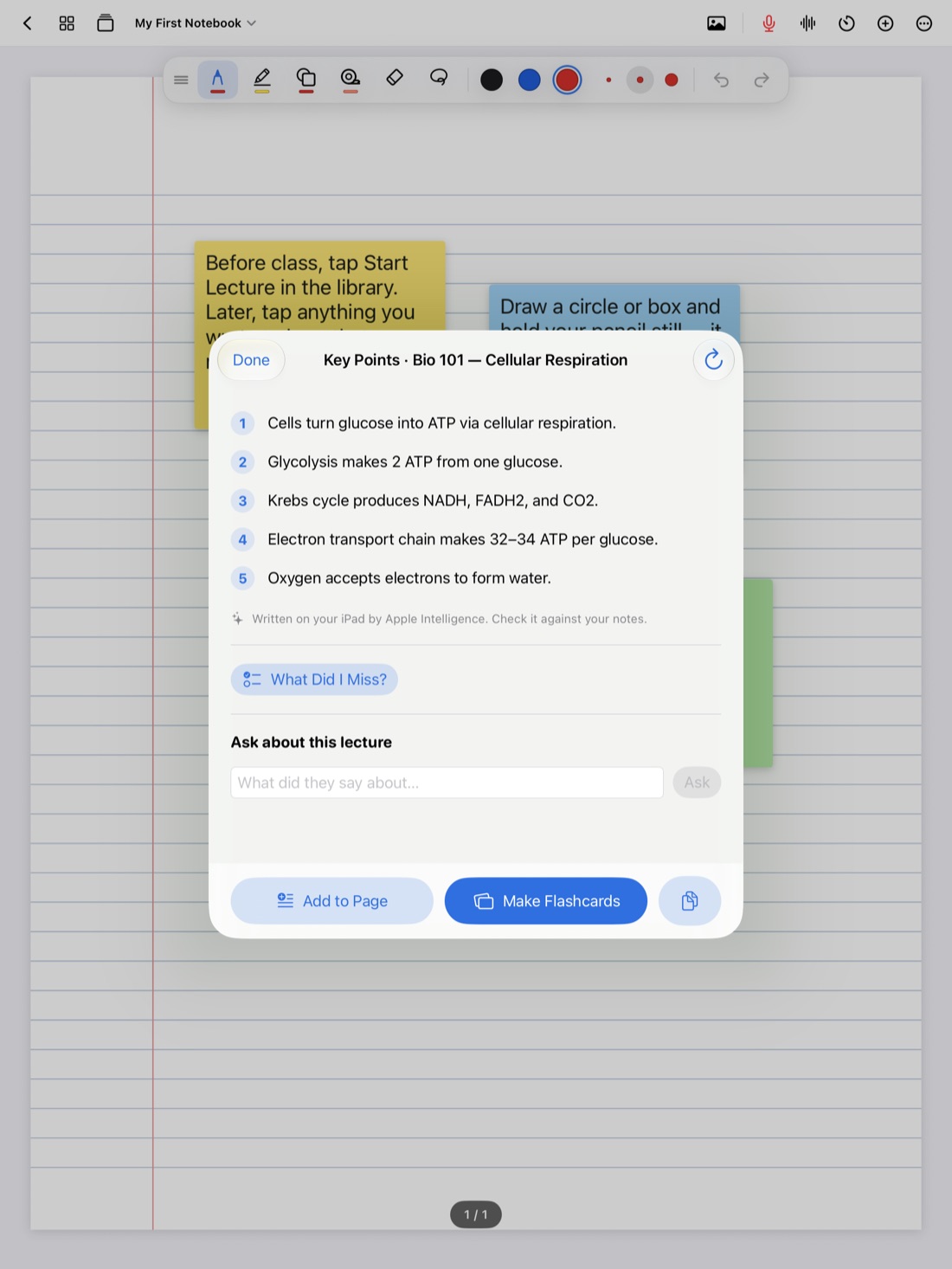
Recording helps with dense lectures. If your professor allows it, tap the mic in Scribba and take notes as usual. Every stroke is linked to that moment, so you can tap a half-drawn pathway and hear the explanation again. On an iPad that supports Apple Intelligence, with it turned on, Scribba writes the key points of each transcribed lecture, and Study Guide puts the key points of every lecture in a notebook on one sheet, which is a good starting point for a cumulative final. See key points from lectures.
Frequently asked questions
How are neuroscience notes different from psychology notes?
Psychology notes focus on theories, studies and terms. Neuroscience notes need more mechanism: graphs, pathways, sections and charts that link molecules to behavior.
What paper is best for neuroscience?
Ruled or Cornell paper for lecture, Grid for graphs, and blank or dot grid for pathways and brain sections. You can change paper per page from the page sidebar.
Do I have to memorize every brain region?
Focus on what your course emphasizes, and learn regions together with their function and their pathways. A structure you can place in a circuit is much easier to remember than one on a list.