 Scribba
Blurting sounds almost too simple: write down everything you know about a topic, then check what you missed. Plenty of students try it once, fill half a page, feel bad, and go back to rereading. The method is good. Most of the difference between blurting that works and blurting that doesn't comes down to a few details: how big a topic you pick, what you check against, and what you do with the gaps.
This guide is about those details. If you're new to the idea behind it, start with active recall, the broader method that blurting is one form of.
What blurting is
You take a topic, close every book and tab, and write down everything you can remember about it as fast as you can. Words, phrases, arrows, rough diagrams, formulas, half-remembered names. Then you open your notes and check, adding what you missed in a different color.
The red additions are what you study. Next session, you blurt the same topic again and see how much of the red you now produce on your own.
Why it works
It shows you what you can produce, not what you recognize. Your notes look familiar when you reread them. A blank page doesn't give you anything to recognize, so it tells you the truth.
It builds connections, not just facts. Flashcards test one item at a time. Blurting asks you to pull up a whole topic, and you'll notice what you remember together and what's floating on its own.
The gaps make your next session obvious. Instead of "review chapter 6," you have a specific list of what you couldn't recall.
How to blurt, step by step
- Pick a topic you can blurt in one page. Use the headings from your syllabus, the learning objectives your professor gave you, or the title of one lecture. "Cell membrane transport" is a good size. "Biology" is not.
- Write the topic at the top and set a timer. Five to ten minutes is plenty. A time limit keeps you from staring at the page and makes you write the first thing that comes.
- Blurt in any order. Don't try to be neat or organized. Keywords are fine. A diagram with half its labels is fine. If you remember a detail but not where it fits, write it anyway.
- Keep going after the first stall. Most people run dry once, then remember more after a pause. Ask yourself prompts: what are the parts, the steps, the causes, the examples, the exceptions?
- Check against a source, in a new color. Open your notes or study guide and go through it line by line. Add anything you missed in red. Fix anything you got wrong in a second color, like orange, so you can tell missing knowledge from mistaken knowledge.
- Write a short gap list. At the bottom, list the three to five most important things you missed. That's where the next session starts.
- Blurt again later. A day or two later, do the same topic on a fresh page without looking at the first one. Then compare.
Tip: count the red. When a re-blurt comes back with almost none, move that topic to a longer review gap and spend the time on a weaker one.
What to check against
A blurt is only as useful as the source you compare it with. If you check against a messy page of notes, you'll miss things the professor stressed.
Good sources, roughly in order: the learning objectives or exam topic list from your professor, a study guide that covers every lecture, your full class notes, and the textbook section summary. If your professor gave you a list of what's on the exam, use it as a checklist and tick each item you blurted. For building a sheet like that yourself, see making a study guide from lecture notes.
Blurting different kinds of material
- Processes and cycles. Blurt the steps in order with arrows. Then check the order as well as the content.
- Diagrams. Draw the diagram from memory, labels and all. Missing labels are the gaps.
- Essay subjects. Blurt the main arguments, the evidence for each, and the names and dates you'd cite. The check shows which arguments are thin.
- Math and science. Blurt the formulas, what each variable means, and when each one applies. Then do a few practice problems, since knowing a formula and using it are separate skills.
Common mistakes
- Peeking. Even a glance turns blurting into copying. If you're stuck, write "?" and move on.
- Topics that are too big. You'll write a few broad sentences and learn little. Narrow it down.
- Checking carelessly. Skimming your notes and thinking "yeah, I had most of that" defeats the point. Go line by line.
- Never re-blurting. The first blurt finds the gaps. The second one tells you whether you closed them.
- Starting too late. Blurting the night before shows you a long list of gaps with no time to fix them. Start a couple of weeks out.
Blurting in Scribba
Blurt on a fresh page in the class notebook. Pull past the last page to add one, or add a page and change its paper from the page sidebar if you'd rather blurt on Blank or Dot Grid. Your notes are a scroll away when it's time to check.
Keep red and orange saved for checking. Scribba keeps three saved colors per tool. Tap the selected color to pick a new one, and save a red for missed items and an orange for corrections, so every check looks the same.
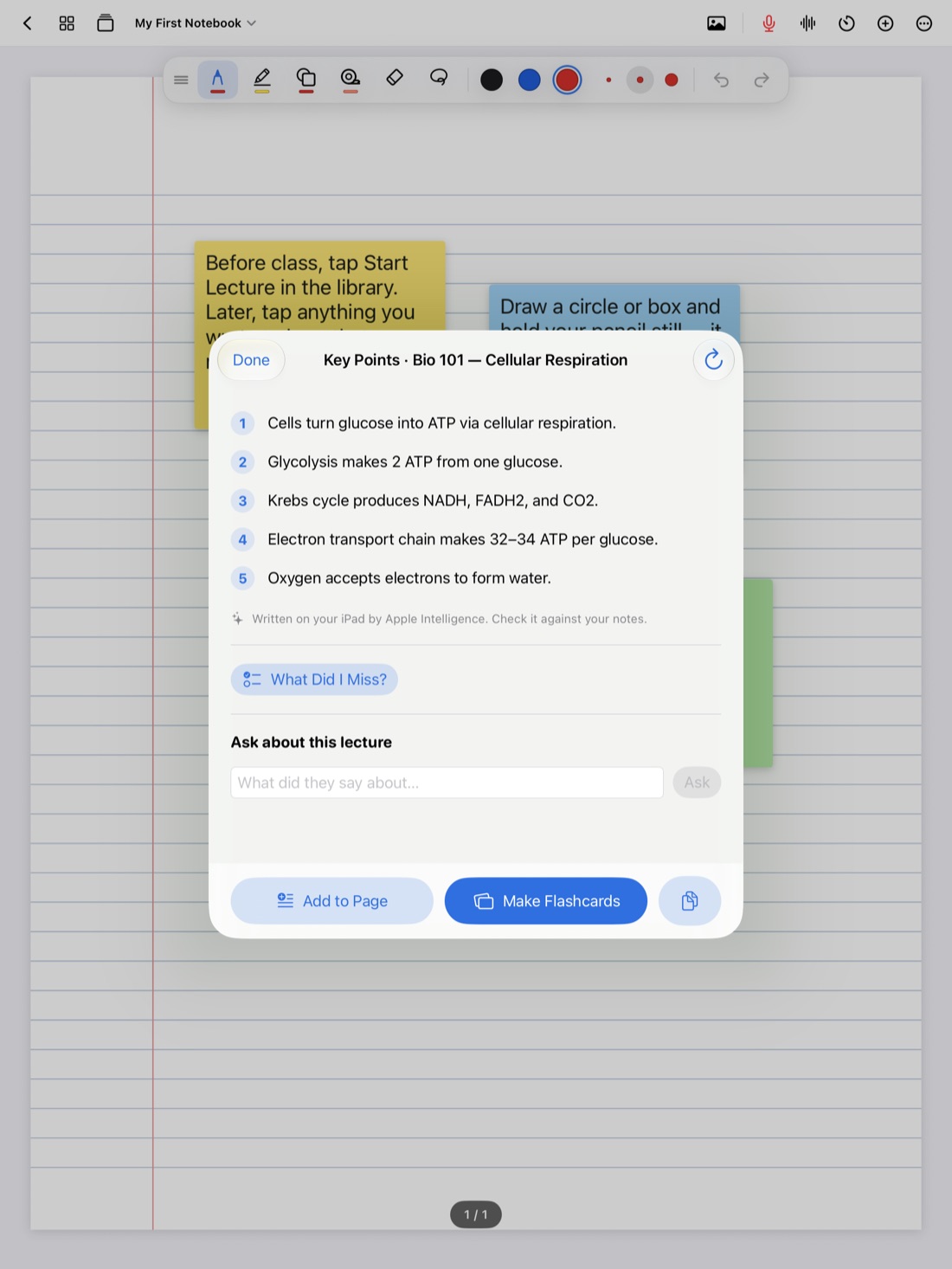
Use the lecture's key points as a checklist. On iPads that support Apple Intelligence, with it turned on, Scribba writes key points from each recorded lecture once it's transcribed. They make a quick list to check a blurt against. A notebook's Study Guide puts the key points of every lecture on one sheet, which is a ready-made set of topics to blurt one at a time. These are drafts, so trust your notes where they disagree.
Use What Did I Miss? the same way, during the semester. It compares a lecture's key points with what you wrote during class and lists what your notes left out. Fixing those before you blurt means you're checking against complete notes. See What Did I Miss?.
Bookmark your blurts. Add a named bookmark in the page sidebar, like "Blurt 2: membrane transport," so you can find earlier attempts and compare them.
Frequently asked questions
Is blurting the same as active recall?
Blurting is one form of active recall. Active recall is the general idea of pulling information out of memory. Blurting does it for a whole topic at once on a blank page.
How long should a blurt take?
Five to ten minutes of writing, then about as long again to check. Short blurts on narrow topics usually beat one long blurt on a huge one.
Should I blurt by typing or writing?
Either works. Writing by hand makes it easier to sketch diagrams and draw arrows between ideas, which helps for most science and history topics.