 Scribba
You've probably had this happen. You read your notes three times the night before a quiz, every page looks familiar, and you feel ready. Then the first question asks you to explain something you definitely read, and nothing comes.
That gap has a simple cause. Rereading puts information in front of you, but the exam asks you to pull it out. Active recall is studying by pulling it out. It's one of the most reliable study methods there is, and it doesn't need any special tools. Here's how it works, and five practical ways to do it.
What active recall is
Active recall means trying to remember something before you look at it. You close the notes, ask yourself a question, and answer from memory. Then you check.
That's the whole method. The effort of finding the answer is the point. Each time you pull something out of memory, it gets easier to pull out the next time. And each time you can't, you learn exactly what you don't know, while there's still time to fix it.
Why rereading feels productive
Rereading isn't useless. It's fine for a first pass, or for getting the big picture back before you start. The problem is how it feels.
When you read a page you've seen before, it looks familiar, and familiar feels a lot like knowing. You nod along, the terms look right, and you mark the chapter as done. But recognizing an answer when it's in front of you is a different skill from producing it on a blank exam page. Rereading trains the first one. Exams test the second.
Active recall feels worse. It's slower, you get things wrong, and it's frustrating to stare at a question you thought you knew. That discomfort is a good sign. It means you're doing the part of studying that builds memory, not the part that only feels nice.
Tip: if a study session feels easy the whole way through, you're probably reviewing, not recalling. Close the notes and ask yourself something.
Five ways to practice active recall
You don't need a complicated system. Pick whichever fits the material.
1. Blank-page recall
Take a blank page and write a topic at the top, like "causes of World War I" or "how neurons fire." Then write down everything you can remember about it: terms, steps, examples, a rough diagram. No notes, no peeking.
When you run dry, open your notes and compare. Fill in what you missed in a different color. Those additions are your study list. A day or two later, do it again on a fresh page and watch the second color shrink.
2. Self-quizzing
Go through your notes and turn each heading into a question. "Supply and demand" becomes "What shifts the demand curve, and what happens to price?" Write the questions in the margin, then answer them out loud without looking at the notes below.
If you take Cornell notes, the cue column already holds these questions. See how to take Cornell notes on iPad.
3. Practice questions
For any class with problems, like math, chemistry, physics or economics, doing problems is active recall. Rework homework without looking at your old answers. Try end-of-chapter questions you weren't assigned. If your professor shares past exams, they're the best practice you'll find.
When you get one wrong, find the exact step where you went off track and write it down. That step is what you study next.
4. Covering your notes
Lay something over part of the page and try to say what's underneath: the definition next to a term, the labels on a diagram, the date next to an event. Then uncover it and check. It's the oldest version of active recall, and it keeps the layout of your notes, which helps a lot with diagrams and processes.
5. Flashcards
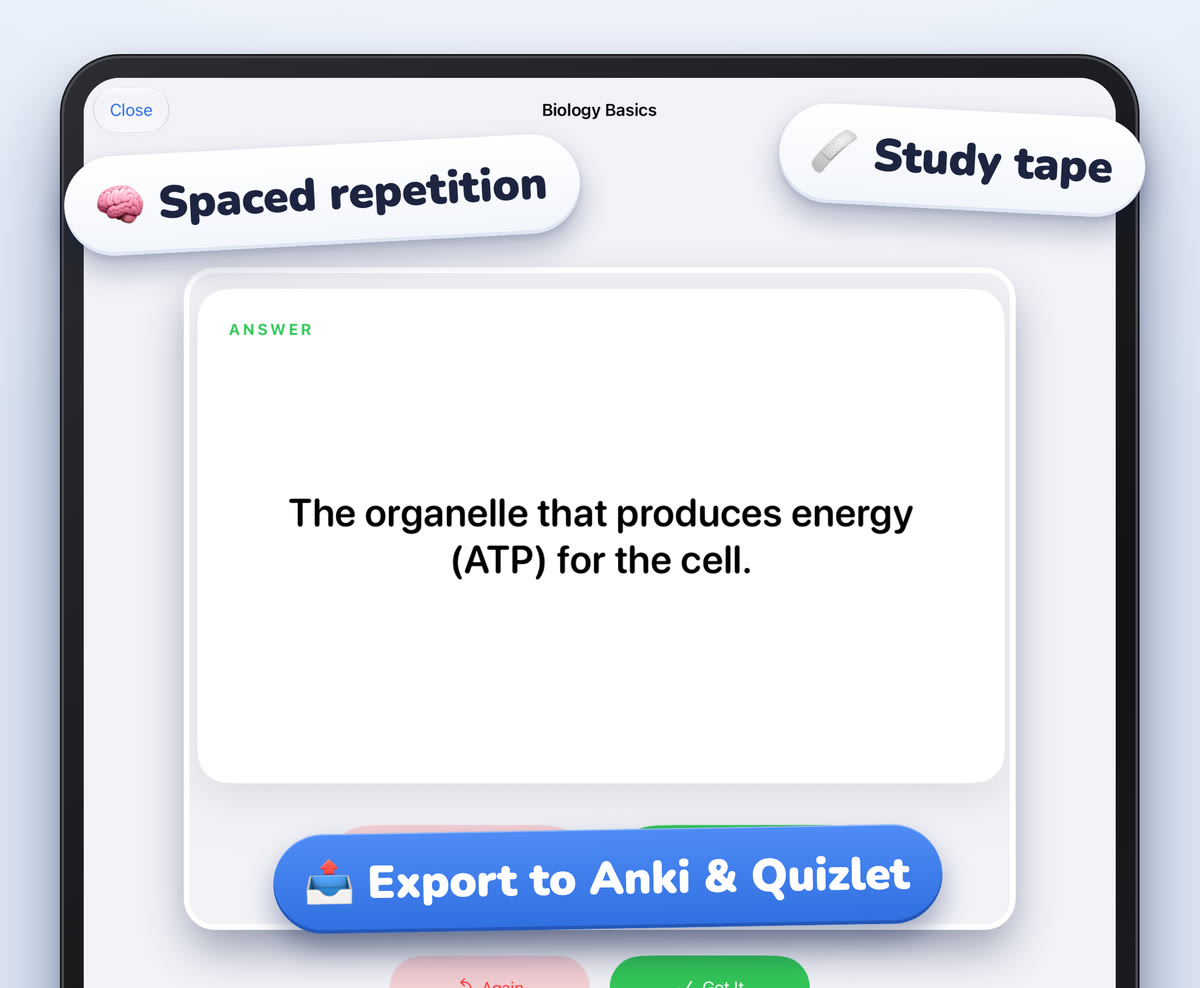
Flashcards are active recall in its most compact form: a question on one side, the answer on the other. They're best for single facts with a clear answer, like vocabulary, formulas and dates. Say the answer before you flip. If you only think "yeah, I know that," you'll overrate yourself.
Make recall a habit
Active recall works best when it's spread out. Quizzing yourself on a topic once is good. Quizzing yourself today, again in a few days and again next week is much better, because each time you've forgotten a little and have to reach for it. That's spaced repetition, and it pairs naturally with recall. Our guide to spaced repetition flashcards explains the schedule.
A few habits keep it practical:
- Start sessions with recall, not reading. Spend the first few minutes writing what you remember from last time.
- Keep a "missed" list. Anything you couldn't recall goes on it, and that list is where the next session starts.
- Mix topics. Quizzing yourself on several topics in one session is harder than doing one at a time, and closer to what an exam asks.
- Explain it to someone. Teaching a friend, or an empty chair, is recall out loud. You'll find the gaps fast.
Active recall in Scribba
Scribba is an iPad notebook for class, and a few of its tools are built for exactly this kind of studying. None of these need Apple Intelligence.
A blank page is one pull away. Pull past the last page of a class notebook to add a new one, and do your blank-page recall in the same notebook as the lecture. Then flip back to compare, and fill in what you missed in a different pen color.
Study tape covers your notes. Choose study tape in the tool palette, drag it over a definition, a label or a formula, then tap the tape to peek. It's method 4 without the sheet of paper. The study tape guide covers what's worth hiding.
Flashcards come from your handwriting. Write terms on Vocabulary paper or questions in a Cornell cue column, and Scribba reads your handwriting and turns each row or cue into a card. Check the words it read, fix anything it got wrong, then study. Decks bring cards back on a spaced schedule, and you can study every due card across your decks in one session. The details are in making flashcards from handwritten notes.
On iPads that support Apple Intelligence, with it turned on, Scribba can also write flashcards from any page of notes or from a lecture transcript. Read those cards through before you rely on them, since they're a first draft.
Frequently asked questions
Is active recall better than rereading?
For remembering, yes. Rereading makes material feel familiar, while recall shows you what you can actually produce on your own. Rereading still has a place for a first pass or to refresh the big picture.
How long should an active recall session be?
Short and focused works well. A few rounds of recall spread across the week do more than one long session, so it's better to quiz yourself briefly and often.
Does active recall work for essay classes?
Yes. Use blank-page recall to write out the main arguments of a topic from memory, then practice outlining answers to likely essay questions without your notes. Check the outline against your notes afterward.