 Scribba
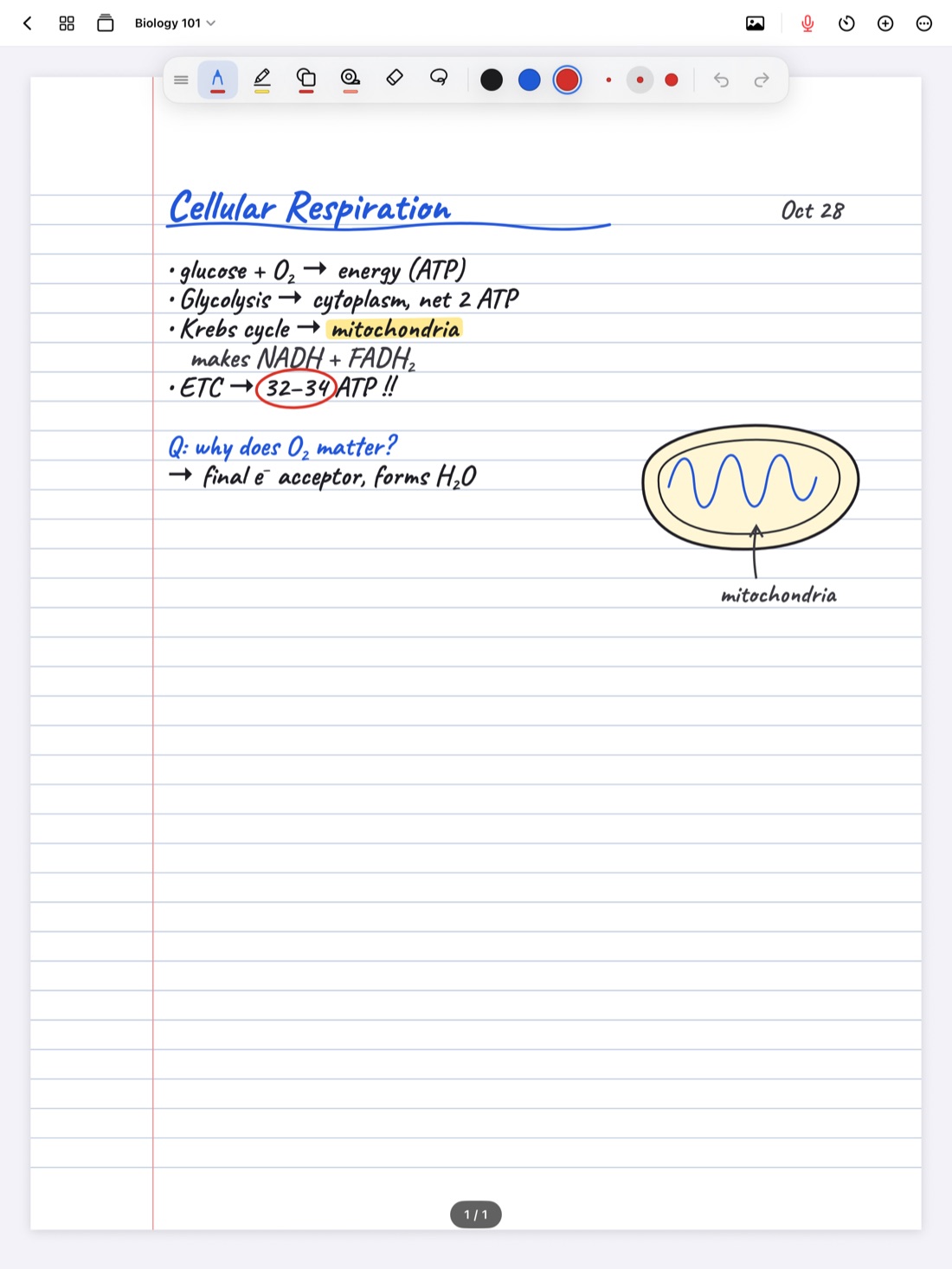
You can follow a lecture on the electron transport chain, nod at every slide, and still be unable to say what it actually does. Understanding something while someone else explains it is not the same as being able to explain it yourself. The Feynman technique is built around that difference.
It's named after the physicist Richard Feynman, who was known for explaining hard ideas in plain language. The step-by-step version students use today is a later summary of his approach, not something he wrote down as a formula. It's simple, it works for almost any subject, and all you need is a blank page.
What the Feynman technique is
You pick one concept, explain it in the simplest words you can, as if to someone who has never taken the class, and watch for the moments where your explanation breaks down. Those moments are your gaps. You go back to the source, fix them, and explain again.
The goal isn't a pretty summary. It's to find out, quickly and honestly, which parts you understand and which parts you've only memorized the words for.
Why it works
Jargon hides gaps. When you write "ATP synthase uses the proton gradient," the sentence sounds right even if you couldn't say what a proton gradient is. Plain words don't let you hide. If you can't say it without the technical term, you don't fully have it yet.
Explaining is recall plus structure. You're pulling ideas out of memory, which strengthens them, and you're also putting them in order: what causes what, what comes first, why it matters. That's the kind of understanding exams with "explain" or "why" questions are looking for.
You get feedback right away. You don't wait for a quiz to find your weak spots. They show up as soon as you get stuck mid-sentence.
How to do it, step by step
- Pick one concept. Make it narrow enough to explain on one page: "how a bill becomes law," "why the demand curve slopes down," "what a derivative means." A whole chapter is too big.
- Explain it on a blank page, from memory. Write as if you're teaching a friend in another major, or a curious twelve-year-old. Use short sentences. Draw a sketch if it helps. Don't open your notes.
- Mark where you got stuck. Circle every spot where you hesitated, used a term you couldn't define, skipped a step with "and then somehow," or wrote something you're not sure is true.
- Go back to the source. Open your notes, the textbook or the lecture recording, and fix only the circled spots. Understand each one well enough to say it plainly.
- Explain it again, simpler. On a fresh page, rewrite the explanation without looking. Replace jargon with plain words, and add an analogy where one fits. If the second version flows without circles, you know it.
Tip: read your explanation out loud. Gaps that look fine on paper are obvious when you hear yourself say "basically, it just kind of happens."
An example: cellular respiration
Say your Biology class covered cellular respiration. Your first attempt might read: "Glucose gets broken down in glycolysis, then the Krebs cycle, then the electron transport chain makes most of the ATP."
That's a list of stages, not an explanation. Ask the questions a beginner would ask. Where does each stage happen? What goes in and what comes out? Why does the last stage make so much more ATP than the others? If you can't answer, circle it.
After checking your notes, a second version might read: "A cell breaks sugar apart in steps so it can catch the energy a little at a time. The early steps strip off high-energy electrons. The last step uses those electrons to pump hydrogen ions across a membrane, like pumping water uphill behind a dam. When the ions flow back through a tiny turbine-like protein, it makes ATP." Every sentence there is something you could defend if a professor asked "why?"
Common mistakes
- Explaining from your notes instead of from memory. Copying your notes in simpler words is rephrasing, not testing. Close them first.
- Choosing a topic that's too big. "The French Revolution" will turn into a vague summary. "Why the Estates-General broke down" gives you something to explain.
- Skipping step 3. It's tempting to write a nice explanation and feel done. The circled gaps are the whole point. If you found none, look harder.
- Oversimplifying until it's wrong. Simple doesn't mean inaccurate. An analogy is a bridge to the real idea, so check it still matches the details your exam will ask about.
- Doing it once. Explain the topic again a few days later, from scratch. That's when you find out what stuck. Pairing it with active recall and spaced review keeps it there.
The Feynman technique in Scribba
Scribba is an iPad notebook for class, and the method fits naturally inside the notebook where the lecture already lives.
Start a blank page in the class notebook. Pull past the last page of the notebook to add a new one, then write your explanation right after that day's notes. Your attempt and the source material sit in the same place, so step 4 is just a scroll up.
Circle gaps in a second color. Tap the selected color to pick a new one, and keep a red or orange saved in your palette for marking gaps. Hold the Pencil still at the end of a stroke and it snaps into a clean circle or arrow. On the second version, the absence of red tells you you're done.
Check gaps against the lecture itself. If you recorded the class, tap anything you wrote during it to jump to that moment in the recording and hear how your professor explained it. You can also read along in the transcript. On iPads that support Apple Intelligence, with it turned on, you can type a question like "Why does the electron transport chain need oxygen?" and get a one-sentence answer from the transcript, with a button that plays the moment it was said. See asking your lecture questions.
Put the source beside your page. Split View opens a notebook in its own window, so your lecture slides or notes can sit next to the page where you're writing the explanation.
Keep your best explanations easy to find. In the page sidebar, add a named bookmark like "Feynman: cellular respiration." Before an exam, your bookmarks become a list of topics to explain again from memory. Make it part of your review after class and you'll catch gaps while the lecture is still fresh.
Frequently asked questions
Do I need another person for the Feynman technique?
No. Writing as if you're teaching someone is enough. Explaining to a real friend can help, since they'll ask questions you didn't think of, but a blank page works on its own.
Does it work for math and science?
Yes. Explain what each step of a method does and why, not just the steps. If you can say why you take a derivative there, or why a reaction goes one way, you'll handle new problems much better.
How is it different from summarizing?
A summary shortens the source while you look at it. The Feynman technique asks you to rebuild the idea from memory in plain words, and its main output is a list of what you couldn't explain.