 Scribba
Quizzes are small, and that makes them easy to ignore. Ten points here, a reading check there. But in a class with a quiz every week, they add up to a real part of your grade. And they do something more useful than that: each one is a checkpoint that tells you whether you're keeping up before the midterm does.
The good news is that quizzes need less time than you think, as long as the time comes in the right shape. This guide covers the weekly habit that makes quizzes easy, then two emergency versions: the night before, and fifteen minutes before class.
Find out what a quiz covers
Quizzes are usually narrow, so a minute of checking saves an hour of studying the wrong thing.
- What's in scope? Usually the last lecture or two, or the assigned reading. Sometimes a running total of everything so far.
- What kind of questions? Vocabulary, a short problem, a reading check, a diagram to label. Each needs different practice.
- Is it announced? Some classes quiz every Friday. Others give pop quizzes. Pop quizzes are the strongest reason to keep up as you go.
- Are the lowest scores dropped? Good to know, but don't count on it in week two.
The weekly habit
The best way to study for a quiz is a little at a time, starting the day of the lecture. A few minutes after each class does more than an hour the night before, because you're coming back to the material more than once.
- The same day: review for ten minutes. Read through your notes from class while they're fresh. Fill in anything you missed and fix messy parts. Our guide to reviewing notes after class covers this step.
- The same day: make the testable pieces testable. Turn terms into flashcards. Write a question next to each heading. Mark the formulas and definitions you'll need.
- A day or two later: quiz yourself. Five or ten minutes. Answer your questions from memory, run your flashcards, redo one example problem.
- The day before the quiz: one more round. Go through only what you missed last time.
That's it. Spread across the week, it's maybe half an hour in total, and it works because each pass makes you pull the material back out of memory after a gap. That's spacing and active recall working together.
Tip: treat every quiz as practice for the next exam. Keep a page of the questions you got wrong on each quiz. It turns into a ready-made study list when the midterm comes.
The night-before version
You didn't keep up this week, and the quiz is tomorrow. You can still do well. Give it about an hour, in this order:
- Ten minutes: find the scope. Check what the quiz covers and gather those notes, slides and readings. Nothing else.
- Ten minutes: skim and list. Read through once and write a short list of what's likely to be asked: terms, formulas, key ideas, the example the professor spent time on.
- Thirty minutes: quiz yourself on the list. Don't reread. Cover the notes and answer. Make quick flashcards for terms. Redo one problem of each type without looking at the solution.
- Ten minutes: go over the misses. Only the things you got wrong. Then stop.
Then sleep. A rested brain recalls more than a tired one that studied an extra hour, and sleep helps hold on to what you just learned. The quiz tomorrow is short, and so is the material. If you're in this spot for something bigger, our guide to cramming the night before is for that.
The 15-minute version
Sometimes you only have the walk to class, or the minutes before the professor arrives. Don't try to learn anything new. Use the time for recall:
- Two minutes: look at the topic list or headings from the last lecture.
- Ten minutes: go through your flashcards or cover your notes and say the answers. Focus on terms and formulas, which are the easiest quick points.
- Three minutes: look once more at the one or two things you keep missing.
Fifteen minutes of recall is worth more than fifteen minutes of reading the same page.
After the quiz
Look at the graded quiz when you get it back. For every miss, write down the right answer and why you missed it: didn't study it, mixed it up with something else, or misread the question. Add those to your page of missed quiz questions. It takes five minutes and it's one of the most useful things you can do for the next exam.
Studying for quizzes in Scribba
Scribba is an iPad notebook for class. Its tools are well suited to the short, frequent reviews that quizzes reward.
Review right after class. If you recorded the lecture, you can tap a line of your notes to hear that moment again. On iPads that support Apple Intelligence, with it turned on, key points are written automatically once a lecture is transcribed, and What Did I Miss? lists what your notes left out, ready to add to the page. That covers the "same day" step in a few minutes.
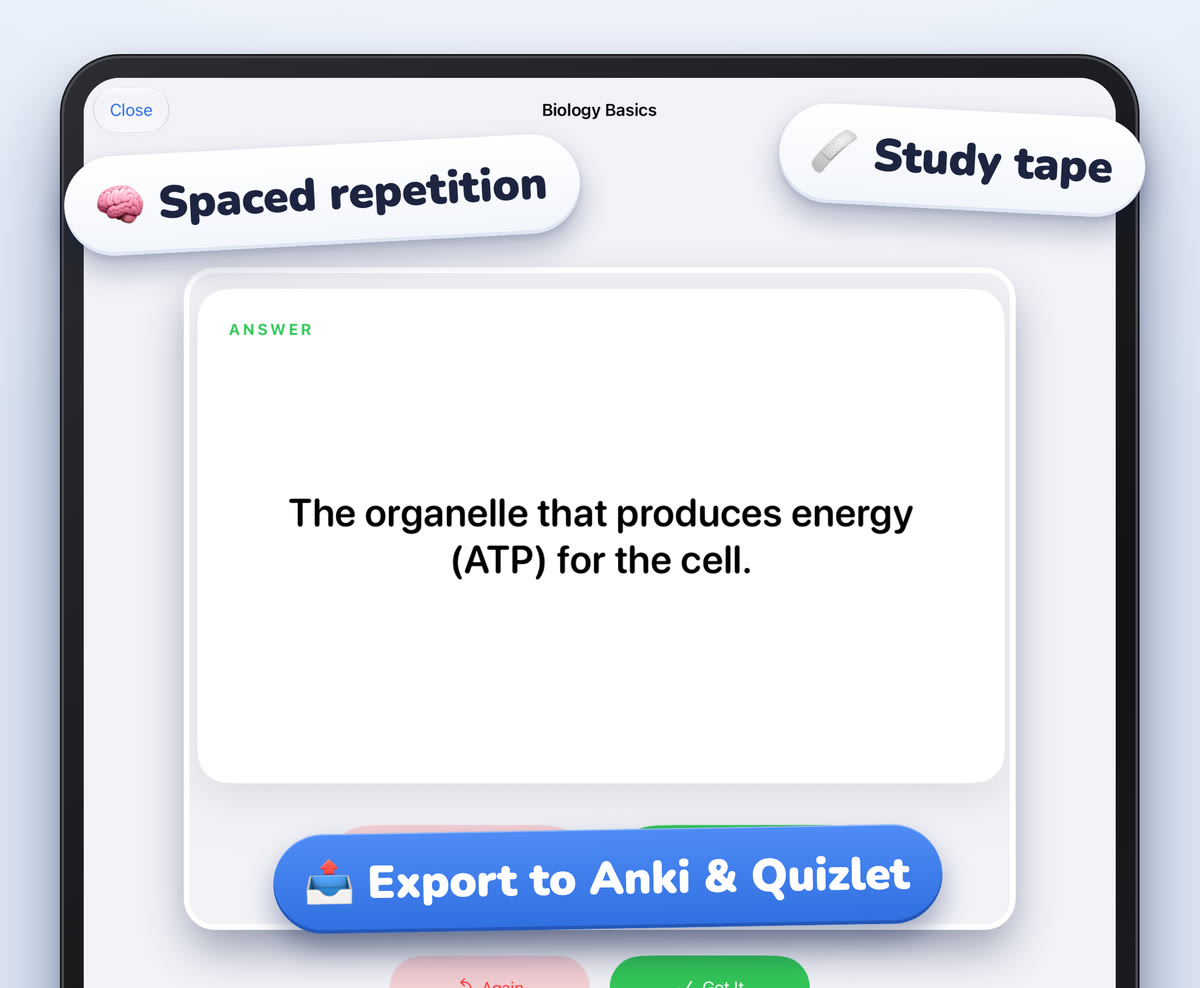
Flashcards that schedule themselves. Write terms on Vocabulary paper or questions in a Cornell cue column, and Scribba turns each row or cue into a flashcard by reading your handwriting, no Apple Intelligence needed. Check the words it read first. Cards come back after 1, 3, 7, 14 and 30 days, and you can study every due card at once, which suits the fifteen-minute version. See spaced repetition flashcards.
Study tape for quick self-tests. Drag study tape over definitions, labels or the answer to a worked example. Tap to peek. It turns last lecture's page into a quiz with no setup.
A timer for short sessions. The focus timer is a Pomodoro timer that follows you between notebooks, handy for the thirty-minute block in the night-before plan.
Frequently asked questions
How long should I study for a quiz?
For a weekly quiz, a few short sessions adding up to about half an hour is usually enough. If you're starting the night before, plan on about an hour of focused recall.
Is it worth studying for low-stakes quizzes?
Yes. Each quiz is a chance to practice recall on a small amount of material, and that practice makes the midterm and final easier.
What should I do if I fail a quiz?
Look at every question you missed and figure out why. Then add the weak topics to your weekly review. One quiz is a small part of your grade, and it's an early warning while there's time to fix things.