 Scribba
Some professors let you bring one page of notes into the exam. It goes by a lot of names: cheat sheet, crib sheet, formula sheet, reference sheet. Whatever it's called, students tend to treat it the same way, by cramming every line of the course onto it in tiny writing the night before.
That's the least useful version. A good reference sheet is short, organized and built over a few days, and the process of making it is some of the best studying you'll do for the exam. That's true even when you're not allowed to bring it in.
First: follow your instructor's rules exactly
Before you write anything, find out what's allowed. Professors set very specific rules, and breaking one by accident can cost you the sheet or worse. Check the syllabus or ask:
- Is a sheet allowed at all? If not, you can still make one to study with. It just stays home.
- What size, and how many sides? One side of a letter-size page is common, but don't assume.
- Handwritten or printed? Some instructors require handwriting. Ask whether a printout of notes you handwrote on a tablet counts, since some say no.
- Any content limits? Some ban worked examples or copied textbook pages.
- Do you hand it in? Some professors collect sheets with the exam, so put your name on it.
If anything is unclear, ask before exam day, not during it.
Why making the sheet is studying
The space limit is the whole trick. You can't fit everything, so you have to decide what matters, what you already know and what you'd forget under pressure. Those are exactly the decisions that build understanding.
You'll also find gaps. Trying to write a formula in its cleanest form, or summarize a topic in two lines, shows you fast which topics you can't explain yet. And because you write each item yourself, often more than once as you revise, you're practicing recall along the way.
Often, by the time the sheet is done, you barely need to look at it in the exam.
What to put on it
The rule of thumb: include what you'd need and might forget, not what you already know cold.
Good things to include:
- Formulas and equations, with what each variable means and the units.
- When to use each formula. The conditions matter as much as the formula. "Only for constant acceleration" saves more points than the equation itself.
- Constants and conversion factors you'd otherwise have to memorize.
- Problem-type checklists. A few words on the steps for each kind of problem the exam will ask.
- One tiny worked example for the problem type you mess up most, if examples are allowed.
- Easily confused pairs. Two similar terms side by side, with the one difference that separates them.
- Your own common mistakes. "Check the sign." "Convert to meters first." Pulled from graded homework and quizzes.
Things to leave off:
- Anything you can do in your sleep.
- Long definitions in full sentences. Use short phrases and symbols.
- Material the exam doesn't cover.
How to build it, step by step
- Start a few days early. A sheet made in one night is a cram session. Spread it out so you come back to each topic more than once.
- Make a long draft first. Go through your notes and homework, one topic at a time, and write everything you think you might need. Don't worry about space yet.
- Work practice problems with the draft. Use it the way you'll use the real sheet. Note what you looked up and what you never touched. Our guide to making practice tests from your notes shows how to build those problems.
- Cut. Remove everything you didn't need. Shorten what's left.
- Organize by how you'll search it. Group by topic or problem type, in the order of the course, with clear headings. In the exam, you need to find things in seconds.
- Write the final version. Neat, readable and as large as you can manage. Tiny writing you can't read under pressure doesn't help.
- Take one more practice test with it, then fix whatever slowed you down.
Tip: color helps you find things fast. Use one color for formulas, another for warnings and common mistakes, and keep it consistent across the page.
If you can't bring it in
Make it anyway, following the steps above. Then use it differently:
- Study from it in the last days. It's a compressed version of the course in your own words.
- Rewrite it from memory. On a blank page, write out the whole sheet without looking. Compare, and study whatever you left out. Repeat a day later.
- Write it down at the start of the exam, but only if your instructor allows it. Some professors are fine with you jotting formulas on scrap paper once the exam begins. Others aren't, so ask.
For formulas specifically, our guide to math and chemistry notes on iPad has more on keeping equations and units organized.
Making a reference sheet in Scribba
Scribba is an iPad notebook for class. It works well for the long draft and for designing the final page, if handwritten tablet notes are allowed.
Match the real page size. Page size is chosen per notebook when you create it, from US Letter, A4, A5, iPad, Square and Widescreen, in portrait or landscape. If you plan to print the sheet, make a small notebook just for it at the size you'll print on.
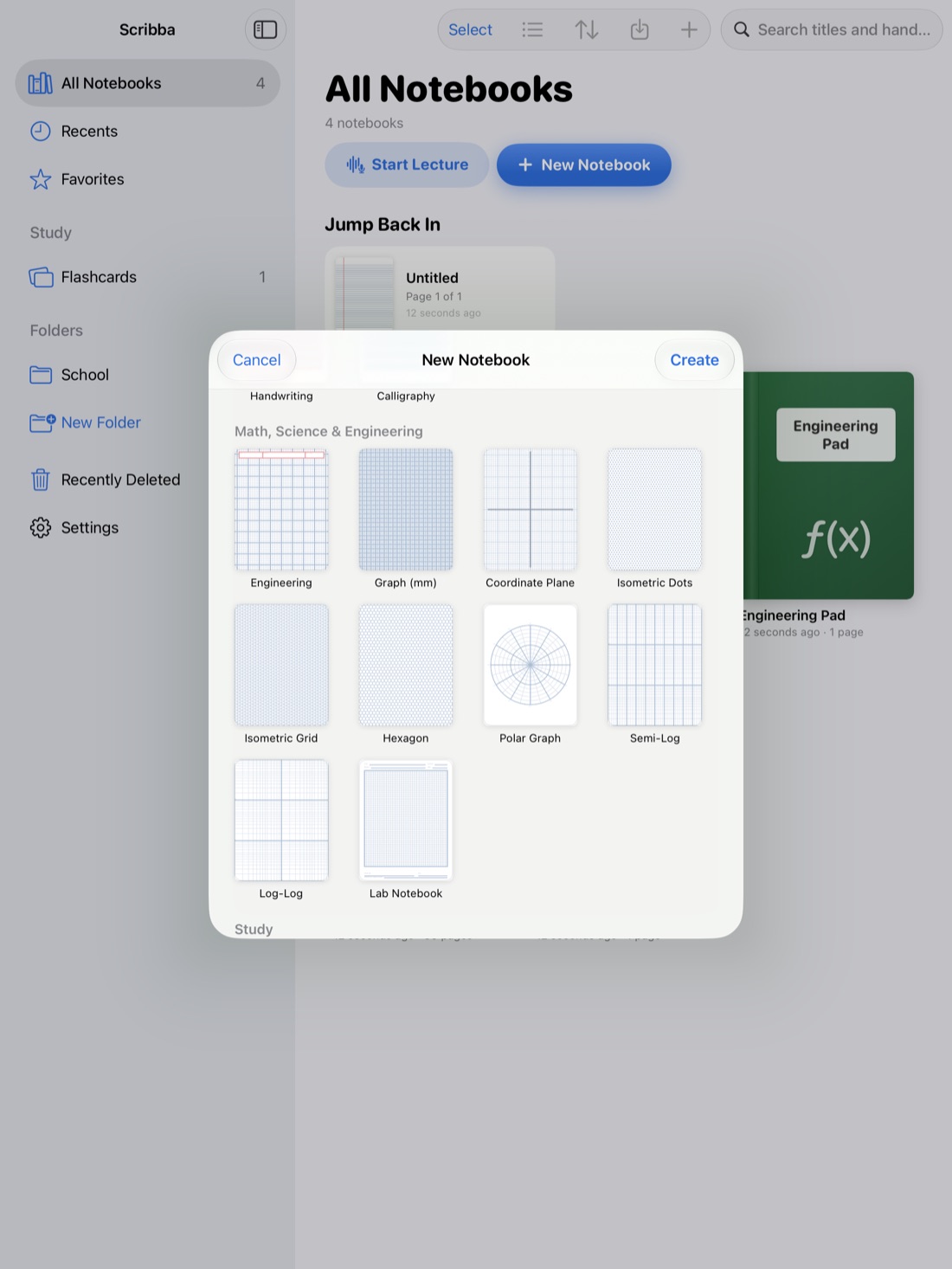
Pick paper that helps layout. Grid or Dot Grid paper (with 5 mm dots) makes it easy to keep columns and boxes straight. For physics or engineering, Engineering paper has a grid heavier every inch and a NAME / SUBJECT / DATE / PAGE title block. Change paper per page from the page sidebar.
Write small and still neat. The Zoom Window lets you write big in a magnified strip, and your writing lands small and neat on the page. It's the easiest way to fit a lot on one sheet without losing readability.
Rearrange as you cut. Use the lasso to select a block of writing and move it, so you can reorganize the page as the draft shrinks. Keep three to six favorite colors for your color code, and use the highlighter, whose strokes snap straight, to mark headings.
Keep the drafts. Duplicate a page from the page sidebar before a big cut, so you can go back to the longer version.
Print it. Select the page in the page sidebar and export it as a PDF, then print. Check the printout against your instructor's rules before exam day.
Practice from memory. For a sheet that stays home, drag study tape over parts of it and tap to peek as you quiz yourself.
Frequently asked questions
Is it cheating to use a cheat sheet?
Not when your instructor allows one and you follow their rules. Bringing notes into an exam that doesn't allow them is an academic integrity violation, so always check first.
Should I type or handwrite my cheat sheet?
Follow your instructor's rules first. If both are allowed, handwriting tends to help you remember more while making it, and it's easier to mix in quick diagrams and arrows.
How small should I write?
Only as small as you can read quickly under pressure. If you can't fit everything at a readable size, that's a sign to cut more, not to shrink your writing.