 Scribba
It's the night before the exam, and you haven't really studied. Maybe the week got away from you, maybe you thought you knew it, maybe you've been dreading it. Either way, here you are.
This guide is honest about two things. Cramming is a weak way to learn, and you probably already know that. But you're here now, and some ways of spending tonight are much better than others. Below is why cramming falls short, then a realistic plan for the hours you have.
Why cramming doesn't work well
Cramming can get you through some exams. It just costs more and gives you less than studying spread over a few days. Here's why.
There's no spacing. Memory gets stronger when you come back to material after you've started to forget it. That's the idea behind spaced repetition. One long session, however intense, only gives you one pass.
It feels better than it is. After three hours of reading, everything looks familiar. Familiar feels like knowing, but recognizing an answer on your notes is a different skill from producing it on a blank exam page.
It costs you sleep. Sleep is when your brain consolidates what you learned that day. Trading sleep for more hours of studying often means you remember less of what you studied, and you think less clearly in the exam room.
It doesn't last. What you cram tends to fade fast. That's a problem if the final is cumulative or the next course builds on this one.
So the goal tonight isn't to learn the whole course. It's to get the most points you can from the time you have, and still sleep.
The plan for tonight
1. Triage first (15 minutes)
Don't open your notes and start reading from page one. Spend the first few minutes deciding what to study.
- Check the format and coverage. Look at the syllabus, the review sheet and any announcements.
- List the topics. One line each. Your notebook's lecture pages are a good place to start.
- Mark each one. Solid, shaky or lost.
- Weight them. What did the professor spend the most time on? What showed up on homework and quizzes? Those are likely to be worth the most points.
Your priority list is the shaky topics that are likely to be heavily tested. Lost topics that are small can wait. A lost topic that's a big part of the exam deserves a focused attempt.
2. Recall, don't reread
You don't have time for the slow, comfortable method. For each topic on your list:
- Write down everything you can remember about it on a blank page, without looking.
- Open your notes and check. Fill in what you missed in a different color.
- Move on.
This tells you what you know in minutes, and the act of recalling helps it stick better than reading would. Our guide to the active recall study method has more ways to do it.
3. Do problems if the exam has problems
For math, science and economics, an hour of practice problems is worth more than an hour of reading solutions. Rework a few homework problems of each type with the answers covered. If there's a practice exam, do it.
For essay exams, outline answers to two or three likely questions from memory, then check your notes for the evidence you forgot.
4. Make a one-page summary
Near the end of the night, put the essentials on a single page: the formulas, terms and ideas you keep forgetting. Write it from memory first, then check. This is what you'll look at in the morning instead of your whole notebook.
5. Stop and sleep
Set a hard stop time and keep it. A short night of sleep is better than none, and an all-nighter is usually the worst trade of the night. If you're still awake at your stop time, put the notes away anyway. Material you study at 3 a.m. while exhausted is unlikely to come back to you at 9 a.m.
6. A short review in the morning
In the morning, read your one-page summary and quiz yourself on it once. Don't start new topics. Eat something, get there early and bring what you need.
Tip: take a few minutes off every hour or so tonight. A short break away from your desk keeps the next hour more focused than pushing straight through.
What to do in the exam
- Skim the whole exam first and start with what you know. Easy points build momentum.
- Don't leave blanks if wrong answers aren't penalized. Partial credit on a problem is often available, so write the setup even if you can't finish.
- Watch the clock. Don't spend ten minutes on one question worth two points.
Using Scribba tonight
Scribba is an iPad notebook for class. If your notes are in it, a few tools save time when time is short.
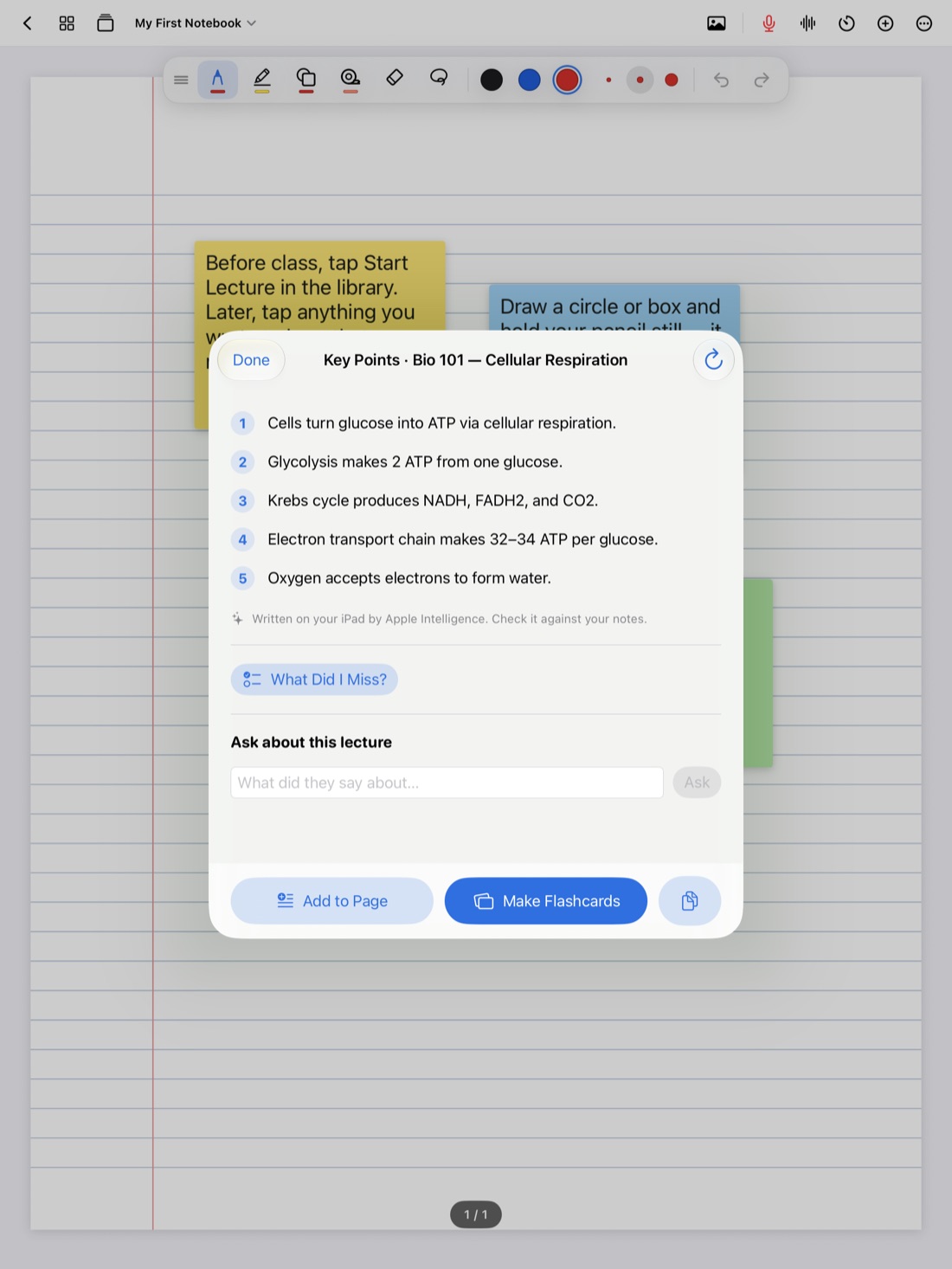
See the course at a glance. On iPads that support Apple Intelligence, with it turned on, Study Guide puts the key points of every lecture in a notebook on one sheet, split at each Start Lecture page. It's a quick way to do the triage step. Each lecture also has its own key points, and What Did I Miss? compares them with what you wrote and lists what your notes left out. Check anything that looks off against your notes. See how to make a study guide from your lecture notes.
Ask what's on the exam. With Apple Intelligence you can also type a question to a recorded lecture, like what the professor said about the exam, and get an answer in a sentence with a button that plays that moment.
Fill gaps fast. If your notes trail off, tap the last thing you wrote and playback jumps to that moment in the recording. Or search transcripts from the library for a term you never wrote down.
Quiz yourself. Drag study tape over terms and formulas on your notes, then tap to peek. If you have flashcard decks, study all your due cards at once.
Keep the time honest. Scribba's focus timer is a Pomodoro timer that follows you between notebooks, so your breaks happen on schedule.
Next time
Cramming once doesn't make you a bad student. It usually means the plan started too late. For the next exam, even a week of short sessions makes a big difference. Our day-by-day plan for studying for a midterm in a week lays one out, and reviewing your notes after class makes the night before much lighter.
Frequently asked questions
Is it better to pull an all-nighter or sleep?
Sleep, even if it's only a few hours. You'll recall more of what you studied and think more clearly during the exam.
How many hours can I usefully cram?
It depends on you, but focus fades as the night goes on. A few focused hours with breaks, then sleep, usually beats studying until morning.
Should I reread my notes the night before?
Only briefly, to get the big picture back. Spend most of the time recalling and doing problems, since that's what the exam will ask you to do.