 Scribba
Formulas are where a lot of exam points disappear quietly. You knew the method, you set the problem up right, and then you wrote the kinetic energy formula without the one-half. Or you remembered the formula perfectly and used it in a situation where it doesn't apply.
Memorizing a formula well means three things: you can write it exactly, you know what every symbol means, and you know when it applies. Flashcards alone tend to cover only the first. Here's a plan that covers all three.
Step 1: understand it before you memorize it
A formula you understand is much easier to remember, and much harder to garble.
- Name every symbol. Write what each letter stands for and its units. In PV = nRT, know which one is the gas constant and which is the number of moles.
- Read it as a sentence. F = ma says "the net force on an object equals its mass times its acceleration." If you can't say a formula in words, you don't know it yet.
- Check the extremes. What happens when a variable is zero, or gets very large? If doubling the mass doubles the force, the formula should show that.
- Know the conditions. Many formulas only hold under assumptions: constant acceleration, ideal gas, no friction, a right triangle. Write the conditions next to the formula, every time.
Step 2: derive it once
You don't need to derive every formula on the exam. But working through where a formula comes from, once, ties it to ideas you already know, and that connection is what holds it in memory.
Derivations also shrink the list. Many formulas are close relatives. Once you see that several kinematics equations come from the definitions of velocity and acceleration, or that a trig identity falls out of the Pythagorean theorem, you only need to memorize the few at the root and know how to get the rest. If you blank on the exam, you can rebuild a formula instead of guessing.
Tip: use units as a safety net. If you're unsure whether a formula has a square in it, check whether the units on both sides match. A formula with mismatched units is wrong.
Step 3: practice it in problems
The real test of a formula is using it, so the most effective memorizing happens in practice problems.
- Work problems without your formula sheet whenever you can. Each time you pull a formula from memory to solve something, you strengthen it.
- Mix problem types. If every problem in a set uses the same formula, you never practice choosing one. Mix problems from different sections so you have to decide which formula fits.
- Say why you chose it. Before you plug in numbers, say or jot down why this formula applies here. That's the step exams actually test.
- Redo the worked examples. Cover the solution to an example from lecture and solve it yourself, then compare.
Step 4: drill them with flashcards
Flashcards are good for the "write it exactly" part. Make them work harder than a bare formula on the back:
- Formula from name: "Ideal gas law?" with PV = nRT and what each symbol means on the back.
- Name from formula: show the formula, recall what it's called and what it's for.
- Situation to formula: "A ball is dropped from rest. Which equation gives its speed after a given fall?" This is the card that matches exam questions best.
- Conditions: "When does the ideal gas law break down?" Short answer, one idea.
Review them on a spaced schedule, a little every day, rather than all at once before the exam. The spaced repetition guide explains why that works better.
Step 5: test the whole sheet
Close to the exam, write a full formula sheet from memory on a blank page. Then check it against your notes and mark what you missed or got slightly wrong. Those are the formulas to drill next. Repeat every few days. If your exam allows a formula sheet, this is still worth doing: knowing the formulas is what lets you use the sheet quickly. For building that sheet, see physics notes on iPad, which covers organizing formulas by idea.
Memorizing formulas in Scribba
Scribba is an iPad notebook for class. It doesn't recognize, convert or solve equations; it's a place to write and practice them, which is the part that builds memory.
A formula page per unit. Add a page on Grid or Engineering paper for each unit's formulas, with symbols, units and conditions next to each. Change the paper on any page from the page sidebar, and give each page a named bookmark so it shows in the notebook's table of contents.
Small symbols, written neatly. Exponents, subscripts and fractions get smudgy at normal size. The Zoom Window lets you write big in a magnified strip, and your writing lands small and neat on the page. More in math and chemistry notes on iPad.
Cover formulas with study tape. Drag study tape over each formula, leaving its name and conditions showing, and write it from memory on scratch space. Tap the tape to peek. This is step 5 without a second sheet of paper. See study tape on iPad.
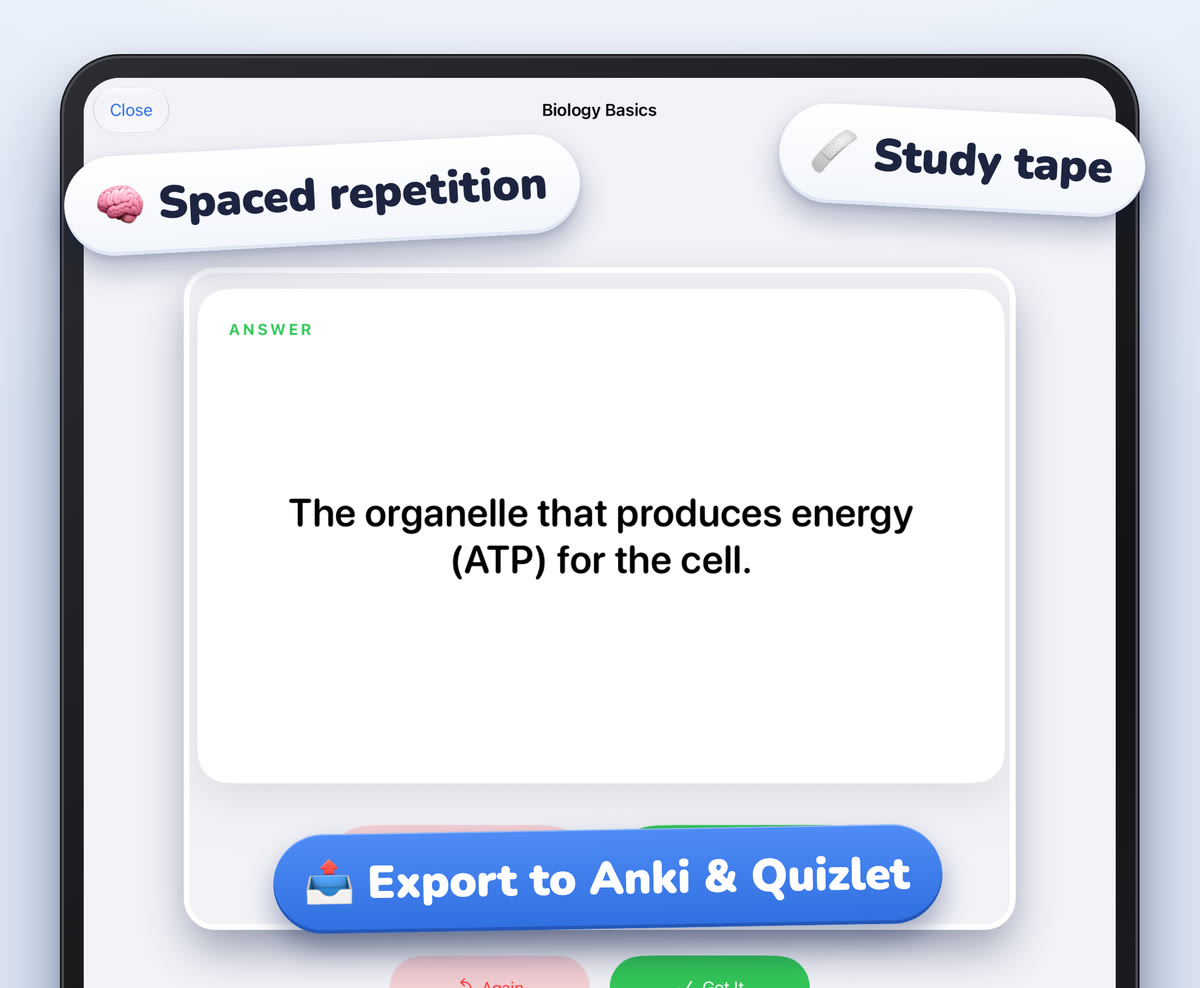
Flashcards for the words around the formula. Scribba can turn Cornell cues and Vocabulary rows into flashcards from your handwriting, without Apple Intelligence. Handwriting recognition reads words, not math, so this works best for name, condition and situation cards. Check every card before you study, since symbols and subscripts are easy to misread. You can also make a deck by hand and type each card's Front and Back. Cards come back after 1, 3, 7, 14 and 30 days.
Replay the derivation. If you recorded the lecture, tap the step of a derivation you didn't follow, and playback jumps to the moment you wrote it, usually while your professor was explaining it.
Frequently asked questions
How many formulas should I memorize?
Fewer than are on the list, if you can. Learn the core ones well and learn to derive the rest. Check your syllabus or ask what's given on the exam, so you don't memorize something that's printed on it.
Should I write formulas down as soon as the exam starts?
It can help to jot your shakiest formulas on scratch paper first, before stress sets in. Check your exam's rules on when you can write, and only do it if it's allowed.
Can Scribba solve or check my formulas?
No. Scribba doesn't recognize equations or solve problems. You write and check the math yourself, which is also how you learn it.