 Scribba
French has a problem that Spanish mostly doesn't: the word you see and the word you hear are far apart. Ils parlent ends in letters nobody pronounces. Vert, verre, vers and ver all sound alike. Liaison glues words together that look separate on the page. French classes test both sides of that gap, with dictées, listening quizzes and written compositions, so your notes need to record how a word is spelled and how it sounds.
This guide covers what's specific to French. For the basic setup of a language notebook, with separate sections for vocabulary, grammar and class work, see Spanish class notes on iPad. It works the same way for French.
Write the sound next to the spelling
When your professor says a word that doesn't sound the way it looks, jot a quick hint beside it. You don't need the phonetic alphabet. Your own shorthand is enough:
- Mark silent letters. Put a small slash through final letters you don't say, like the -ent in ils parlent or the s in les.
- Mark liaisons. Draw a little curve under two words that link, like les‿amis or vous‿avez. Note where your professor says liaison is required and where it's forbidden, like after et.
- Flag nasal vowels. An, en, on, in and un are the sounds English speakers miss most. Underline them in one color.
- Group homophones. Write words that sound the same on one line, with a short meaning for each. Seeing vert, verre, vers, ver together is what makes the spelling stick.
Treat accents as spelling
In French, accents aren't decoration. They change how a vowel sounds, like é and è, and sometimes what a word means: ou is "or" and où is "where," a is "has" and à is "to," du is "of the" and dû is "owed." Many instructors mark a missing accent as a spelling error.
Write the accent at the same moment you write the letter, not in a second pass. If you add them later, you'll forget some, and you'll memorize the word without them. One pattern worth noting when you meet it: a circumflex often marks an s that dropped out, which is why forêt looks like "forest" and hôpital like "hospital."
Make gender visible
Every French noun is masculine or feminine, and it affects articles, adjectives and past participles. Learn each noun with its gender, and be careful with words that start with a vowel: l'arbre hides the gender, so write un arbre instead.
Pick two colors, one for masculine and one for feminine, and use them on every vocabulary page all year. When you meet an ending pattern, write it down too: words ending in -tion are feminine, and most words ending in -ment are masculine. Keep a short list of exceptions as you find them.
Draw the tenses on a timeline
Much of a second-semester French course is about when to use the passé composé and when to use the imparfait. Rules alone are hard to apply. A picture helps:
- Draw a long horizontal line for a story in the past.
- Shade a long band under it for imparfait: background, description, what was going on, habits.
- Draw short vertical ticks on it for passé composé: single events that happened and finished.
- Write a two-sentence example across it, like Il pleuvait quand je suis sorti.
Do the same for the verbs that take être in the passé composé. Many students draw them around a little house, entering, leaving, going up and coming down, or learn the "Dr. and Mrs. Vandertramp" mnemonic. Whichever you use, draw it once on its own page and come back to it.
Keep an error log for compositions
French classes hand back compositions covered in corrections, and most students glance at the grade and move on. Instead, keep one running page with three columns: what you wrote, the correction, and the rule. Before the next composition, read the log. You'll see that you make the same few mistakes over and over, usually agreement, accents and gender, and those are the easiest points to win back.
You can scan the marked-up composition straight into your notebook so the corrections are next to your log. See how to scan handouts with your iPad.
Practice dictée with recordings
Dictée is the one exercise that tests the whole spelling-and-sound gap at once. If your professor allows recording, your class recordings are a dictée source. Ask first: recording rules vary by school and professor.
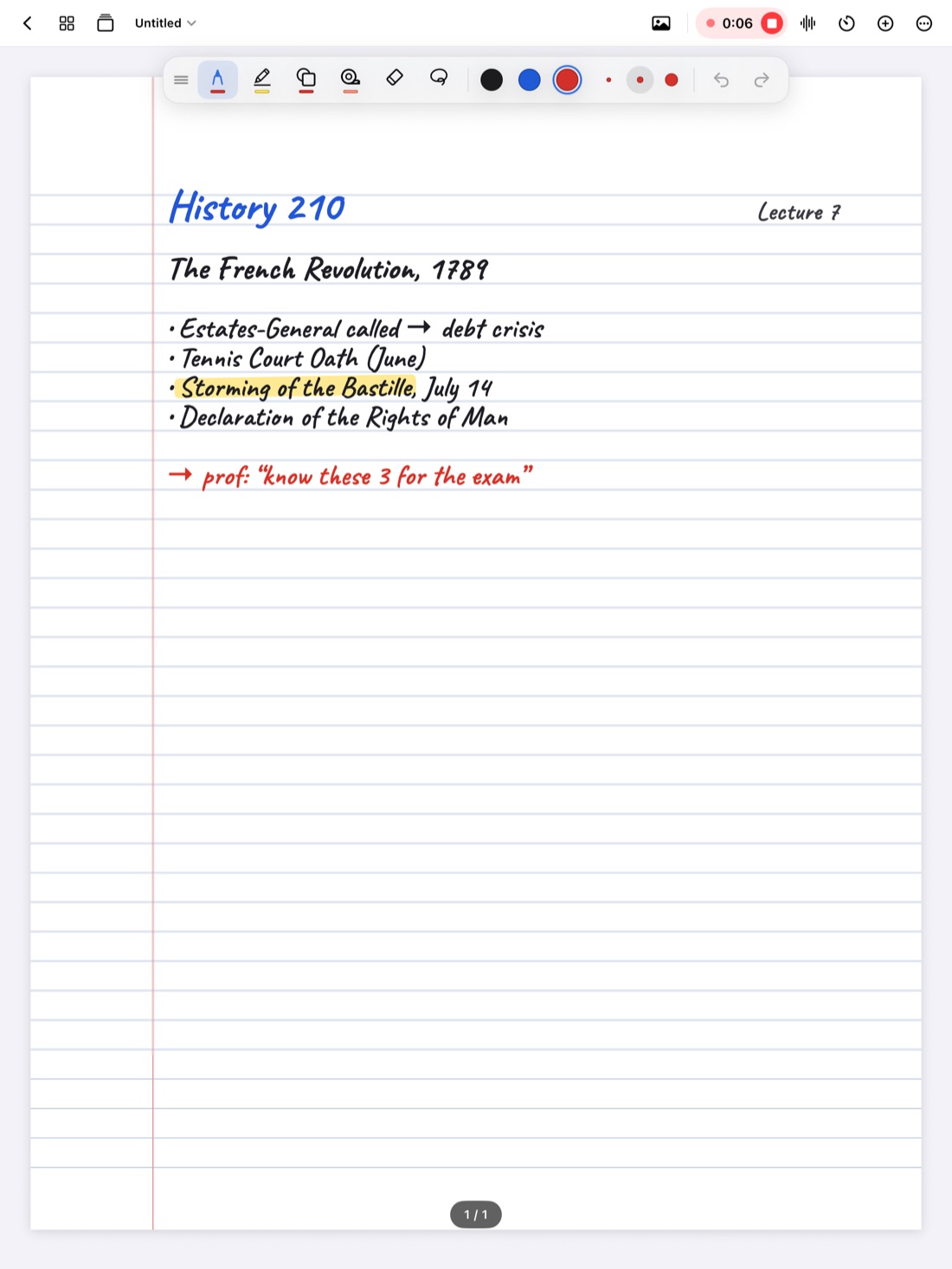
In Scribba, tap the mic and take notes as usual. Every stroke is linked to that moment in the recording, so later you can tap any word you wrote to hear your professor say it. For dictée practice:
- Tap the start of a sentence you wrote down, listen once, and write it again on a blank line without looking.
- Slow the playback speed if the sentence runs together.
- Skip back 15 seconds to hear it again.
- Compare with your notes and circle every accent and silent ending you missed.
More on the basics in how to record a lecture on iPad.
What works in French in Scribba, and what doesn't
Scribba's interface is in English and Spanish, not French. Here's how its features handle a French class:
- Recording, tapping your ink to replay, playback speed and skipping work in any language.
- Transcripts don't work for French. Scribba transcribes in the language it's showing, English or Spanish. A class taught mostly in French won't transcribe well, and in a class taught in English, the French words themselves will come out wrong. Rely on tapping your ink instead of searching the transcript.
- The Apple Intelligence study tools, like key points and What Did I Miss?, need an iPad that supports Apple Intelligence with it turned on, and they work in English and Spanish. Don't count on them for French content.
- Vocabulary flashcards from handwriting work, with checking. The Vocabulary paper has a TERM column and a DEFINITION / EXAMPLE column. Scribba reads your handwriting and turns each row into a card. Recognition reads the Latin alphabet and works best on English, so look over every French word in the review step, and check each accent and cedilla before you save.
- Or type the cards. Create a new deck, tap Add Card and type a Front and Back. On the iPad keyboard, press and hold a letter like e or c to pick an accented version.
Either way, your cards come back after 1, 3, 7, 14 and 30 days, and you can export decks to Quizlet or Anki. For quick quizzing on the page itself, drag study tape over the English column of a vocabulary page and recall the French.
Frequently asked questions
Will Scribba transcribe my French class?
Not well. Transcription listens for English or Spanish. Recording and tapping your notes to replay a moment still work for French, and that's what helps most with pronunciation.
Can Scribba read my handwritten French?
It reads Latin-alphabet handwriting and works best on English. Expect to fix some French words and accents in the review step before you save the cards, or type the cards yourself.
What's the best way to learn French noun genders?
Always learn the noun with un or une, use one color for each gender, and note ending patterns like -tion for feminine. Then quiz yourself with spaced repetition.