 Scribba
Calculus lectures look like a stream of examples, and most students copy them line by line. The trouble shows up on the exam. The problems don't come labeled "use u-substitution" or "this is a related rates problem." Half the work is deciding what kind of problem you're looking at, and line-by-line notes don't train that.
Good calculus notes do three jobs. They connect each formula to a picture, they record how to choose a technique, and they keep track of your own mistakes. Here's how to build them on an iPad.
General habits for writing out steps, like one step per line and lining up equals signs, are in math and chemistry notes on iPad. This guide is about what's specific to calculus.
Draw the picture next to the algebra
Almost every idea in calculus is a picture before it's a formula. A derivative is the slope of a tangent line. A definite integral is signed area. A limit is where a graph is heading. When you understand the picture, you can often check an answer just by sketching it.
Make a habit of drawing a small graph next to examples:
- Limits: sketch the function near the point, with an open circle for a hole and arrows showing where each side is heading.
- Derivatives: draw the tangent line at the point. If your answer is a negative slope and the curve is rising, something is off.
- Optimization: mark the maximum or minimum you're looking for before you start differentiating.
- Integrals: shade the area, and draw a few Riemann rectangles the first time you meet a new kind of region.
- Volumes of revolution: sketch the region, the axis, and one representative disk, washer or shell. Most setup mistakes come from skipping this sketch.
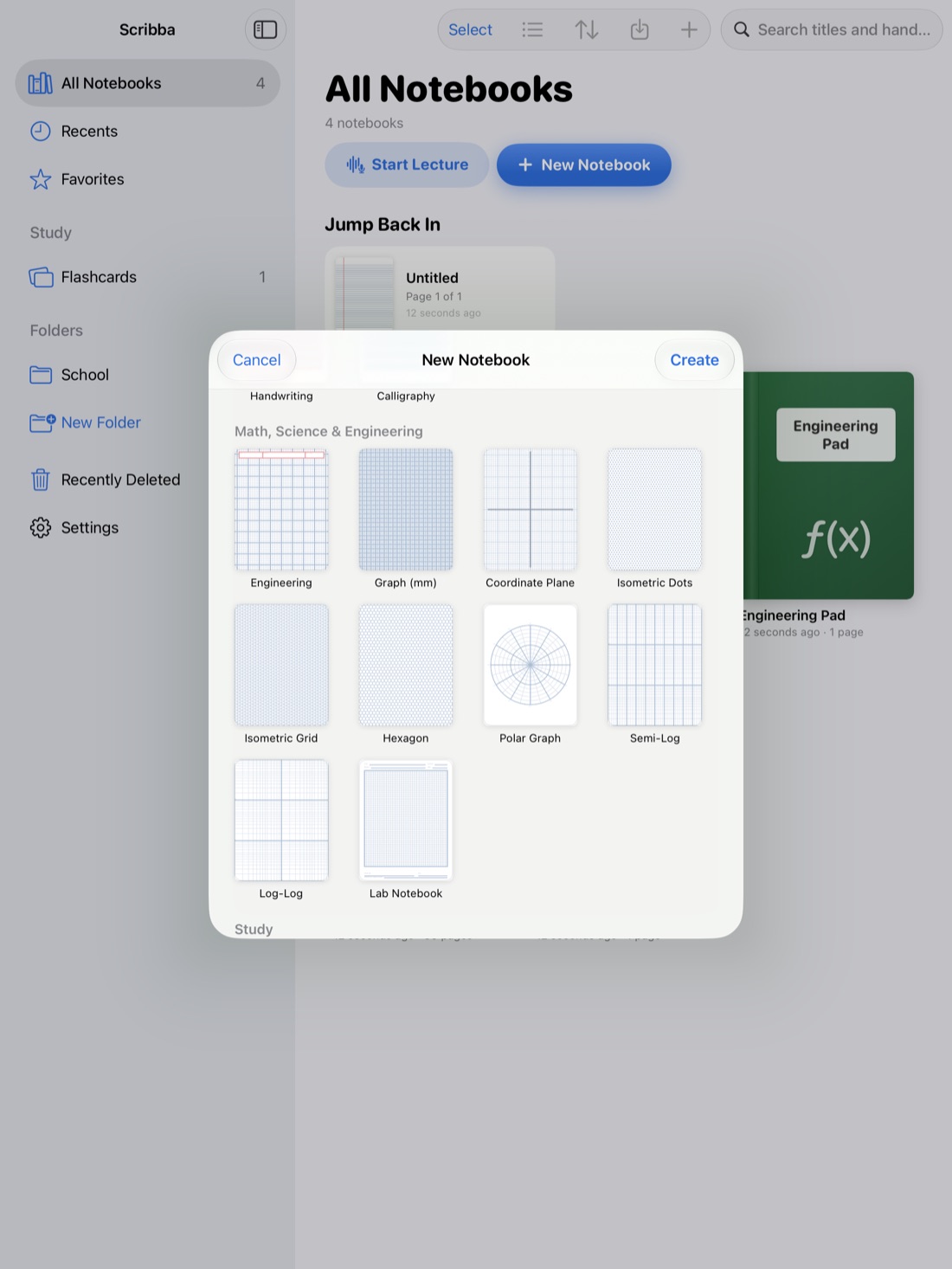
Coordinate plane paper has the axes and tick labels already drawn, so a quick sketch takes seconds. More in coordinate plane paper on iPad. In Scribba, change the paper of any page from the page sidebar, so a ruled lecture page can be followed by a graphing page.
Tip: for multivariable calculus, isometric paper helps with 3D sketches of surfaces, planes and vectors. See isometric paper on iPad.
Keep a technique sheet, not just a formula sheet
A formula sheet tells you what the derivative of arctan is. A technique sheet tells you what to try when you see a problem. Build one page for each part of the course and add to it as you go.
Derivatives
List the rules (power, product, quotient, chain), and next to each, a tiny example that shows when it applies. Add a note on implicit differentiation: differentiate both sides, and every time you differentiate a y, multiply by dy/dx.
Integrals
Integration is where a decision process matters most. Write the questions you ask yourself, in order:
- Is it a basic form you already know?
- Is there a function and its derivative both in the integrand? Try u-substitution.
- Is it a product of two different kinds of functions? Try integration by parts.
- Is it a rational function? Try partial fractions.
- Is there a square root of a sum or difference of squares? Try a trig substitution.
Your professor may teach a different order. Use theirs, but write it down.
Series
Series tests are a classic source of confusion. For each test (divergence, integral, comparison, limit comparison, ratio, root, alternating series), write when to reach for it and what it can't tell you. The divergence test can only prove divergence, for example, and the ratio test is inconclusive when the limit equals 1.
In Scribba, give each technique sheet a named bookmark in the page sidebar. The bookmarks act as a table of contents, so the integration sheet is one tap away during homework.
Write word problems in the same order
Related rates and optimization problems scare people because the hard part is the setup, not the calculus. Use the same layout every time:
- Draw the situation and label every quantity.
- Mark what changes and what stays constant.
- Write what you're given and what you want, including units and rates like dV/dt.
- Write an equation that relates the quantities, before you differentiate anything.
- Differentiate, then plug in values. In related rates, plugging in too early is a common mistake.
- Answer the question in a sentence with units.
Problem set paper has NAME, COURSE, DUE and ASSIGNMENT fields over a grid split into four numbered problem areas, so each homework problem gets its own space. See problem set paper on iPad.
Keep a mistake log
Most calculus points are lost to the same handful of errors: a dropped negative sign, a missing chain rule factor, forgetting +C, wrong limits after substitution. Keep one page at the back of your notebook where you write each mistake you make on homework or quizzes and what the correct version is. Read it before every exam. It's a short page, and it's about you specifically.
Write small notation clearly
Calculus is full of small marks that change the meaning: an exponent, a subscript on a limit, the dx at the end of an integral, the bounds on a definite integral. In Scribba, the Zoom Window lets you write big in a magnified strip, and your writing lands small and neat on the page. It slides along the line as you go, which helps with long expressions.
Hold the Apple Pencil still at the end of a stroke to snap a straight line, which is handy for axes, tangent lines and the vertical lines that bound an area.
If your professor allows recording, tap the mic before the lecture. Every stroke you write is linked to that moment, so you can tap the step you didn't follow and hear the explanation again.
Practice the way the exam tests you
Calculus exams mix problem types, so practice that way. Once you've covered a few techniques, stop doing homework in blocks of the same kind. Mix problems from different sections so you have to decide which technique fits. That's called interleaving, and it builds the skill exams actually test. More in the interleaving study method.
To re-solve worked examples from lecture, drag study tape over the solution in Scribba, solve it on a fresh page, then tap the tape to peek and compare.
Frequently asked questions
Can Scribba solve derivatives or integrals?
No. Scribba doesn't recognize equations, solve math or convert handwriting to LaTeX. It's for writing your work clearly, linking it to the lecture and studying it later.
What paper is best for calculus notes?
Grid or ruled paper for lecture notes, coordinate plane paper for graphs, and problem set paper for homework. You can mix them in one notebook.
Should I memorize the derivative and integral formulas?
Yes, the basic ones. Many exams don't provide them, and recognizing a basic form quickly is what makes harder problems manageable. Pair memorizing with plenty of practice problems.