 Scribba
German has a reputation for being hard, but it's also one of the most systematic languages you can take. Three genders, four cases, a fixed spot for the verb and endings that follow patterns. Once you see the system, a lot of it falls into place. That makes German a class where organized notes pay off more than usual: a few well-built reference pages do most of the work all year.
This guide covers what's specific to German. For the general setup of a language notebook, with vocabulary, grammar and class sections, see Spanish class notes on iPad.
Learn every noun as article, noun and plural
A German noun on its own is only half learned. You need its gender, because it changes articles and adjective endings, and its plural, because German plurals are hard to guess. Write every noun the way a dictionary does:
- der Tisch, -e (die Tische)
- die Lampe, -n (die Lampen)
- das Buch, ¨-er (die Bücher)
Then color-code the gender. A common scheme is blue for der, red for die and green for das. Whatever colors you pick, keep them for the whole course, on every page and every flashcard. After a few weeks, you start to remember a word's color along with the word.
Always capitalize nouns, in your notes too. It's a rule of German spelling, and writing tisch in your notes trains the wrong habit for tests.
Tip: note the gender patterns you meet. Nouns ending in -ung, -heit, -keit and -schaft are feminine, and -chen and -lein are neuter. Write the exceptions next to the rule when you find them.
Build one master case table
Most German grammar comes back to the four cases: nominative, accusative, dative and genitive. Instead of scattered notes from each chapter, build one table and keep adding to it.
- Draw a grid with four rows, one per case, and four columns: masculine, feminine, neuter and plural.
- Fill in the definite articles: der, die, das, die / den, die, das, die / dem, der, dem, den / des, der, des, der.
- Under it, add a second grid for ein and kein, and later one for adjective endings.
- Circle the cells that change from row to row. You'll see that most of the action is in the masculine column and the dative row.
Give the prepositions their own short lists by case: accusative (durch, für, gegen, ohne, um), dative (aus, außer, bei, mit, nach, seit, von, zu), and the two-way prepositions that take accusative for motion and dative for location (an, auf, hinter, in, neben, über, unter, vor, zwischen).
Diagram where the verb goes
German word order trips up English speakers more than the vocabulary does. Draw it as slots instead of memorizing rules:
- Main clauses: the conjugated verb sits in slot two, whatever comes first. Morgen fahre ich nach Berlin.
- Separable verbs: the prefix jumps to the end. Draw an arrow from anrufen to Ich rufe dich morgen an.
- Modal verbs and the perfect tense: the second verb goes to the end, making a bracket around the middle of the sentence.
- Subordinate clauses: after weil, dass or wenn, the conjugated verb goes all the way to the end.
Draw boxes for the slots and write a model sentence in them for each pattern. When you write your own sentences for homework, check them against the boxes.
Break long compounds apart
German builds long words out of short ones, and they're easier than they look. When you write a compound in your notes, split it with a small line: Kranken|haus (sick + house, a hospital), Hand|schuh (hand + shoe, a glove). The last part decides the gender, so das Haus makes das Krankenhaus. Once you get used to splitting words, unfamiliar compounds on a reading test become puzzles you can solve.
Listen for the sounds English doesn't have
Ü, ö, the two sounds of ch (as in ich and ach) and a final d that sounds like t are the usual trouble spots. If your professor allows recording, it's a good way to hear these again. Ask first, since recording rules vary by school and professor.
In Scribba, tap the mic and take notes as usual. Every stroke is linked to that moment in the recording. Later, tap a word you wrote to hear your professor say it, slow the playback down, or skip back 15 seconds to hear it again. Say the word out loud each time. See how to record a lecture on iPad.
Setting up German notes in Scribba
Paper for tables. Grid or Dot Grid paper makes case tables quick to draw. Hold the Apple Pencil still at the end of a stroke and it snaps into a straight line or rectangle, so your grid comes out clean. Change a page's paper from the page sidebar.
Bookmark your reference pages. Name a bookmark for the case table, the preposition lists and the word order page, so they show up in the notebook's table of contents and you can jump to them from any lesson.
Gender colors. Keep blue, red and green as saved colors on your pen, so switching colors mid-word list takes one tap.
Quiz the table with study tape. Drag a strip of study tape over the dative row or the plural column, say each form, then tap to peek. See study tape on iPad.
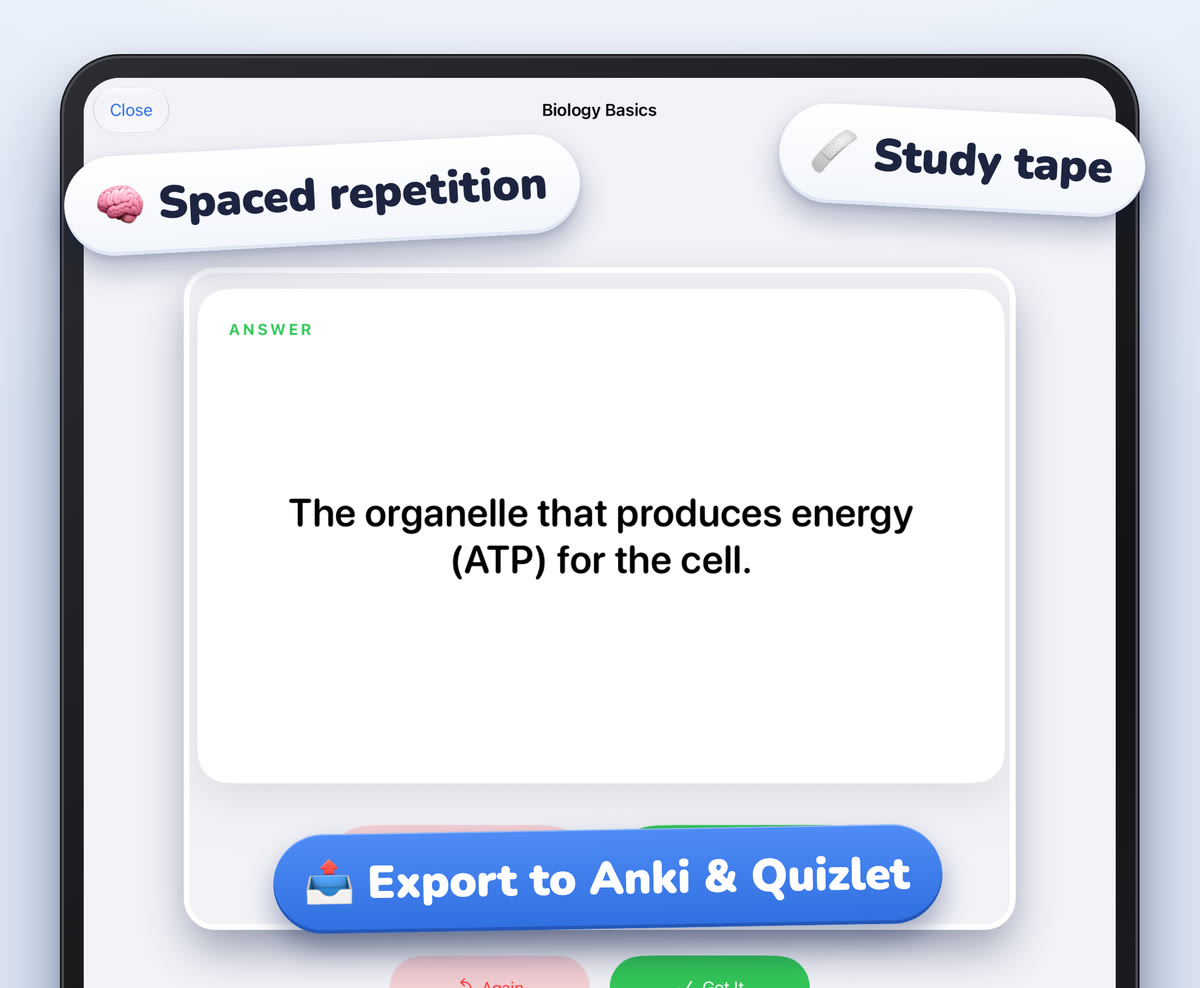
Flashcards, with honest limits. Write nouns on Vocabulary paper, with the German in the TERM column and the meaning in DEFINITION / EXAMPLE, and Scribba turns each row into a card. Its handwriting recognition reads the Latin alphabet and works best on English, so in the review step check every umlaut, every ß, and that nouns kept their capital letter. You can also type cards by hand: create a new deck, tap Add Card and type a Front and Back. On the iPad keyboard, press and hold u, o, a or s to get ü, ö, ä or ß. Cards come back after 1, 3, 7, 14 and 30 days, and decks export to Quizlet or Anki.
What doesn't work in German. Scribba transcribes lectures in English or Spanish, the languages its interface comes in. A class taught mostly in German won't transcribe well, and German words in an English-taught class will come out wrong. The Apple Intelligence tools, such as key points, need an iPad that supports Apple Intelligence with it turned on, and work in English and Spanish only, so don't rely on them for German content. Recording and tapping your ink to replay work in any language.
Frequently asked questions
What's the best way to learn der, die and das?
Learn every noun with its article and plural, use one color per gender on every page and card, and note ending patterns like -ung for feminine. Then review with spaced repetition.
Will Scribba transcribe a German lecture?
Not well. Transcription listens for English or Spanish. Recording and tapping your notes to hear a moment again work for German.
Can Scribba read umlauts in my handwriting?
Recognition reads the Latin alphabet but works best on English, so umlauts and ß may need fixing in the review step. Check each card before you save the deck.