 Scribba
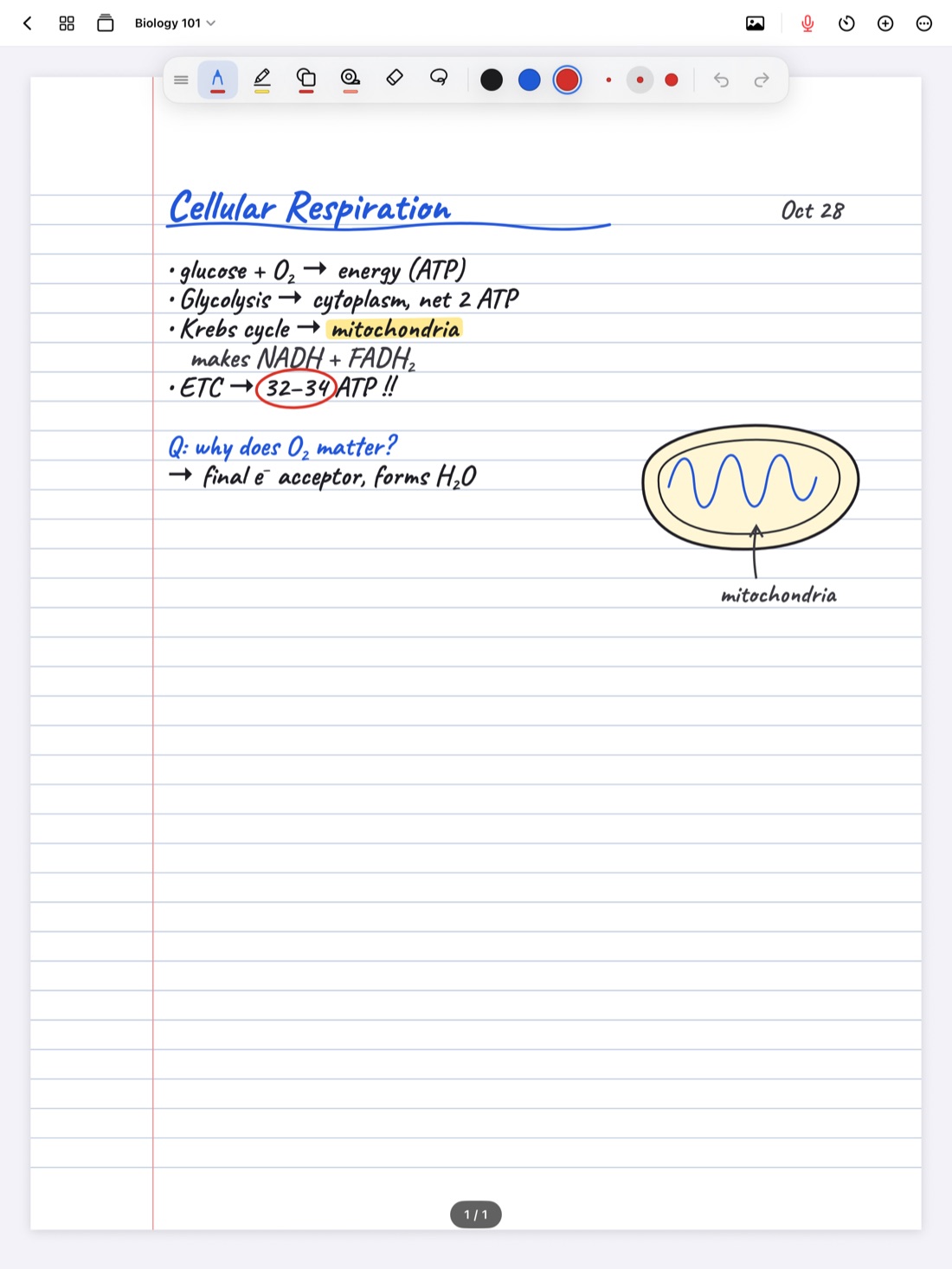
Biochemistry sits where organic chemistry and biology meet, and it asks for both at once. You need the chemistry to understand why a step happens, and you need the big picture to see how glycolysis, the citric acid cycle and fatty acid metabolism fit together. Students tend to struggle in one of two ways: they memorize every enzyme and miss the logic, or they get the logic and blank on the names.
Good biochem notes handle three kinds of material: pathways, structures and kinetics. Each one needs a different kind of page.
If you're also in intro biology, biology notes on iPad covers general diagram and vocabulary habits. This guide goes deeper on what's specific to biochemistry.
Map every pathway the same way
Pathways are most of a biochem exam. A consistent layout makes them easier to learn and easier to compare. For every step, record:
- Substrate and product, with the structure if your course expects you to draw it.
- Enzyme name. Many names tell you what the enzyme does: a kinase adds a phosphate, a dehydrogenase removes hydrogen, an isomerase rearranges.
- Cofactors and energy carriers, like ATP used or made, NAD+ reduced to NADH, or CO2 released.
- Reversible or irreversible. Mark irreversible steps clearly.
- Regulation. What activates or inhibits the enzyme, and where the signal comes from.
The irreversible steps deserve special attention. They're usually where the pathway is regulated, and they're why a pathway and its reverse (glycolysis and gluconeogenesis, for example) need different enzymes at those points. Exams love asking about them.
Use color as a code
Pick one color per kind of information and keep it all semester: one for enzymes, one for energy carriers, one for regulation, with green for activation and red for inhibition. When you review, you can scan a pathway for just the regulated steps or just the ATP.
In Scribba, keep three to six favorite colors in the tool palette, so your code is always one tap away. Write the key on the first page of the notebook.
Give long pathways room
Glycolysis has ten steps, and the citric acid cycle loops back on itself. A cramped pathway is hard to follow. Two things help:
- A landscape notebook for pathway maps. You choose orientation when you create a notebook, so some students keep a separate landscape notebook just for pathways.
- Two versions of each pathway. A full version with every structure and enzyme, and a one-line summary showing only inputs, outputs and regulated steps. Learn the summary first, then fill in detail.
Hold the Apple Pencil still at the end of a stroke to snap a straight arrow between steps, or a circle for a cycle. For enzyme names and small labels next to an arrow, the Zoom Window lets you write big in a magnified strip and lands it small and neat on the page.
Build one map that connects everything
By midterm, pathways start sharing molecules. Pyruvate, acetyl-CoA and glucose-6-phosphate each sit where several pathways meet. A single connection map on one large page, with each pathway as a short labeled arrow and the shared molecules as hubs, helps you answer the questions that cross chapters: what happens to fatty acid breakdown when a cell is low on glucose, or where carbons from an amino acid can end up.
Also keep an energy ledger: for each pathway, a short tally of ATP, NADH and FADH2 made or used. Totals for complete glucose oxidation come up on almost every exam, and having the tally per pathway lets you rebuild the total instead of memorizing it.
In Scribba, add a named bookmark in the page sidebar to the connection map and the ledger, so they're one tap away from any lecture. Bookmarks act as the notebook's table of contents.
Learn structures by drawing them
You'll likely need to draw or recognize amino acids, sugars and nucleotides. Reading structures doesn't stick; drawing them does.
- Group amino acids by side chain: nonpolar, polar uncharged, acidic and basic. Draw the shared backbone once, then focus on what makes each side chain different.
- Practice sugar projections. Draw Fischer projections and the matching Haworth ring side by side, so you can see where each OH ends up.
- Note charges at physiological pH next to each ionizable group.
Index card paper is handy here: one structure per card outline on the page. Hexagon paper helps with ring structures, as described in hexagon paper on iPad. You can change paper per page from the page sidebar.
Sketch the kinetics graphs
Enzyme kinetics is where biochem turns into graphs. Two are worth drawing until you can do them from memory:
- Michaelis-Menten: reaction rate against substrate concentration, rising and leveling off at Vmax. Km is the substrate concentration at half of Vmax.
- Lineweaver-Burk: the double-reciprocal plot, a straight line. The y-intercept is 1/Vmax and the x-intercept is -1/Km.
Then draw each type of inhibition on the same axes as the uninhibited line. Competitive inhibition raises Km and leaves Vmax unchanged, so the lines cross on the y-axis. Pure noncompetitive inhibition lowers Vmax and leaves Km unchanged, so they cross on the x-axis. Uncompetitive inhibition lowers both, giving parallel lines. Seeing all three on one page makes them much harder to mix up.
Coordinate plane paper gives you the axes already drawn. See coordinate plane paper on iPad.
Study with recall, not rereading
Biochem rewards drawing from memory. Take a blank page, write the starting molecule of a pathway, and draw everything you can: steps, enzymes, cofactors, regulation. Then compare with your notes and fill gaps in another color.
In Scribba, drag study tape over the enzyme names or the regulated steps of a pathway you've already drawn, then name each one and tap to peek. For enzyme names and definitions, a Vocabulary page works well: write the enzyme in the TERM column and its reaction in DEFINITION / EXAMPLE. Scribba reads your handwriting and turns each row into a flashcard, with spaced repetition bringing cards back after 1, 3, 7, 14 and 30 days. This doesn't need Apple Intelligence.
On iPads that support Apple Intelligence, with it turned on, Scribba can also write the key points of a recorded lecture and show what your notes left out with What Did I Miss?. That's useful on days when the professor lists regulators faster than you can write.
Frequently asked questions
Can Scribba recognize structures or balance pathway equations?
No. Scribba doesn't recognize chemical structures or equations. It's for drawing them by hand and studying them later.
What paper is best for pathway maps?
Blank or dot grid paper in a landscape notebook gives long pathways room. Use grid paper for your energy ledger and coordinate plane paper for kinetics graphs.
How do I memorize all the enzyme names?
Learn what each name means first (kinase, dehydrogenase, synthase), then put the names on vocabulary flashcards and review them on a spaced schedule.