 Scribba
Religious studies is the academic study of religion: what communities believe and practice, how traditions change over time, how texts are read and argued over. It sits beside theology but isn't the same thing. You aren't asked to decide which religion is right. You're asked to describe traditions accurately, analyze them carefully and compare them fairly, whatever your own beliefs.
That shapes how you take notes. Precision and attribution matter more here than in almost any other humanities class, and you'll be juggling terms from several languages at once.
Attribute every claim
The most important habit in religious studies is writing down who holds a view. Compare these two notes:
- "The soul is reborn after death."
- "In many Hindu traditions, the self (atman) is understood to be reborn."
The first reads like a fact. The second is what your professor actually said, and it's what an exam answer needs. Some practical habits:
- Name the tradition, and the branch if relevant. Traditions are not single blocks. Note when a teaching belongs to one school, period or region.
- Separate three voices: what a tradition teaches, what a text says, and what a scholar argues about it. A margin letter for each (T, X, S) works well.
- Use the course's terms for groups and practices. Your professor will usually explain why some words are preferred over others. Write that down too.
- Keep your own reactions in a separate place. It's fine to have them. Mark them clearly so they don't blur into the description.
Build a glossary across languages
A single course might introduce words in Hebrew, Greek, Arabic, Sanskrit, Pali, Chinese and Japanese. Many are transliterated into the Latin alphabet, often with diacritical marks, and the same word may be spelled several ways.
Keep a glossary page for each tradition:
- The term in the spelling your course uses, with its diacritics.
- The original script, if your professor shows it and it helps you.
- A short meaning, with the tradition and context it belongs to.
- Look-alikes: terms in other traditions that seem similar but aren't the same idea. Note the difference rather than treating them as equivalents.
Term identification questions are common on religious studies exams, so this page pays off. See memorize vocabulary faster for ways to drill it.
Read sacred texts with care
Primary texts are at the center of most courses. Approach them the way a scholar would:
- Note the translation you're reading. Translations differ, sometimes a lot. If your class compares translations, write both versions side by side.
- Use the standard reference system. Many texts are cited by book, chapter and verse, or by their own numbering. Write the reference beside every passage you note, not just a page number.
- Note the genre: law, poetry, narrative, hymn, letter, commentary. Genre changes how a passage is read.
- Write the context: who the text was for, when it was likely composed, and how communities have used it.
- Separate what the passage says from how it's been interpreted. Interpretations often come from specific schools or periods, and exams test that distinction.
The general reading routine is in annotating PDF readings on iPad.
Compare fairly
Comparison is at the heart of the field, and it's easy to do badly. A few rules help:
- Compare on a specific question, like "How does each tradition understand ritual purity?", not "Which is more peaceful?"
- Use a chart with traditions across the top and your questions down the side. Leave a cell blank if a question doesn't fit a tradition, rather than forcing an answer.
- Note differences as carefully as similarities. Two terms that both get translated as "salvation" may describe very different ideas.
Keep a timeline and a map
Traditions grow, split and travel. A timeline of founders, councils, reform movements and key texts helps you follow lectures that jump between centuries. A rough map of where traditions spread, with arrows and approximate dates, is often a good way to understand a unit. Redraw both from memory before exams.
Visiting a place of worship
Many religious studies classes ask you to attend a service or visit a community you don't belong to. Treat it as a guest:
- Contact the community first and ask if a student visit is welcome.
- Ask before taking notes, photos or recordings. In many settings, writing during worship is inappropriate. Plan to write your notes right afterward instead.
- Follow the community's customs for dress, seating and participation, and ask a host if you're unsure.
- In your write-up, describe before you interpret, and don't use people's names without permission.
Religious studies notes in Scribba
Readings. Import PDF readings into the class notebook and highlight and write directly on them. Their text is searchable. Open a notebook in its own window with Split View to keep two translations, or a text and your notes, side by side.
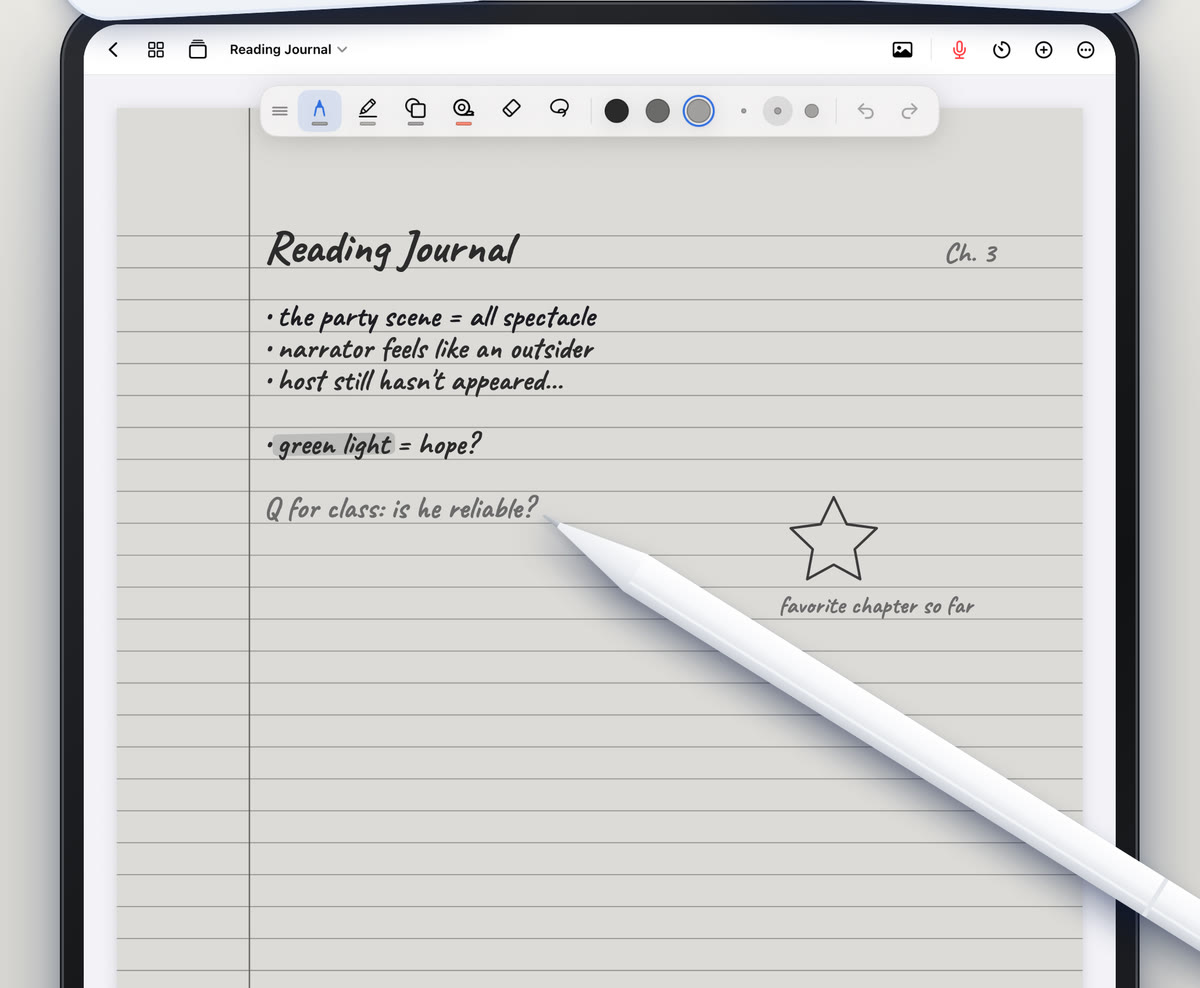
A calmer page for long reading. E-Ink Books gives any paper a soft gray e-ink look, with pens and highlighters in e-ink grays. Some students like it for long reading sessions. See E-Ink paper on iPad.
Glossary flashcards. Vocabulary paper has a TERM column and a DEFINITION / EXAMPLE column, and Scribba can turn each row into a flashcard, without Apple Intelligence. Handwriting recognition is built for Latin-alphabet handwriting, so check the review step carefully: diacritics may need fixing, and it won't read Hebrew, Arabic, Chinese or other non-Latin scripts. For terms that need exact spelling, make a deck by hand: create a new deck, tap Add Card and type a Front and Back with any iPad keyboard, including one for the original script. Then study with spaced repetition.
Timelines. Hold the Pencil still at the end of a stroke to snap a straight line. A landscape notebook, chosen when you create it, gives long timelines room.
Lectures. If your professor allows recording, tap the mic and take notes as usual, then tap any line later to hear that moment. Ask first: policies vary by school, professor and location. Transcription works best when lectures are in English or Spanish, so foreign terms may be transcribed loosely. Your own glossary is the better source for spelling.
Frequently asked questions
Do I have to be religious to do well in religious studies?
No. The field asks you to describe and analyze traditions accurately, whatever your own beliefs. Careful attribution matters more than personal background.
How do I write terms with diacritical marks in my notes?
Write them by hand exactly as your course spells them. For flashcards, type them on a hand-made deck with an iPad keyboard so the marks are exact.
How should I study for passage identification questions?
Make flashcards with a short passage on the front and its text, reference and significance on the back. See how to study for essay exams for the longer answers.