 Scribba
You read the assigned chapter, every word of it, and an hour later you couldn't say what it was about. Most students have been there. Reading a textbook front to back like a novel is slow, and very little of it stays.
SQ3R is a reading method built to fix that. It's been taught to students for decades, and it works because it turns reading from something that happens to you into something you do. The name stands for its five steps: Survey, Question, Read, Recite, Review.
What SQ3R is
SQ3R breaks reading a chapter into five stages:
- Survey: skim the chapter's structure before you read.
- Question: turn headings into questions you want answered.
- Read: read one section at a time, looking for the answers.
- Recite: after each section, answer the questions from memory.
- Review: at the end, go back over the whole chapter's questions.
Why it works
You read with a purpose. When you know what you're looking for, you notice it. Questions give every section a job, so your attention has somewhere to go.
The survey gives you a map. Knowing the chapter's main sections before you start makes every detail easier to place. New facts attach to something instead of floating.
Recite is active recall. Answering from memory right after a section strengthens what you just read and shows you instantly if you missed something. That's the same effect behind active recall.
Review closes the loop. Going back over the whole chapter connects the sections and gives you one more round of recall before you forget.
How to do it, step by step
1. Survey
Spend a few minutes looking over the chapter without reading it closely. Read the title, the introduction, every heading and subheading, the bold terms, the figure captions and the summary at the end. Glance at any review questions. You're building a mental outline, not learning details.
2. Question
Turn each heading into a question. "The structure of the Senate" becomes "How is the Senate structured, and why that way?" "Elasticity of demand" becomes "What makes demand elastic or inelastic?" Use the end-of-chapter questions too. Write the questions down before you read.
3. Read
Read one section at a time, looking for the answer to that section's question. Slow down for the parts that answer it and for anything in bold, figures and tables. Keep marking light. If you highlight everything, nothing stands out.
4. Recite
At the end of each section, look away and answer its question in your own words, out loud or in a few written lines. If you can't, reread just the part you missed and try again. Then move to the next section.
5. Review
When you finish the chapter, go back through all your questions and answer them from memory. Then review again over the next few days, briefly. This is when the chapter starts to stay.
Tip: if you only have time for part of the method, keep Recite. Pausing to answer from memory after each section matters more than any other step.
An example: an economics chapter
Say you have a chapter on market structures. In the survey, you see four main sections: perfect competition, monopoly, monopolistic competition and oligopoly, plus a summary table comparing them. You write four questions: "What defines each structure?", "How does a monopoly set its price?", "Why do firms in monopolistic competition advertise?", and "Why do oligopolies sometimes act like a monopoly?"
You read the section on perfect competition, then close the book and explain what makes a market perfectly competitive. You forget one condition, check, and add it. You repeat for each section. At the end, you answer all four questions from memory, then sketch the comparison table without looking.
Common mistakes
- Skipping the survey. It feels like wasted time, but it's what makes the rest faster.
- Questions that are just headings with question marks. "What is monopoly?" is weak. "How does a monopoly decide price and quantity?" gives you something to look for.
- Reciting while looking at the page. That's rereading. Look away.
- Reading the whole chapter before reciting. Recite after every section, while it's fresh.
- Leaving out Review. Without it, most of what you recited will fade before the exam.
SQ3R in Scribba
Scribba is an iPad notebook for class, so your reading notes can live in the same notebook as your lecture notes.
Write your questions on Cornell Notes paper. Cornell Notes paper has TOPIC, DATE and CLASS at the top, a CUES & QUESTIONS column, a NOTES column and a SUMMARY box. Write your Question-step questions in the cue column, your Read-step notes beside them, and use the summary box during Review. Scribba can read your handwriting and turn each cue into a flashcard, which gives you a Review deck with spaced repetition. See Cornell notes on iPad.
Read a PDF chapter right in the notebook. Import a PDF reading as a new notebook or into the current one, and write on it. Its text becomes searchable. Use the highlighter sparingly during the Read step. For printed pages, you can scan them with the camera. The approach in annotating lecture slides on iPad carries over to readings.
Put the book beside your notes. Split View opens a notebook in its own window, so the chapter can sit next to your Cornell page.
Cover answers for the Recite step. Drag study tape over your notes column, then answer each cue from memory and tap the tape to peek.
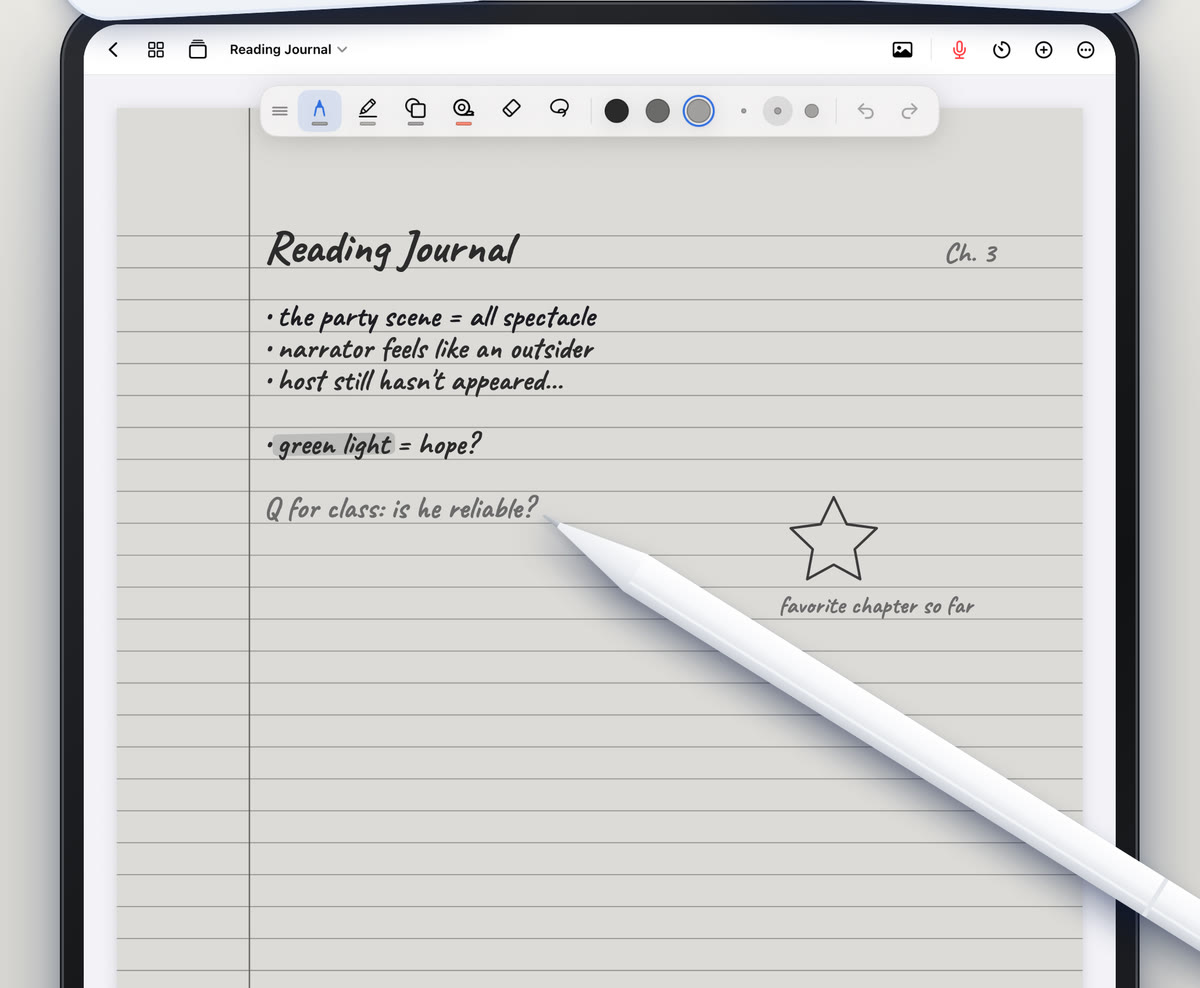
Try E-Ink paper for long reading sessions. E-Ink paper is a soft gray in any template, with pens and highlighters that write in e-ink grays. If bright white paper tires your eyes during a long chapter, give it a try.
Frequently asked questions
Is SQ3R worth the extra time?
Usually, yes. It takes longer than reading straight through, but more of the chapter sticks, so you spend less time rereading before the exam.
Does SQ3R work for every subject?
It fits textbook chapters with clear headings best, like biology, psychology, economics and history. For math, use the survey and question steps, then work the examples yourself instead of only reading them.
Can I shorten SQ3R when I'm short on time?
Yes. A quick survey, a question per heading and a short recite after each section still beats reading straight through. Don't skip reciting.