 Scribba
Homework is usually organized in blocks. Section 4.2 has twenty integration-by-parts problems, section 4.3 has twenty partial fractions problems, and you know which method to use before you read the question. Then the exam mixes them all together, and suddenly the hard part isn't doing the method. It's knowing which one to use.
Interleaving is a way of studying that practices that hard part on purpose.
What interleaving is
Blocked practice means doing many problems of one type in a row: AAAA, then BBBB, then CCCC. Interleaved practice mixes them: A, C, B, A, B, C. Each problem could be any type, so you have to figure out what kind it is before you can solve it.
It applies to more than math. You can interleave:
- Problem types in math, physics, chemistry and economics.
- Concepts that look alike, like mitosis and meiosis, or the different types of market structures.
- Examples to identify, like paintings by different artists, rhythms in music theory, or case studies that each fit a different psychological disorder.
- Grammar points in a language class, mixing tenses instead of drilling one at a time.
Why mixing works
You practice choosing, not just doing. In a block, the choice is made for you by the heading. In a mix, you have to notice the features that tell problems apart. That's the skill an exam tests.
You learn the differences. Seeing two similar ideas side by side makes the contrast obvious. If you only study mitosis on Monday and meiosis on Wednesday, it's easy to blur them. Alternate between them and you're forced to see where they differ.
Spacing comes built in. In a mixed set, each problem type returns after a gap, so you have to pull the method back out of memory each time. That's the same effect that makes spaced repetition work.
Why it feels worse, and why that's fine
Interleaving feels slower and messier. You get more problems wrong during practice, and switching between methods is tiring. Blocked practice feels smooth because by the fifth problem you're on autopilot.
That smoothness is the trap. It tells you how well you can repeat a method you just used, not how well you'll do on a mixed exam next week. Expect your practice scores to look a little worse with interleaving. Judge it by the test, not by how the session felt.
How to interleave, step by step
- Learn each topic first. Interleaving is for practice, not first exposure. Work a few problems of a new type in a block until you understand how the method goes.
- Choose topics that can be confused. Mixing works best with material that's related: problem types from the same unit, or terms that are easy to swap. Mixing organic chemistry with Spanish verbs doesn't teach you to tell anything apart.
- Build a mixed set. Pull a few problems from each section and shuffle them. Cover the section headings, so the problem itself is the only clue.
- Name the type before you solve. Before you start each problem, write down which method you'll use and why. This is the step that builds the skill.
- Check and sort your mistakes. When you get one wrong, decide whether you picked the wrong method or did the right method badly. Those need different fixes.
- Repeat with a new mix. A few days later, build another set that includes the newest topic and some older ones.
Tip: if you're short on problems, rework old homework in a random order. The questions aren't new, but without the section heading you'll have to choose the method again.
An example: a calculus unit
Say your next exam covers u-substitution, integration by parts and partial fractions. After learning each one in its own block, you make a set of twelve problems, four of each, mixed up.
For each one, you write a quick label in the margin before solving: "product of polynomial and exponential, so by parts" or "rational function, factor the bottom, so partial fractions." By the end, you've practiced spotting the pattern twelve times, which is exactly what you'll need when the exam doesn't tell you.
Common mistakes
- Interleaving before you understand anything. If you can't do one type on its own yet, mixing just adds confusion. Block first, then mix.
- Mixing unrelated subjects. Switching classes every half hour is fine for variety, but the benefit comes from mixing things you need to tell apart.
- Leaving clues in place. If the problem sits under a heading that says "Partial fractions," you're not choosing.
- Quitting because it feels hard. That difficulty is the method working.
Interleaving in Scribba
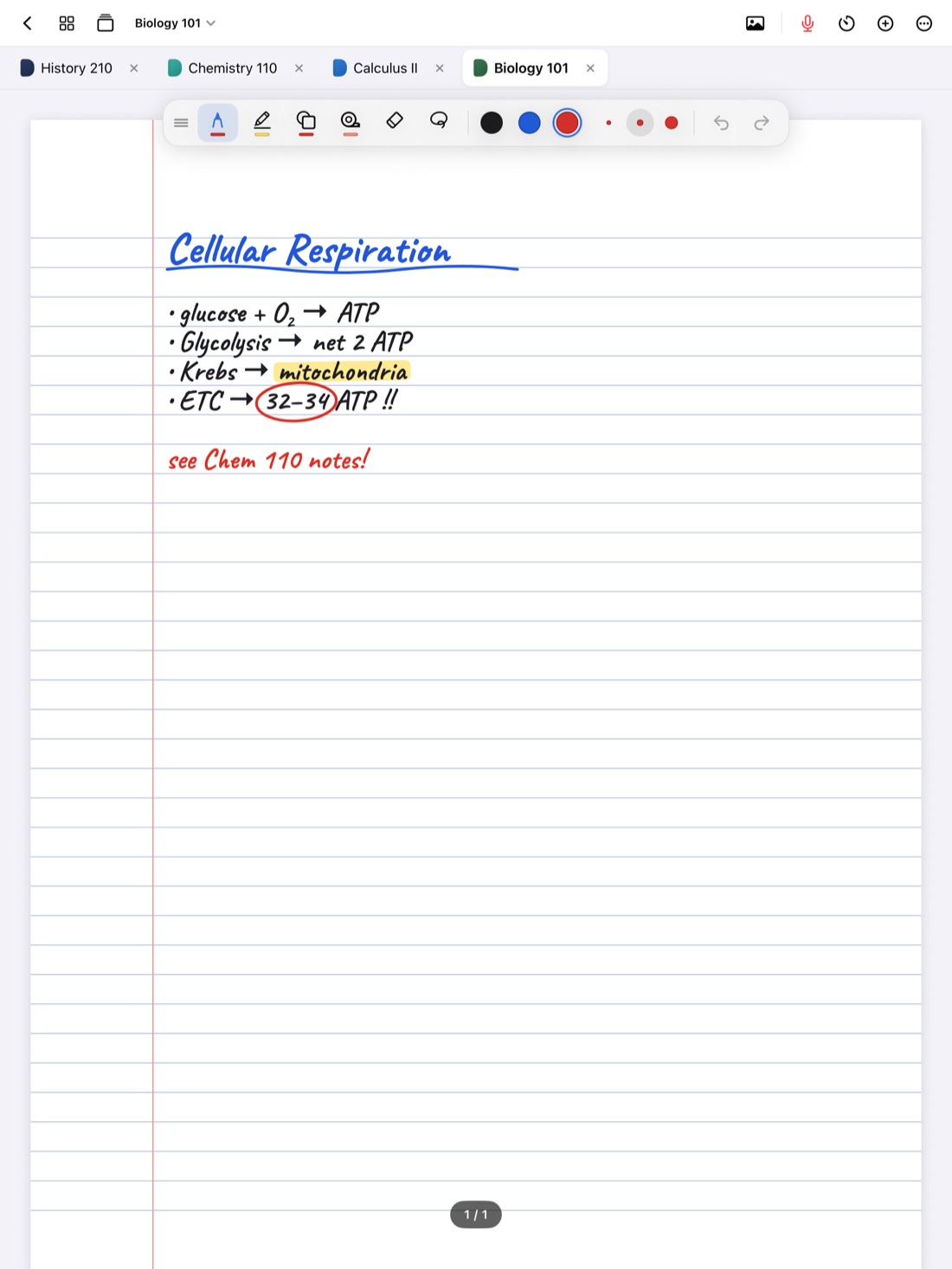
Keep several classes or units open as tabs. Scribba holds up to six open notebooks as tabs, and with a keyboard you can move between them with ⌘⇧ and ⌘⇧]. If your units live in separate notebooks, you can pull problems from each without hunting through the library. ⌘O opens the quick switcher for anything else. The [tabs and quick switcher guide covers the setup.
Build a mixed set on Problem Set paper. Problem Set paper has NAME, COURSE, DUE and ASSIGNMENT fields over a grid split into four numbered problem areas. Copy one problem from each topic into the four areas, write the method label above your work, and solve. Pull past the last page to add another sheet.
Collect pages into one practice notebook. From the page sidebar you can copy pages between notebooks. Copy a few worked problems from different weeks into a "Practice" notebook, put study tape over the solutions, and reorder the pages so neighboring problems don't share a method.
Mix your flashcard decks. Scribba can study all your due cards at once, across every deck. If you keep one deck per unit, that session interleaves them for you, which is especially helpful for terms that are easy to mix up.
Frequently asked questions
Should I always interleave instead of blocking?
No. Block when a topic is brand new, so you can learn how the method works. Switch to interleaving once you can do each type on its own, and use it for most of your review.
Does interleaving work for subjects without problems to solve?
Yes. Mix examples to classify, terms that are easy to confuse, or essay prompts from different units. Anything where you have to decide which idea applies is a good fit.
How many topics should I mix at once?
Start with two or three related ones. Add older topics to later sets so earlier material keeps coming back.