 Scribba
Organic chemistry has a reputation as the class where you memorize a hundred reactions. Students who do well usually see it differently. Most of those reactions are a few moves repeated: a nucleophile attacks an electrophile, a leaving group leaves, a proton moves. Once you can see those moves, a new reaction is a variation on something you already know.
So the goal of orgo notes isn't a complete list. It's notes that make the patterns visible: mechanisms you can follow arrow by arrow, a reaction sheet that grows with the course, and practice pages where you draw from a blank start.
For general habits with worked problems and units, see math and chemistry notes on iPad. This guide is about the parts that are specific to organic.
Draw mechanisms you can follow later
Your professor will draw mechanisms fast, and it's easy to copy the structures and miss half the arrows. The arrows are the whole point. A few rules keep them readable:
- Every curved arrow starts at electrons. That's a lone pair or a bond, never a bare atom or a positive charge.
- The head points where the electrons end up, either onto an atom or between two atoms to form a new bond.
- Use a full arrowhead for a pair of electrons and a single-barbed fishhook for one electron in radical reactions.
- Draw every intermediate. Carbocations, carbanions, tetrahedral intermediates: if it exists for a moment, give it its own drawing.
- Show charges and lone pairs on the atoms that take part in the step. A missing formal charge is the most common reason a mechanism stops making sense.
- Write conditions on the reaction arrow. Reagent above, solvent, heat or light below.
Draw curved arrows in a different color from the structures. When you review, you can follow the electron flow in one glance without reading the whole drawing.
Tip: when the professor skips a step ("and then a proton transfer"), draw it anyway in your notes. Exams often ask for the full mechanism, including the boring proton transfers.
Getting the drawing right
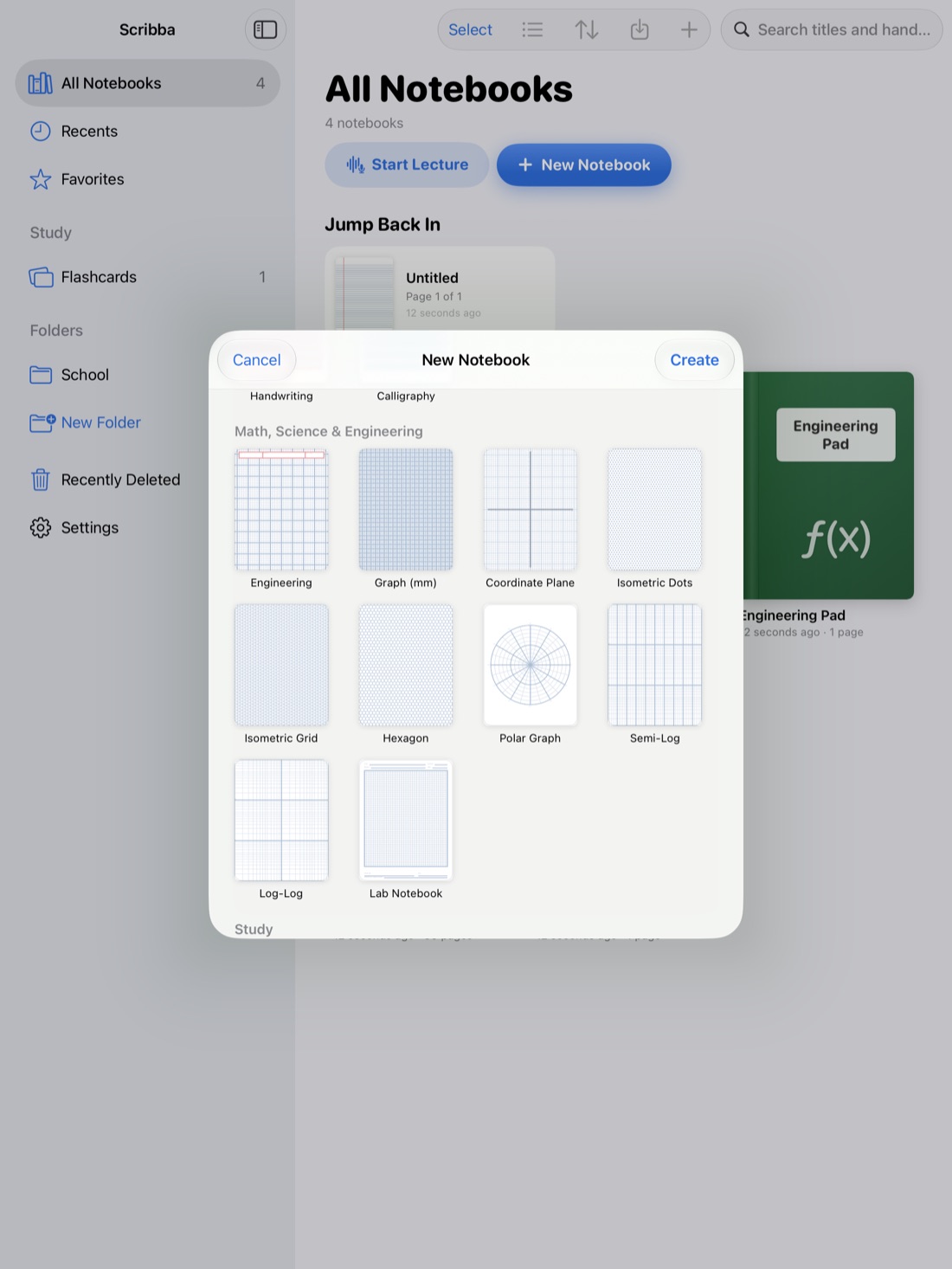
Skeletal structures are easier to read when the angles are consistent. Hexagon paper gives you regular rings and the 120° zigzag of carbon chains, which helps a lot early in the course. We covered how to use it in hexagon paper on iPad. For chair conformations and wedge-and-dash drawings, plain or dot grid paper is often easier, because those don't follow the grid.
In Scribba, you can change the paper of any page from the page sidebar, so one chemistry notebook can have ruled lecture pages, hexagon pages for structures and grid pages for your reaction sheet.
A few tools help with the drawing itself:
- Straight bonds and reaction arrows. Hold the Apple Pencil still at the end of a stroke and it snaps into a straight line or an arrow. Curved arrows stay freehand.
- Smoother curves. Double-tap the pen tool to open pen settings and adjust stabilization, which smooths your strokes. Try it if your curved arrows come out shaky.
- Small labels. The Zoom Window lets you write big in a magnified strip, and it lands small and neat on the page. That keeps δ+, subscripts and charges legible next to a crowded structure.
Keep one reaction sheet for the whole course
Organic builds on itself. Reactions from week three show up again in synthesis problems in week twelve. A running reaction sheet keeps them in one place, so you aren't flipping through a whole notebook to find how to turn an alkene into an alcohol.
For each reaction, record the same things:
- Starting functional group and product functional group.
- Reagents and conditions.
- Regiochemistry, such as Markovnikov or anti-Markovnikov.
- Stereochemistry, such as syn or anti addition, inversion, or a racemic mix.
- Mechanism type, like SN1, SN2, E1, E2, electrophilic addition or radical.
- The catch. Rearrangements, competing elimination, reagents that don't work on certain substrates.
Group the sheet by starting functional group, not by chapter. When a synthesis problem gives you an alkyl halide, you want every reaction that starts from an alkyl halide in one spot.
In Scribba, give each functional group its own page and add a named bookmark in the page sidebar. The bookmarks act as a table of contents, so "Alkenes" or "Carbonyls" is one tap away. Grid paper helps keep the columns lined up.
Draw a roadmap for synthesis
Synthesis questions ask you to get from one molecule to another in several steps. A roadmap makes them much easier. On one large page, write each functional group as a node and draw an arrow between two groups for every reaction that connects them, with the reagents on the arrow.
When you face a synthesis problem, work backward from the product. Ask what functional group could have made it, find that node on your map, and keep going until you reach the starting material. Building the roadmap is studying in itself, because you have to know how every reaction connects. If you like this kind of page, mind map notes on iPad has more on laying one out.
Practice from a blank page
Rereading mechanisms feels like progress, but drawing them is what exams test. Try this routine after each lecture:
- Copy only the starting material and reagents from a reaction onto a fresh page.
- Draw the full mechanism and product without looking.
- Check against your notes and circle anything you got wrong in a different color.
- Redo the ones you circled a few days later.
In Scribba, you can do this without recopying anything. Drag study tape over the mechanism and product in your lecture notes, leaving the starting material visible. Work it out on a scratch page, then tap the tape to peek. See study tape on iPad.
Reagents are another good target. You can make a flashcard deck by hand: create a deck, tap Add Card, and type a reagent on the front ("BH3, then H2O2, NaOH") and what it does on the back. Scribba's decks use spaced repetition, so cards come back after 1, 3, 7, 14 and 30 days. Named reactions and terms in words also work well on a Vocabulary page, which Scribba can turn into flashcards from your handwriting. That reads words, not structures, so keep drawings for study tape.
Record the fast mechanism days
If your professor allows recording, it pays off on mechanism-heavy days. In Scribba, tap the mic and write as usual; every stroke is linked to that moment in the recording. Later, tap the arrow where you got lost and hear the explanation that went with it. Check your class's policy first. More in how to record a lecture on iPad.
Frequently asked questions
Can Scribba recognize or name my structures?
No. Scribba doesn't recognize chemical structures or equations, and it doesn't check mechanisms. It's paper and pens, with recording and study tools around them.
Should I draw structures freehand or on hexagon paper?
Start with hexagon paper if your rings come out lopsided. Many students switch to dot grid or plain paper once they can draw regular rings freehand, since exams are usually on blank paper.
How many reactions should be on my reaction sheet?
Every reaction your course covers, but in short form. The sheet is a reference. The learning happens when you practice mechanisms from a blank page.