 Scribba
Hexagon paper looks like a novelty until you need it. Then it's hard to go back. Organic chemistry students use it to draw rings that actually look regular. Tabletop gamers use it for maps where every step costs the same. Designers use it for patterns that tile with no gaps. All three come down to the same geometry, and once you see why, you'll know when to reach for it.
Why hexagons
Three properties make hexagon paper useful:
- They tile. Regular hexagons fill a flat surface with no gaps, like a honeycomb. You can keep adding cells in any direction.
- Every neighbor is equal. On square paper, a diagonal neighbor is farther away than a side neighbor. On hexagon paper, all six neighbors are the same distance from the center. That's why games use hexes for movement.
- The angles are 120°. Each corner of a regular hexagon is 120°. That happens to match how organic chemistry draws carbon chains and six-membered rings.
Organic chemistry structures
Organic chemistry runs on skeletal formulas: lines for bonds, with a carbon at every corner and end, and hydrogens on carbon left implied. Students often struggle to make their structures look right, and messy structures lead to miscounted carbons and wrong answers.
Hexagon paper helps in a few specific ways:
- Rings come out regular. Trace one cell for cyclohexane or benzene. For benzene, add three double bonds inside alternating edges, or a circle inside to show the delocalized electrons, whichever your course uses.
- Fused rings line up. Naphthalene is two hexagons sharing an edge, and anthracene is three in a row. On hexagon paper, you just trace neighboring cells.
- Zigzag chains have the right angles. Following the edges of the cells gives you the 120° zigzag that skeletal formulas use for carbon chains. Count corners to count carbons.
- Substituents have a place to go. An edge that points away from a ring is a natural spot for a methyl group, an OH or a halogen.
A few habits that save points on exams:
- Number the carbons in the main chain or ring lightly before naming the compound.
- Draw lone pairs and formal charges on any atom that has them. It makes mechanisms much easier to follow.
- Start curved arrows where the electrons are, at a lone pair or a bond, and point them where the electrons go. Show every arrow, not just the first.
- Redraw the product from scratch rather than editing the starting material. You'll catch dropped hydrogens and misplaced bonds.
Not every structure fits the grid. Five-membered rings, chair conformations and 3D wedge-and-dash drawings won't trace neatly, so draw those freehand near the cells. The hexagons still help you keep sizes consistent. For the rest of your chemistry setup, see math and chemistry notes on iPad.
Tip: practice mechanisms by drawing only the starting materials and reagents, then working out the product on your own before checking your notes.
Tabletop game maps
Hex maps are a staple of tabletop role-playing games and strategy games, and hexagon paper makes them quick to draw.
- Decide the scale first. Pick what one hex represents, like a day's travel or a few meters, and write it in a corner.
- Fill in terrain by color. Green for forest, blue for water, brown for hills, gray for mountains. Add a small key.
- Draw roads and rivers along hex edges or through centers, and stick to one rule so distances stay easy to count.
- Number or letter the hexes of a large map, like a coordinate grid, so you can refer to them in notes ("the cave in D7").
- Keep a player map and a game master map. Draw the full map first, then copy only what the players have seen onto a second page.
Design sketches
Hexagons show up all over design: honeycomb patterns, floor and wall tile layouts, quilting, logos and pattern drawing. Hexagon paper lets you test ideas before committing.
- Tile layouts. Color cells to try out a pattern, like a flower of seven hexes (one in the center and six around it) repeated across the page.
- Quilting. Hexagon quilts are a classic. Sketch your color layout cell by cell before cutting any fabric.
- Pattern studies. Connect cell centers to get a triangle grid, or skip cells to make stars and larger shapes.
Hexagon paper in Scribba
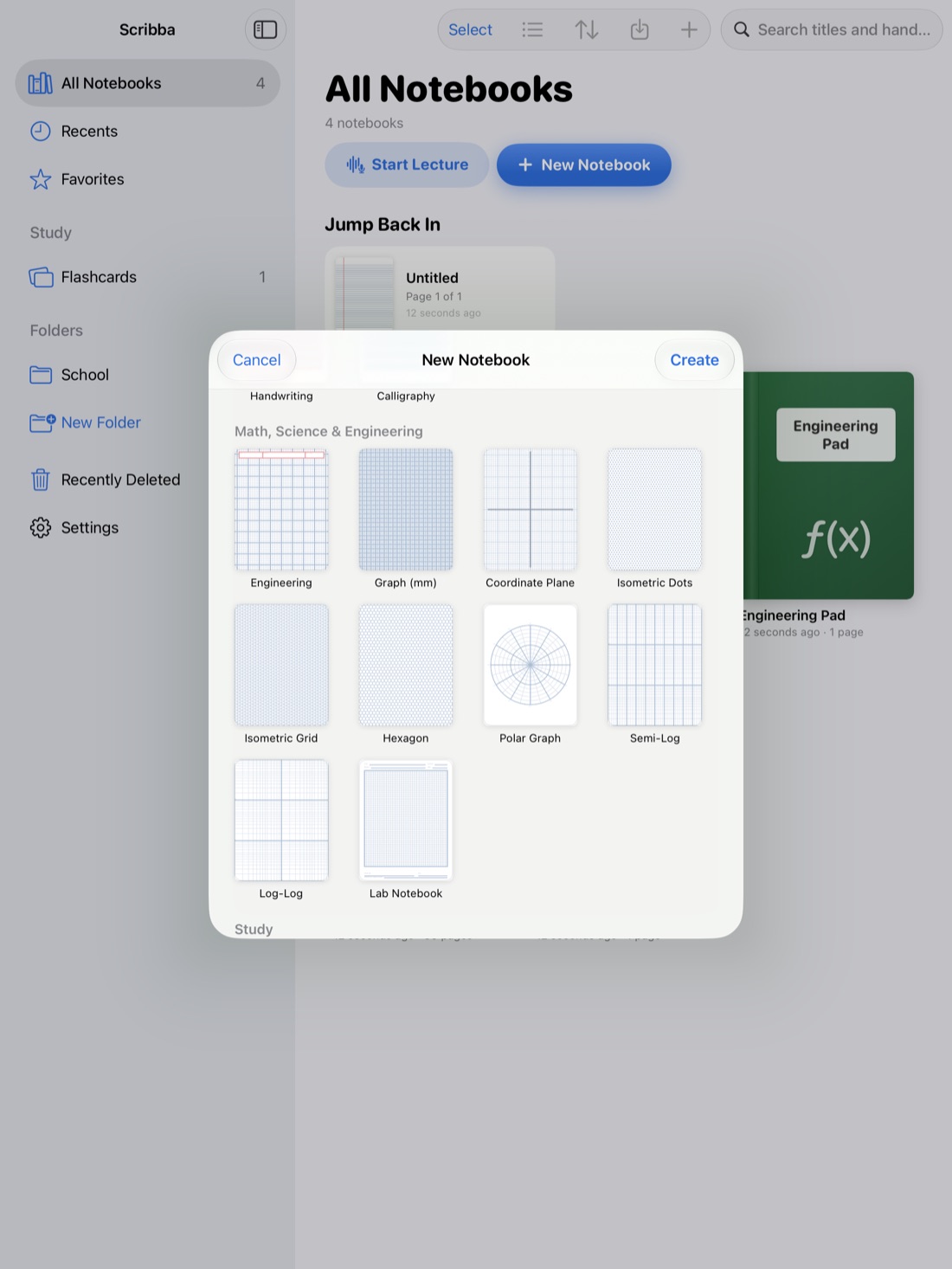
Scribba's Hexagon paper, hexagons tiling the page, is in the Math, Science & Engineering section of the paper picker. Paper type and color are set per page from the page sidebar, so one chemistry notebook can mix ruled lecture pages with hexagon pages for structures.
Tools that fit this paper:
- Snapped bonds. Hold the Apple Pencil still at the end of a stroke and it snaps into a straight line or an arrow. That's useful for bonds that leave the grid and for reaction arrows.
- Small labels. The Zoom Window lets you write big in a magnified strip, and it lands small on the page. That keeps subscripts in groups like CH₃ and charges legible beside a crowded ring.
- Pens for maps and patterns. Scribba has six pen types. A fineliner keeps bond lines crisp; the crayon or brush pen fills terrain and pattern cells with texture.
- Dark paper for maps. Charcoal and Black are among the nine paper colors, and bright pens stand out well on them.
- Self-quiz on reactions. Drag study tape over the product of a reaction, try to draw it yourself, then tap the tape to peek. More in study tape on iPad.
Scribba is paper and pens. It doesn't recognize or check chemical structures, so the chemistry stays yours. For similar geometric papers, see isometric paper on iPad.
Frequently asked questions
Do I need hexagon paper for organic chemistry?
No, but it helps while you're learning to draw structures consistently. Many students use it early in the course, then switch to plain or dot grid paper once their rings come out regular freehand.
Can Scribba recognize my chemical structures?
No. Scribba doesn't recognize structures or equations. It's for drawing them by hand, linking them to the lecture recording if you record, and studying them later.
Can I color in individual hexagons?
Yes. Pick a pen or highlighter and fill in the cells by hand. The crayon and brush pens work well for filling larger areas.