 Scribba
In a French or Spanish class, writing is the easy part. In Japanese, writing is a skill of its own. You start with two syllabaries, hiragana and katakana, before the first month is out, and then kanji arrive a few at a time for as long as you take the language. Each kanji has a stroke order, often more than one reading, and a meaning.
So a Japanese notebook has two jobs. It's a practice book, where you drill characters until your hand knows them, and a reference, where vocabulary, grammar patterns and example sentences live. Keep those apart and both get easier.
Practice kana and kanji on grid paper
Japanese characters are written to fit a square. Practicing inside squares trains the balance and proportion your teacher is looking for, and it's why Japanese practice sheets are printed as grids.
A simple routine for each new character:
- Write it once, slowly, with stroke numbers. Copy the stroke order from your textbook and write a tiny number at the start of each stroke.
- Fill a row of squares with copies, saying the reading out loud as you go.
- Cover the row and write it from memory in the next square. Then check the stroke order, not just the shape.
- Come back the next day and write it from memory once before learning new ones.
Pay attention to how strokes end. Japanese teachers look at whether a stroke stops cleanly, flicks up at the end, or sweeps away to a point, and these endings are often graded on kanji quizzes. Learn the general stroke order rules too, like top to bottom and left to right, and horizontal before a crossing vertical in most characters. They let you guess the order of kanji you haven't seen yet.
Tip: count strokes as you write them. Knowing a kanji's stroke count helps when you look it up in a dictionary, and it catches mistakes, like writing one stroke as two.
Small kana and katakana need their own drills
Two things trip up beginners more than anything else:
- Small kana. The small ゃ, ゅ, ょ and っ look like full-size kana but change the sound completely: きや (kiya) and きゃ (kya) aren't read the same. Practice them on lined paper so the size difference is obvious.
- Look-alike katakana. シ and ツ, and ソ and ン, differ only in stroke direction or angle. Practice them in pairs, side by side, and write a short note on how each one moves.
Write vocabulary with all three parts
A Japanese word has a written form, a reading and a meaning. Your vocabulary notes need all three:
- Write the kanji with furigana, the small kana reading above it, until you know the word cold. Then drop the furigana and see if you can still read it.
- Include the kana that follow the kanji, like the べる in 食べる. They're part of the spelling, and they tell you how the word conjugates.
- Add one example sentence with the particle the word usually takes.
- Note the verb group next to every verb: ru-verb, u-verb, or irregular like する and くる. Every conjugation chart you'll draw depends on it.
Map grammar as patterns
Japanese grammar is easier to see as patterns than as rules. Give each one its own small block in your notes: the pattern, what it means, and two example sentences. Keep a separate page for particles, since は vs. が and に vs. で come up all year, and add a new example every time your teacher corrects you on one. For the te-form, draw a chart by verb ending and fill it in from memory before each quiz.
Mark politeness levels as you go. When a sentence in your notes uses plain form instead of です and ます, put a small mark next to it so you don't use it in a formal composition.
Setting up Japanese notes in Scribba
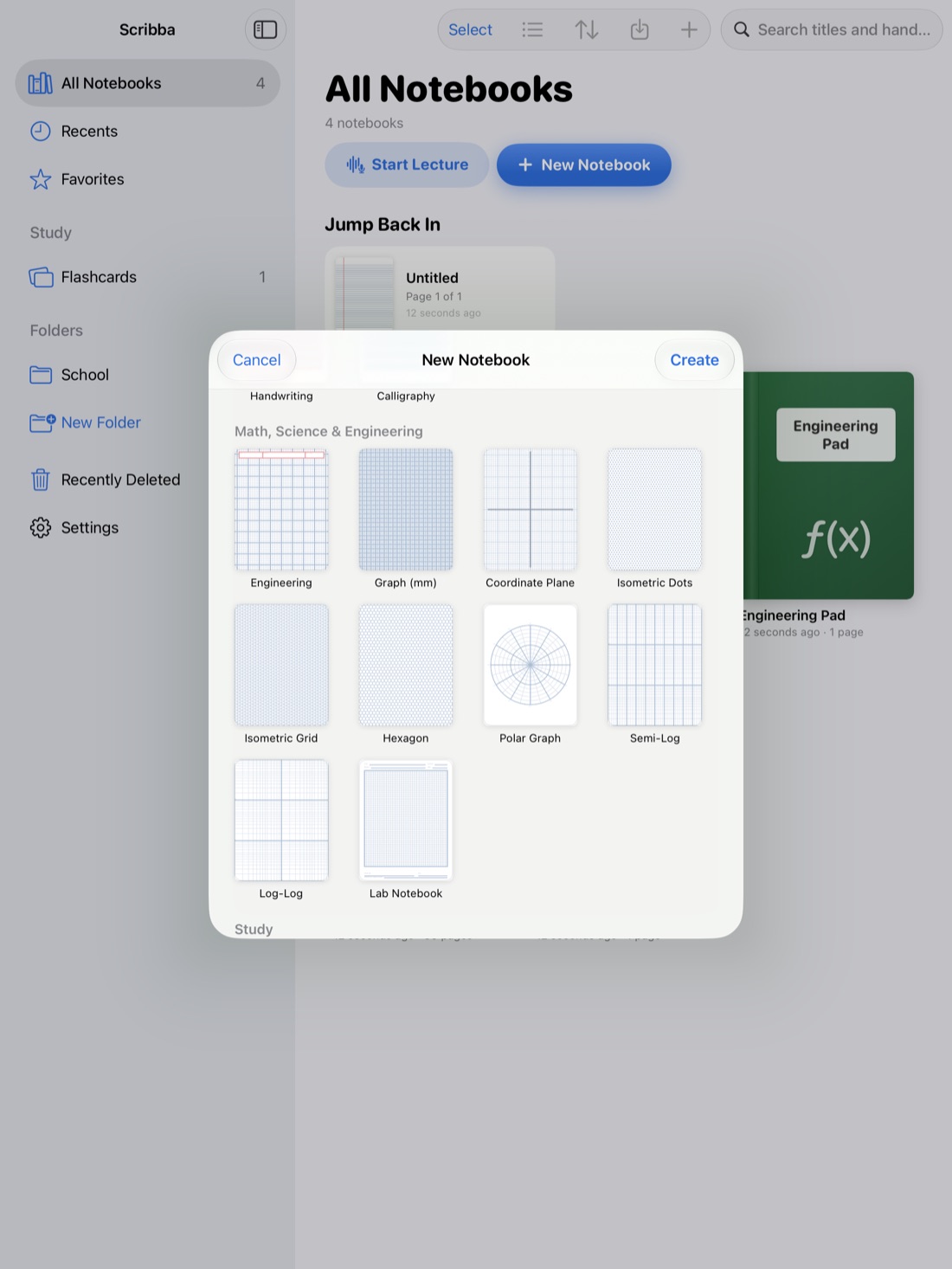
Grid paper for characters. Scribba's Grid paper gives every character its own square. For a square with a guide through the middle, try Graph (mm): it's a millimeter grid with bolder lines every 5 mm and every centimeter, so each centimeter square has a bolder cross through it to help you center a character. Zoom in to make the squares as big as you like; the paper stays sharp at any zoom.
Handwriting paper for kana sizing. The Handwriting paper has practice lines: a solid top line, a dashed midline and a colored baseline. It's useful for kana in a row, and it makes small kana easy to check, since they should stay clearly smaller than full-size ones. See handwriting practice paper on iPad for how the lines work.
Pens that show stroke endings. Try the fineliner or pencil for clean practice, or the brush pen if your class practices brush-style endings. Double-tap the pen tool to open pen settings and turn pressure sensitivity up, so a sweep that lifts away gets thinner like it should. (The fineliner always writes an even line.)
Quiz yourself with study tape. On a vocabulary page, drag study tape over the kanji column, write each word from its meaning on scratch paper, then tap the tape to peek. See study tape on iPad.
Typed flashcards with a Japanese keyboard
Here's an honest limit: Scribba's handwriting recognition doesn't read Japanese. It's built for the Latin alphabet. That means a handwritten Vocabulary page in Japanese won't turn into flashcards on its own, and search won't find your Japanese handwriting. You can still write Japanese anywhere on the page; it's ink.
For flashcards, type them instead. First add a Japanese keyboard on your iPad in Settings › General › Keyboard › Keyboards › Add New Keyboard. The Romaji layout lets you type with Latin letters and converts to kana and kanji; the Kana layout shows the kana directly. Then in Scribba, create a new deck with a title, tap Add Card, and type a Front and Back. For example, 食べる on the front, and たべる, to eat (ru-verb) on the back. Cards can be edited, reordered and deleted later.
Cards come back on a spaced repetition schedule, after 1, 3, 7, 14 and 30 days, and you can export decks to Quizlet or Anki. More in spaced repetition flashcards.
Tip: to find pages without handwriting search, name a bookmark for each lesson, like "Lesson 6: te-form," so the notebook's table of contents takes you there.
Recording class
If your professor allows it, recording helps with listening and pitch. Ask first: rules vary by school and professor. Scribba links every stroke to the moment in the recording, so you can tap a word you wrote to hear it again, slow the playback, or skip back 15 seconds. That works in any language. Transcripts don't: Scribba transcribes English or Spanish, so a lecture in Japanese won't transcribe. The Apple Intelligence tools, which need an iPad that supports Apple Intelligence with it turned on, also work only in English and Spanish.
Frequently asked questions
Can Scribba read my handwritten Japanese?
No. Handwriting recognition works on the Latin alphabet, so it won't search or convert kana and kanji. Your writing stays on the page as ink, and you can type flashcards with a Japanese keyboard.
What's the best paper for kanji practice?
Grid paper gives each character a square. Graph (mm) adds a bolder cross through each centimeter square, which helps with balance.
Will Scribba transcribe a Japanese lecture?
No. Transcription listens for English or Spanish. Recording and tapping your notes to replay a moment still work.