 Scribba
You probably learned your first mnemonic before you could spell it. "Every Good Boy Does Fine" for the lines of the treble staff. "Thirty days hath September." A mnemonic is any trick that hangs hard-to-remember information on something easy to remember: a word, a sentence, a rhythm, a pattern.
In college, mnemonics are worth having for one kind of material: lists and sequences where the order or the members are arbitrary, and the exam expects you to produce them cold. Here are the main types, with examples you can borrow, and how to write your own.
Acronyms
An acronym takes the first letter of each item and makes a word, or something you can say like one.
- HOMES: the Great Lakes (Huron, Ontario, Michigan, Erie, Superior).
- ROY G BIV: the colors of the visible spectrum in order (red, orange, yellow, green, blue, indigo, violet).
- OIL RIG: in chemistry, Oxidation Is Loss, Reduction Is Gain (of electrons).
- FACE: the spaces of the treble staff, bottom to top.
Acronyms work best when the letters already spell something, or nearly do. HOMES works because it's a real word. If your letters are all consonants, try an acrostic instead.
Acrostics
An acrostic turns the first letters into a sentence. You get more freedom than with an acronym, because every letter becomes a whole word.
- "King Philip Came Over For Good Soup": the levels of biological classification (kingdom, phylum, class, order, family, genus, species).
- "Please Excuse My Dear Aunt Sally": the order of operations in math (parentheses, exponents, multiplication, division, addition, subtraction).
- "Every Good Boy Does Fine": the lines of the treble staff (E, G, B, D, F).
The weakness of both acronyms and acrostics is that a first letter can stand for more than one word. If your list has two items starting with the same letter, or terms that are easy to swap, use the first two letters, or add a word to the sentence that hints at the right one.
Rhymes and rhythm
Rhyme and rhythm are hard to forget, because a wrong word breaks the pattern and you notice.
- "In fourteen hundred ninety-two, Columbus sailed the ocean blue."
- "Thirty days hath September, April, June and November."
- "Righty tighty, lefty loosey."
You don't need to be a poet. A clumsy rhyme you made up yourself often beats a polished one you read somewhere. Setting a list to a tune you already know works the same way, and it's a common trick for long anatomy lists.
Chunking
Chunking means grouping many small items into a few bigger ones. It's why a phone number is split into groups: ten separate digits are hard, three short groups are easy.
- Numbers: a long constant or date sequence is easier as two or three groups than as one string.
- Long lists: twelve steps of a process become three stages of four. Learn the stage names first, then the steps inside each.
- Related terms: instead of memorizing twenty amino acids as one list, group them by a property you're learning anyway.
Chunking works best when the groups mean something. Grouping by real categories teaches you the material while you memorize it. There's more on this in the guide to the chunking study method.
How to make your own mnemonic
The best mnemonics are often the ones you build yourself, because building them is already a round of studying.
- Get the list right first. Check the items and their order against your notes or textbook before you encode them. A mnemonic for the wrong list is very hard to unlearn.
- Pick the type that fits. Short list of distinct letters: acronym. Awkward letters: acrostic. Numbers or long lists: chunking. Anything you'll say out loud: a rhyme.
- Make it vivid. Funny, strange or personal sentences stick better than bland ones. Put your roommate, your dog or your professor in it.
- Test it cold. The next day, write the mnemonic, then expand it into the full list without looking. If you stall on an item, change the word for it.
- Write the meaning next to it. "OIL RIG" alone is a phrase. "OIL RIG: oxidation is loss of electrons" is something you can use on an exam.
Tip: ask your professor or TA what mnemonics they use. Lecturers often have a favorite for the lists they know students struggle with, and it may match how the exam asks the question.
When mnemonics get in the way
A mnemonic tells you what's on a list. It doesn't tell you what any of it means. If an exam asks you to explain why reduction is a gain of electrons, OIL RIG won't help. Use mnemonics for the scaffolding, and learn the content with practice questions and active recall.
Don't overdo them either. Ten mnemonics for one exam start to blur together. Save them for the lists that keep slipping. For long ordered lists, the memory palace holds more than any acronym can.
Keeping mnemonics in Scribba
Scribba is an iPad notebook for class, and a mnemonic is most useful written right where you learned the list.
Write it beside the term. On a Vocabulary page, put the list's name in the TERM column and the mnemonic plus the expanded list in DEFINITION / EXAMPLE. On a Cornell Notes page, write a question like "Taxonomy levels, in order?" in the CUES & QUESTIONS column and the acrostic and its meaning in NOTES.
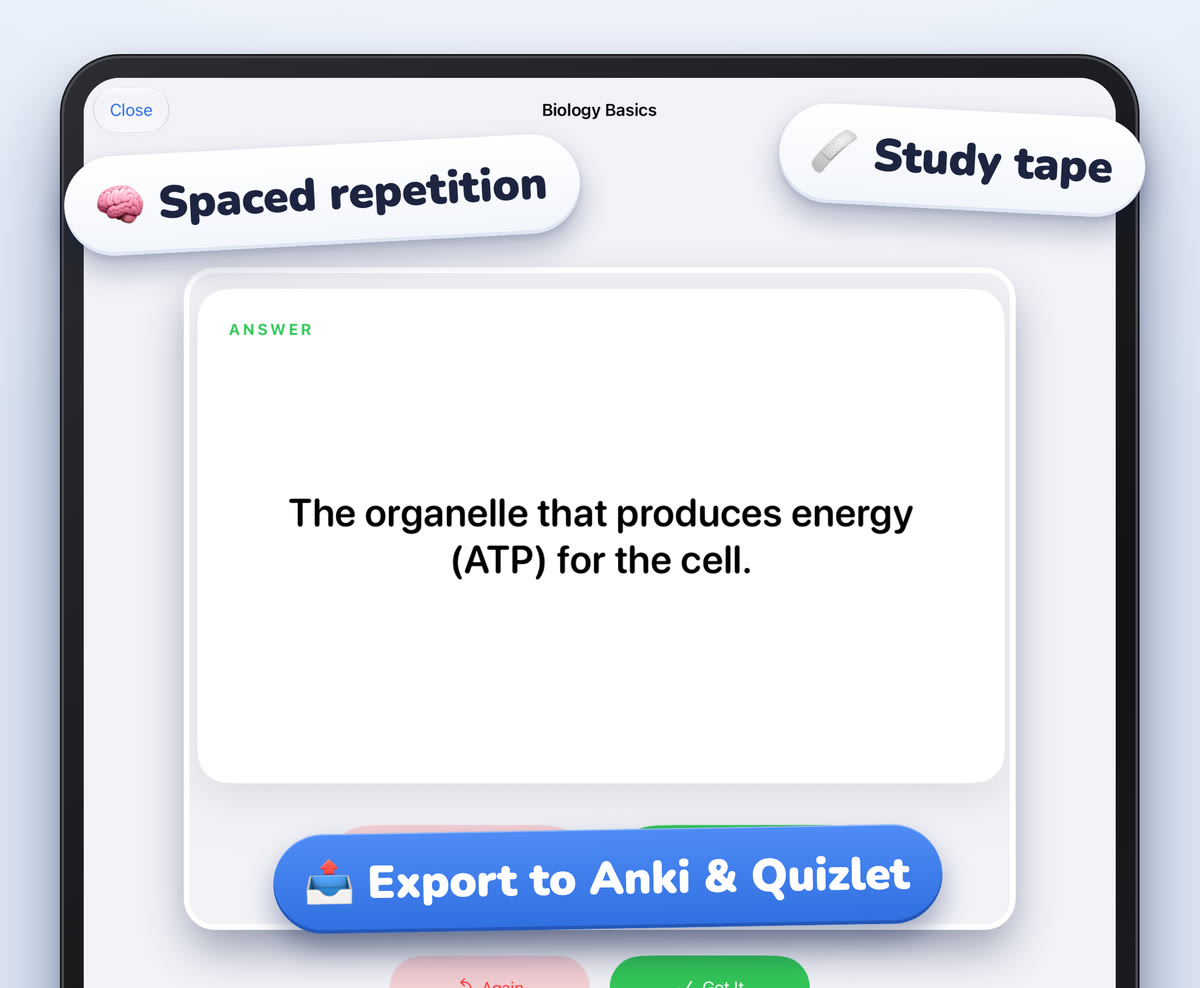
Turn it into flashcards. Scribba reads your handwriting and turns each vocabulary row or Cornell cue into a flashcard, without needing Apple Intelligence. Check the words it read and fix any it got wrong. You can also make a deck by hand and type each card's Front and Back. Cards come back on a spaced schedule, after 1, 3, 7, 14 and 30 days, which keeps a mnemonic alive until the final. Making flashcards from handwritten notes has the details.
Highlight the letters. Run the highlighter over the first letter of each item so the acronym shows on the page. Highlighter strokes snap straight, so the marks stay neat.
Cover the list, keep the mnemonic. Drag study tape over the expanded list, leave the mnemonic showing, and rebuild the list from it. Tap the tape to peek.
Hear the professor's version. If you recorded the lecture, tap where you wrote the mnemonic down, and playback jumps to the moment you wrote it.
Frequently asked questions
Are mnemonics cheating?
No. A mnemonic is a way of remembering, and you still have to know the material it points to. Check your exam's rules if you plan to write anything on scratch paper before you start.
What if I mix up two mnemonics?
Make them more different. Change one into a rhyme or a different kind of sentence, or tie each one to its subject, like a biology word in the biology mnemonic.
Do mnemonics work for vocabulary?
They help with tricky single words, especially through sound-alike images. For learning many terms, see how to memorize vocabulary faster.