 Scribba
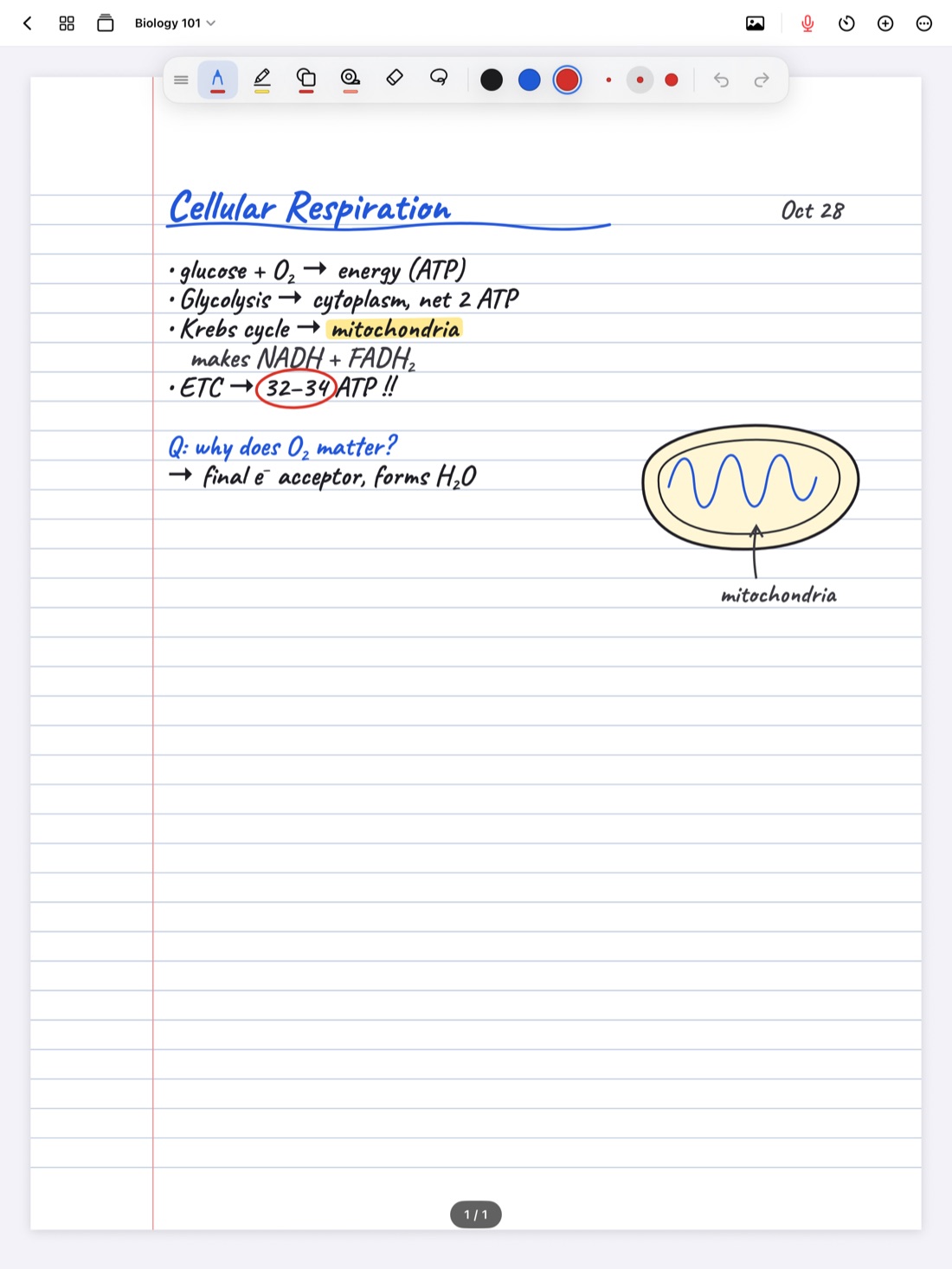
Every student uses a few abbreviations. "w/" for with, an arrow for "leads to." The difference between that and a real shorthand is a system: a set you use the same way every time, so your hand writes it without thinking and your eyes read it without decoding.
This guide is a reference you can build from. It covers the abbreviations and symbols that work in almost any lecture, simple rules for shortening words you'll never find in a list, and subject-specific terms. Take what fits, ignore the rest, and write your own key. For the bigger picture on keeping up in a fast class, see how to take notes when your professor talks too fast.
Three rules for a shorthand that works
- One meaning per abbreviation. If "p" means page in one class and pressure in another, you'll misread it eventually. Pick one meaning, or use a different form in each class.
- Readable in three weeks. Shorthand is only useful if you can read it the night before the exam. If you have to stop and puzzle out a word, it's too short.
- Spell it out the first time. Write a new term in full once, then abbreviate. "Oxidative phosphorylation (OxPhos)" at the top of the page makes "OxPhos" readable everywhere below it.
Common abbreviations
These work in any class:
- w/ with, w/o without, w/in within
- b/c because, b4 before, btwn between
- ex example, def definition, imp important
- e.g. for example, i.e. that is, etc. and so on
- vs versus, re regarding, cf. compare
- esp especially, approx approximately
- diff different or difference, sim similar
- info information, intro introduction, govt government
- ppl people, yr year, wk week, mo month
- min minimum, max maximum, avg average
- Q question, A answer
- c. circa (around a date), C19 19th century
Watch for abbreviations with two meanings. "Prob" can be probably, problem or probability. "Diff" can be different or differential. Pick one and use another form for the other.
Symbols
Symbols are faster than any word, and many come from math, so they're easy to remember.
- → leads to, causes, results in
- ← comes from, is caused by
- ↔ relationship, goes both ways
- ↑ and ↓ increase and decrease, rises and falls
- = is, means, equals
- ≠ is not, differs from
- ≈ approximately, similar to
- > and < more than, less than
- ∴ therefore
- ∵ because
- + or & and
- # number
- @ at
- Δ change
- ∅ none, nothing, empty
- ✓ yes, correct, confirmed
- × no, wrong, false
Combine them. "↑ interest rate → ↓ borrowing" is a full sentence in eight characters.
Margin marks
Margin marks aren't about the content. They tell future you what to do with it. Keep them consistent across every class:
- ? missed this or don't understand, check later
- ★ important, the professor emphasized it
- ! surprising, or a common mistake
- EX exam hint ("this will be on the test")
- ~ not sure of the spelling
- → HW relates to homework
Rules for shortening any word
You can't memorize an abbreviation for every word. These rules let you shorten new ones on the fly and still read them later:
- Drop the vowels in the middle, keep the first letter: "dvlpmt" for development, "gvt" for government, "bkgd" for background.
- Keep the first syllable of long, familiar words: "intro," "info," "psych," "bio."
- Shorten common endings: -ing becomes "g" ("procssg"), -tion becomes "tn" ("reactn"), -ment becomes "mt" ("argumt").
- Use initials for repeated names and terms after the first full mention: "World Health Organization (WHO)," then "WHO."
- Use numbers, not words: "3 types," "2nd," "1990s."
Subject-specific shorthand
Many fields have standard abbreviations. Learning them saves time and makes your notes match the textbook.
- Biology: DNA, RNA, ATP, "mito" for mitochondria, "PS" for photosynthesis, "resp" for respiration.
- Chemistry: "rxn" for reaction, "soln" for solution, "conc" for concentration, "ppt" for precipitate, [X] for the concentration of X.
- Economics: D and S for demand and supply, P and Q for price and quantity, MC and MR for marginal cost and marginal revenue, GDP.
- Math: "s.t." such that, "w.r.t." with respect to, "iff" if and only if, ∀ for all, ∃ there exists.
- Psychology: IV and DV for independent and dependent variable, "pts" for participants, "corr" for correlation.
- History: initials for people and organizations after first mention, "c." for approximate dates, "C18" for 18th century, "Rev" for revolution.
- Nursing and health: "pt" for patient, "hx" for history, "dx" for diagnosis, "tx" for treatment, "sx" for symptoms. In clinical documentation, use only the abbreviations your program and workplace approve. These are for your own lecture notes.
Build your own key
The best shorthand is the one you actually use. Start small:
- Pick ten abbreviations and symbols from this guide that fit your classes.
- Write them on the first page of each class notebook, as a key.
- Add new ones as you invent them in class, the same day.
- Read your notes back that evening. If something you wrote is unclear, fix the key or drop that abbreviation.
After a few weeks, most of it becomes automatic.
Shorthand on iPad with Scribba
A few things to know when you use shorthand in Scribba:
- Search finds what you wrote. Scribba searches your handwriting, but it finds the letters on the page. If you only ever wrote "OxPhos," searching "oxidative" won't find it in your handwriting. Writing the full term once, the first time, gives search something to match. More in how to search handwriting on iPad.
- Keep your key one tap away. Put the key on its own page at the front of the notebook and give it a named bookmark in the page sidebar, so it shows in the notebook's table of contents. Vocabulary paper works well for it: a TERM column for the abbreviation and a DEFINITION / EXAMPLE column for what it means.
- The recording can decode it. If you recorded the lecture and can't read your own abbreviation, tap it and playback jumps to the moment you wrote it. The transcript has the full words.
- Snap symbols into shape. Hold the Pencil still at the end of a stroke to snap a line or arrow straight, which keeps quick arrows readable. Apple Pencil tips has more on writing faster.
Tip: when you copy a page's handwriting as text, the abbreviations come along as written. If you plan to share the text or paste it into an essay draft, expand the shorthand first.
Frequently asked questions
How many abbreviations should I use?
Start with ten to fifteen you'll use every class. Add more only when you notice yourself writing the same long word over and over.
Is shorthand bad for remembering things?
Not if you can read it. Abbreviations free up time to listen and think, which helps. Review your notes the same day, while you still remember what each one meant.
Should I use the same shorthand in every class?
Use the same core set everywhere, and add a few subject-specific ones per class. Keep a short key in each class notebook for the ones that only apply there.