 Scribba
In a written exam, you can stare at a question for a minute, cross things out and start over. In an oral exam, someone is waiting for your answer. You have to find the words, put them in order and say them out loud, often while the examiner follows up with "Why?" or "Can you give an example?"
That's what makes oral exams feel hard, and it's also what makes them predictable to prepare for. Knowing the material is necessary but not enough. You also need practice explaining it out loud, under questions. Most students only do the first half.
Know which kind of oral exam you have
"Oral exam" covers a few different formats, and each one changes what you practice:
- Language orals. A conversation or presentation in the language you're learning. The test is fluency and accuracy as much as content.
- Course orals. The examiner asks questions on the course material, often starting broad and drilling down.
- Comprehensive or qualifying exams. A committee questions you on a whole field, common in grad school.
- Thesis or project defenses. You present your own work, then answer questions about your methods, choices and conclusions.
Ask your instructor or advisor how it will run. How long is it? Is there a prepared part, like a short presentation? Can you bring notes? Will you get questions in advance? Knowing this up front tells you how to spend your prep time.
Predict the questions
Oral exam questions tend to come from a few places, so you can usually predict most of them.
- The core topics. Every major idea from the course or your project. Write each one at the top of a page.
- The "why" behind each one. Examiners love asking why something is true, why you chose a method, why one theory beats another.
- The connections. "How does this relate to what we covered in week three?" Oral exams reward seeing links between topics.
- The weak spots. For a defense, the limitations of your work. For a course, the topics you'd rather not be asked about. Assume they'll come up.
For each topic, write two or three likely questions. That list becomes your practice set.
Practice out loud, not in your head
This is the step that matters most. Explaining something in your head feels complete because your brain fills in the gaps. Saying it out loud doesn't let you skip anything. You'll notice where you pause, repeat yourself or say "it's kind of like..." and trail off.
- Answer every practice question out loud. Stand up if it helps. Speak at the pace you'd use in the room.
- Start with a one-sentence answer. Then add the explanation, then an example. That structure keeps you clear when you're nervous, and it lets the examiner stop you once they've heard enough.
- Explain it to someone who doesn't know the topic. If a friend can follow you, an examiner can too. This is the idea behind the Feynman technique: explain it simply, find the gaps, go back to the source.
- Get questioned. Ask a friend or classmate to read your questions and add follow-ups. Being interrupted is part of the exam, so practice being interrupted.
Tip: practice your first minute until it's smooth. Starting well calms the nerves, and the rest of the answer tends to follow.
Record yourself and listen back
It's uncomfortable, but listening to yourself is one of the fastest ways to improve. Record a practice session, then listen for:
- Filler. Lots of "um," "like" and "basically."
- Vague answers. Where you circled the point without making it.
- Missing pieces. Steps or examples you meant to include but didn't.
- Pace. Most people speak faster when nervous. If you're fast in practice, you'll be faster in the room.
Do another round on the answers that need it. By the third recording, you'll hear a real difference.
Plan for "I don't know"
You will get a question you can't fully answer. Everyone does. What matters is how you handle it.
- Take a breath and think. A few seconds of silence is fine. Saying "Let me think about that for a moment" is better than rushing.
- Say what you do know. "I'm not sure about the exact mechanism, but I know it involves..." shows reasoning.
- Ask for clarification if the question is unclear. Examiners expect it.
- Be honest in a defense. "That's a limitation of the study" is a stronger answer than a defensive one.
Preparing for an oral exam in Scribba
Scribba is an iPad notebook for class. Its recording tools are built for lectures, but they work well for practicing out loud.
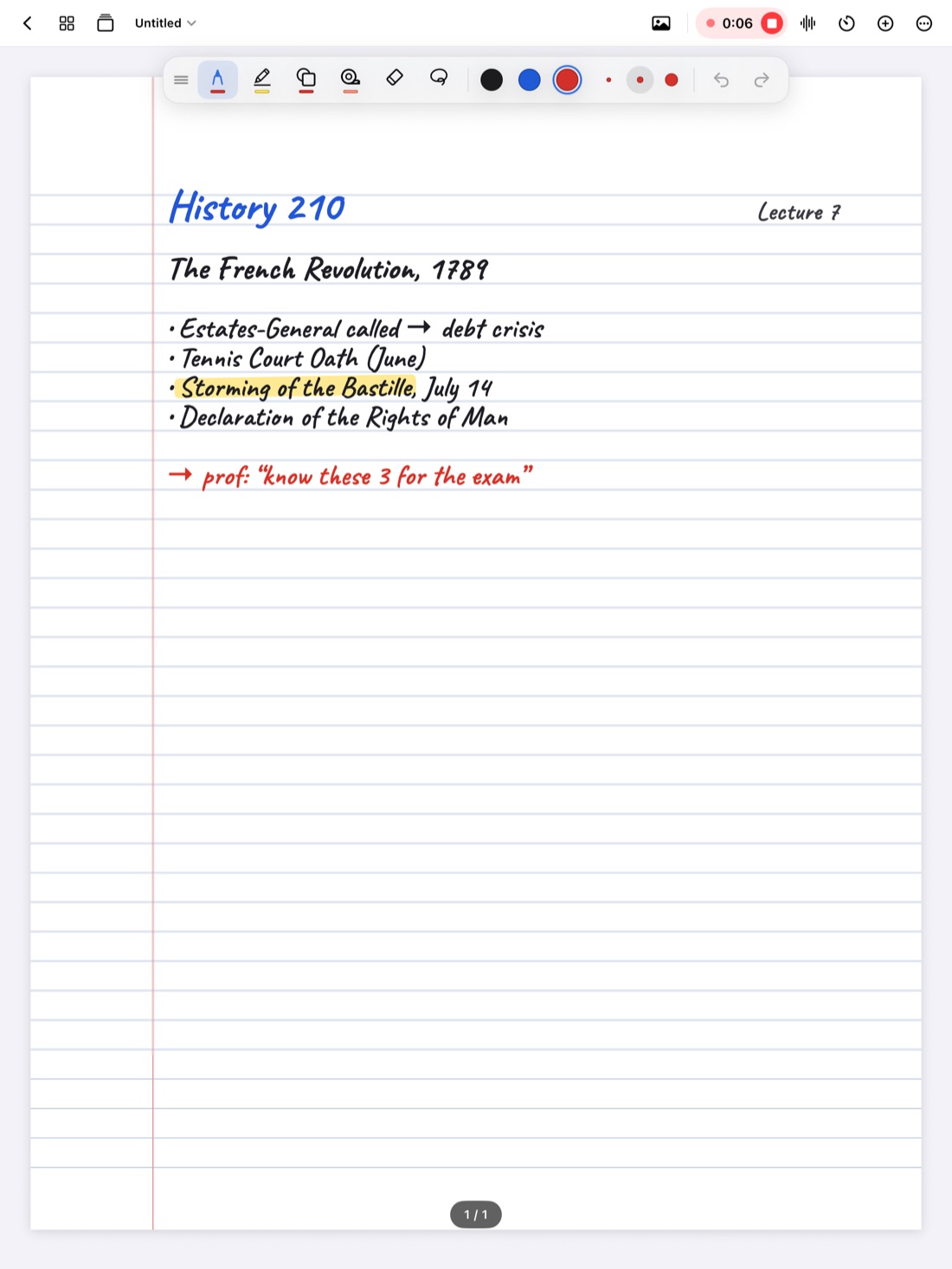
Record your practice answers. Open your study notebook, tap the mic (or press ⌘R) and answer your practice questions out loud. Write the question or a quick keyword on the page as you start each answer. Later, tap what you wrote and playback jumps to that answer, so you can review one at a time instead of scrubbing through the whole session.
Read your answers back. Scribba transcribes each recording after you stop. Reading your answer as text makes vague phrasing easy to spot; for filler words, listen to the recording, since a transcript may leave them out. You can also change the playback speed and skip back 15 seconds to hear a part again. The lecture transcripts guide explains how transcripts work.
Prompt cards on the page. Index Cards paper gives you a page of card outlines. Put one question on each card, with a few keywords for the answer. If you're allowed notes in the exam, this is also a good format for them.
Review the course material. If you recorded your lectures, search transcripts for topics you need to explain. On iPads that support Apple Intelligence, with it turned on, Study Guide puts the key points of every lecture in a notebook on one sheet, which is a handy checklist of topics to practice. Then practice each one out loud with your notes closed, which is active recall spoken rather than written.
Language orals. Scribba runs in English and Spanish, and its Apple Intelligence study tools work in both. Transcripts follow the language Scribba is showing, so switch Settings › Language to Spanish before recording Spanish practice. Practice in another language still records and plays back, but won't transcribe well. For a Spanish oral, see Spanish class notes on iPad for vocabulary pages and flashcards.
Frequently asked questions
How long should I prepare for an oral exam?
Give yourself at least a week of short daily practice for a course oral, and longer for a comprehensive exam or defense. Speaking practice works best spread over several days.
Should I memorize my answers?
No. Memorize key facts and examples, but practice explaining ideas in your own words. Memorized answers fall apart when the examiner rephrases a question.
What if I freeze during an oral exam?
Pause, take a breath and restate the question in your own words. It buys you a few seconds and often gets your thinking started again.