 Scribba
Multiple choice exams have a reputation for being the easy kind. The answer is right there on the page, after all. Then you sit down, read a question, and find that two of the four options both look right. That's not bad luck. It's how good multiple choice questions are written.
The wrong options, called distractors, are usually built from real course material: a term from the same chapter, a step from a similar process, a definition that's almost right. If you only recognize the material, every option looks familiar. To pick the right one, you need to know it precisely. This guide is about studying for that.
Why "I recognize it" isn't enough
Recognition is the feeling of "I've seen this before." It's what rereading builds, and it's exactly what distractors exploit. A wrong answer that uses the right vocabulary will feel just as familiar as the right one.
So study as if the test had no options. If you can answer a question from memory, before looking at choices, the options only confirm what you already know. A good self-check: cover the four answers, read the question stem, and say your answer. Then uncover them. If your answer is there, you knew it. If you were relying on the options to jog your memory, you've found a weak spot.
This is active recall, and it's the backbone of studying for any exam. Our guide to the active recall study method covers the basics. What follows is the part specific to multiple choice.
Study the differences, not just the facts
Most wrong answers on a multiple choice exam are near misses. Mitosis versus meiosis. Classical versus operant conditioning. Mean versus median. Stalin's policies versus Lenin's. The exam isn't asking whether you've heard of these. It's asking whether you can tell them apart.
Make a contrast page for each pair or group of things that are easy to mix up:
- Put the look-alikes side by side. Two or three columns, one per concept.
- Fill in the same rows for each. Definition, when it happens, an example, the key word that gives it away.
- Circle the deciding difference. The single detail that would let you choose between them on a test.
When you review, cover one column and rebuild it from the other. Those circled differences are what most of your points depend on.
Write your own questions
Writing a multiple choice question is one of the best ways to study for one. To write good distractors, you have to know why each wrong answer is wrong.
Take a page of notes and write three or four questions from it. For each one, write the correct answer and three plausible wrong ones, and next to each wrong one, a few words on why it's wrong. Trade with a classmate if you can. You'll get practice on questions you didn't write, and you'll see which topics someone else thought were testable.
Tip: pay attention to words like "not," "except," "always" and "only" when you write questions. Your professor uses them too, and practicing with them makes you slow down and read carefully on the real exam.
Do practice questions, then study your mistakes
If your textbook has end-of-chapter questions or your professor posts a practice exam, use them. Do them closed-notes and timed, then grade yourself honestly.
The real study happens after. For every miss, write down which kind of mistake it was:
- Didn't know it. The fact or concept wasn't there. Add it to your flashcards.
- Mixed it up. You picked a near miss. Add the pair to a contrast page.
- Misread the question. You knew the material but missed a "not" or answered a different question. Practice reading stems more slowly.
Sorting your mistakes like this tells you how to fix them. A pile of misreads calls for slower reading, not more studying.
Use flashcards the right way
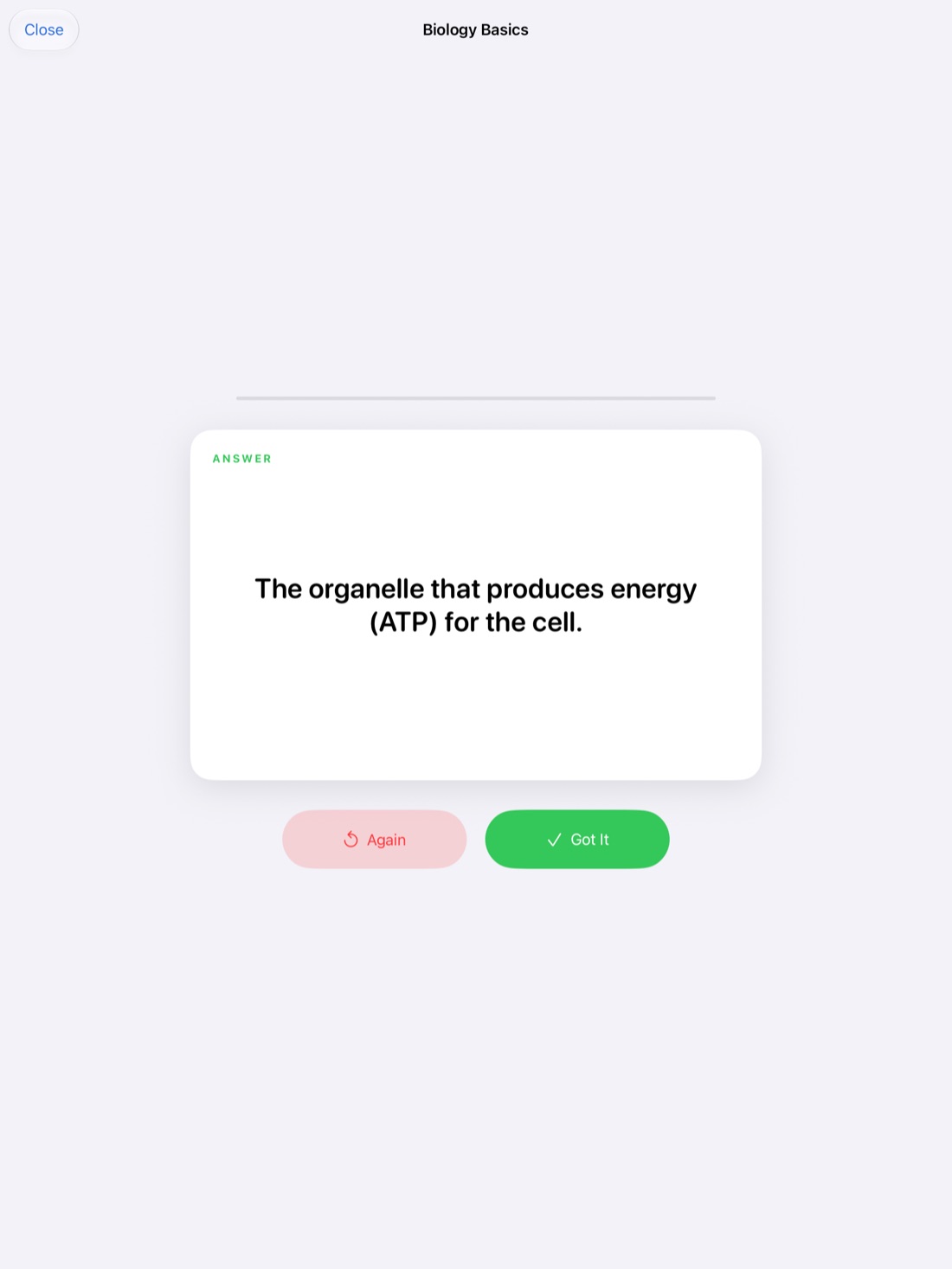
Flashcards suit multiple choice exams well, since many questions test single facts: terms, dates, formulas, definitions. But they have a weakness. A card always asks the question the same way, so you can learn to answer the card without learning the idea.
A few habits help:
- Say the answer before you flip. Only count it as right if you produced it.
- Make reverse cards. If one card goes from term to definition, make another from definition to term. Exams ask both ways.
- Add an example. A card that asks for an example of a concept is closer to how exam questions are written.
- Space them out. Reviewing over several days does more than one long session. See spaced repetition flashcards.
On exam day
Study habits carry into the test room. Read the stem and try to answer it before you look at the options. Cross out the options you can rule out, then choose between what's left. If a question stalls you, mark it and move on, and come back once the easier points are banked.
You'll hear advice never to change your first answer. A better rule: change it when you have a concrete reason, like a later question that reminded you of a fact or a word you misread the first time. Don't change it just because you're nervous.
Studying for multiple choice in Scribba
Scribba is an iPad notebook for class, and its study tools fit this kind of exam.
Flashcards from your handwriting. Write terms on Vocabulary paper, with each term and its definition or example on a row, and Scribba reads your handwriting and turns each row into a card. Cornell Notes pages work too: each cue in the CUES & QUESTIONS column becomes a card. Check the words it read and fix any mistakes before you study. This doesn't need Apple Intelligence. More in flashcards from handwritten notes.
Spaced repetition built in. Decks bring cards back after 1, 3, 7, 14 and 30 days, and you can study all your due cards at once. You can also export a deck to Quizlet or Anki.
Study tape for contrast pages. Draw your contrast page by hand, then drag study tape over one column and tap to peek as you check yourself. It also works on any page of notes where you want to cover the answer and leave the question showing.
Flashcards and key points from lectures. On iPads that support Apple Intelligence, with it turned on, Scribba can write key points and flashcards from a lecture transcript or any page of notes. Read those cards through and edit them, since a card you've checked is a card you've already started to learn.
Frequently asked questions
Are multiple choice exams easier to study for?
Not really. They test more topics in less depth, and distractors punish fuzzy knowledge. Studying so you can answer without seeing the options is the safest approach.
How many practice questions should I do?
Enough to cover every topic, with extra on the ones you miss. Reviewing your mistakes matters more than the total number you do.
Should I make flashcards for everything?
No. Use flashcards for single facts. For concepts that are easy to confuse, a contrast page works better, and for processes, quiz yourself on the whole page.