 Scribba
A creative writing class doesn't have much to memorize. There's no midterm on the definition of a metaphor. What it has instead is a lot of talk about your work and other people's, a stream of ideas you'll want later, and drafts that change from week to week. The notes that matter are the ones that help you write and revise.
Here's how to take notes in workshop, on craft readings and in your own drafting, so the class actually feeds your writing.
When your piece is being workshopped
In many workshops, the writer listens silently while classmates discuss the piece. That's hard, and it's also the best moment to take notes, because you can't argue back.
- Write down everything, including what stings. Don't filter in the moment. You'll decide what to use later.
- Note who said it, with initials. Some readers will turn out to share your taste; others will push you in useful directions.
- Mark where readers got lost or excited. "Confused on p. 3, the jump in time" is more useful than "pacing issues."
- Track agreement. When two or three people say the same thing independently, put a mark beside it. That's the note to take most seriously.
- Write your questions, for when the floor opens to you at the end, if your workshop does that.
Sort feedback after workshop, not during
Wait a day, then go through your notes and sort every comment into three groups:
- Act on it. Several readers saw it, or it names something you secretly knew.
- Consider it. One reader's idea that might work. Try it in a copy of the draft before deciding.
- Set it aside. Comments that want a different story than the one you're writing. It's your piece.
Then write a short revision plan at the top of a fresh page: the three biggest changes you'll make, in order.
Giving feedback on classmates' work
The comments you write on other people's drafts teach you as much as the ones you get. Good workshop comments:
- Start with what works, specifically. "The dialogue in the kitchen scene sounds like real people" helps more than "nice."
- Describe your experience as a reader instead of prescribing fixes. "I didn't know whose memory this was" leaves the solution to the writer.
- Point to exact lines. Underline or bracket them in the margin.
- Ask questions where you're unsure what the writer intended.
- End with a short summary note: what the piece is doing well and the one thing you'd look at in revision.
Craft lectures and readings
When your class reads published work, read it as a writer: notice how it's built, not just what happens. For each reading, note:
- One technique the author uses: a point-of-view shift, a scene told in summary, a line break that changes meaning, a delayed reveal.
- Where it happens, with a page number.
- What it does to you as a reader.
- How you might try it in your own work.
Copying out a sentence or a stanza you admire, by hand, is an old writer's exercise. It slows you down enough to see how the sentence was made. Keep a page of these and of craft terms your instructor uses.
Draft by hand, at least sometimes
Many writers draft early versions by hand. Writing is slower than typing, and that slowness can help: you're less tempted to fix every sentence as it appears, and crossed-out lines stay visible, so you can return to an idea you abandoned too soon.
A workflow that works for many students:
- Draft freely by hand. Don't erase; strike through.
- Read it back and mark the passages with energy.
- Type the draft into your word processor, revising as you go. Typing it up becomes your first revision.
If you're comparing approaches, handwriting vs typing notes covers the general tradeoffs.
Keep an idea journal
Most ideas arrive when you can't use them: an overheard line, an image on the walk home, a "what if" in the middle of a chemistry lecture. An idea journal catches them.
- Date every entry. You'll want to know when an idea came from.
- Write fragments, not plans. A line of dialogue, an object, a setting, a question.
- Keep it in one place so you know where to look when you're stuck.
- Review it weekly and star anything that still interests you a week later.
Be thoughtful with material drawn from real people's lives. Changing details and asking permission when someone could be recognized are part of the craft.
Creative writing notes in Scribba
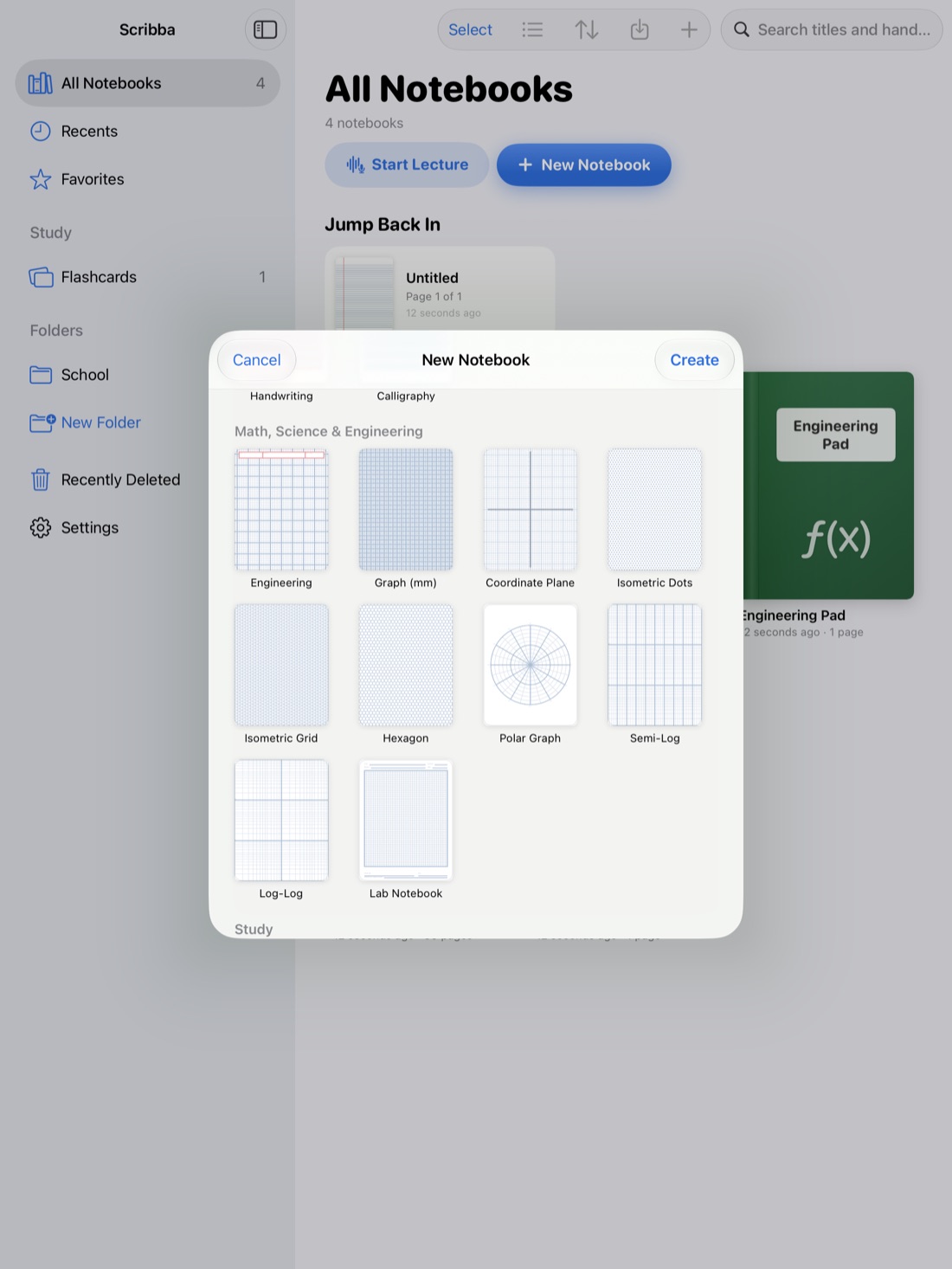
Paper for each job. Paper type changes per page from the page sidebar. Journal paper has a DATE line and wide-spaced rules and opens on ivory paper, which suits an idea journal or handwritten drafts. Index Cards paper gives you a page of card outlines for scene ideas. Storyboard paper has numbered SCENE frames with lines under each, useful for mapping a story's structure or a screenplay. See the storyboard template guide.
Drafting by hand. Try the fountain or pencil pen for long drafting sessions, or E-Ink Books for a soft gray page with pens in e-ink grays. Use the lasso to move a paragraph or stanza somewhere else on the page. Duplicate a page in the page sidebar before a big revision, so the earlier version stays intact.
From ink to text. When a handwritten draft is ready to type up, Scribba can copy, share or place a page's handwriting as typed text. Check it for misread words, especially names and invented words. More in handwriting to text on iPad.
Workshop manuscripts. Import classmates' drafts as PDFs and write comments directly on them. Export the annotated pages as PDF to return them, however your class shares feedback.
Workshop discussions. Recording a workshop includes classmates talking about their own work, so ask your instructor and the group before you record, and check your school's policy. If everyone agrees, tap the mic while you take notes, and later tap a comment to hear exactly how it was said.
Frequently asked questions
Should I reply to feedback during workshop?
Many workshops ask the writer to stay quiet until the end. Write your responses down as questions and ask them when invited.
Is it better to draft fiction by hand or by typing?
Either can work. Many writers draft early versions by hand and type them up as a first revision.
Can I keep my idea journal private in Scribba?
Yes. Notebooks stay on your iPad, or your private iCloud if you turn on sync, and you can lock a notebook with Face ID, Touch ID or a passcode.