 Scribba
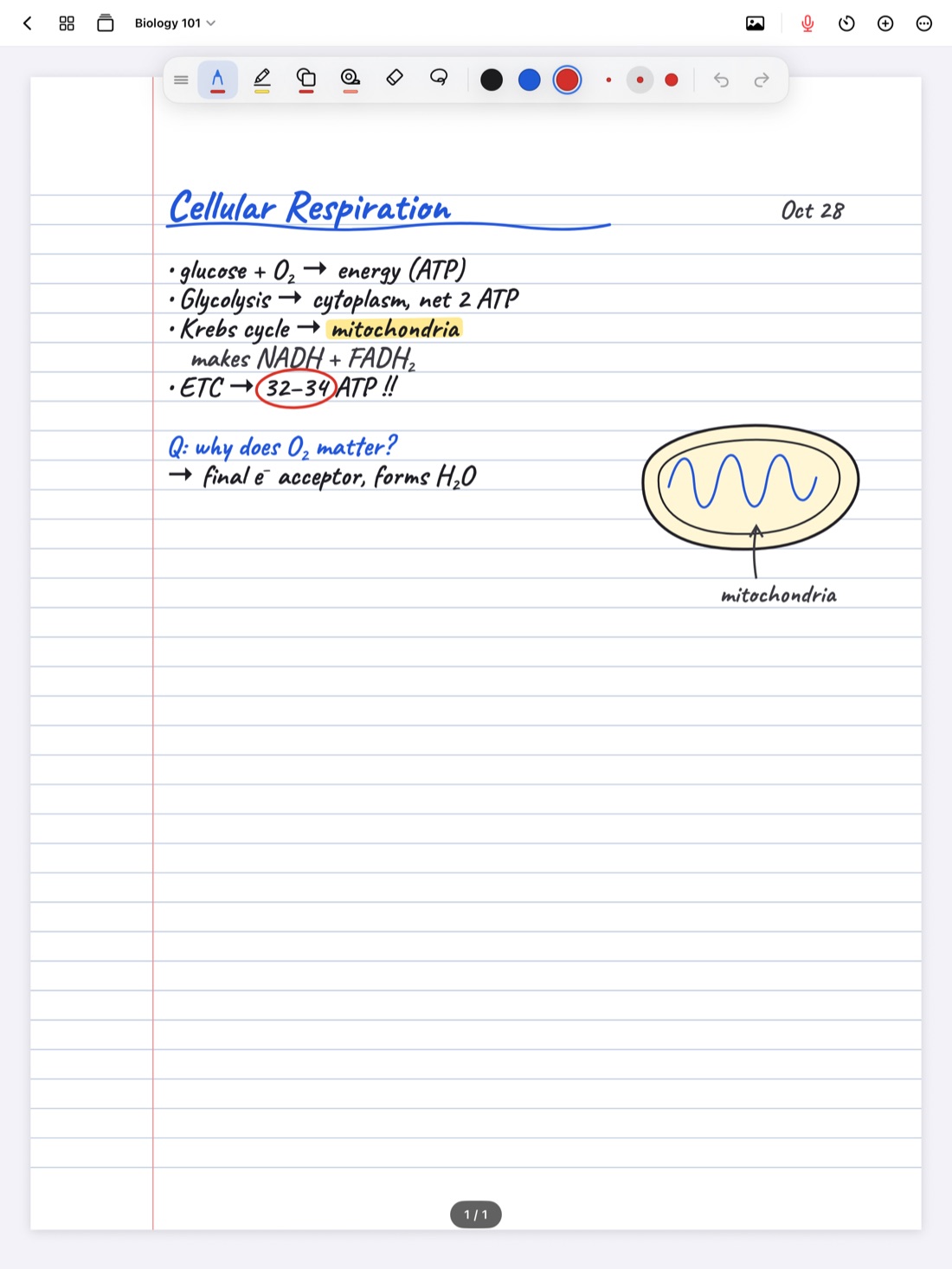
You've seen the photos: perfectly lettered notes in three pastel colors, every heading underlined, not a single crossed-out word. Plenty of students spend evenings copying their messy lecture notes into a clean version like that. It feels like studying. You're looking at the material for an hour, and you end up with something nice to show for it.
The problem is that copying isn't the same as learning. Your hand does the work while your brain coasts. But rewriting isn't always a waste either. It depends entirely on how you do it. Here's how to tell the difference, and what to do with that hour instead.
Why straight copying doesn't work well
When you copy notes word for word, you don't have to decide anything. You don't recall, choose, reword or connect. You read a line, write the line, and move on. That's passive review, and passive review is one of the weaker ways to study.
The things that make material stick are the opposite. Pulling ideas out of memory, known as active recall, is one of the most reliable. So is coming back to material over spaced-out sessions. Explaining something in your own words, and connecting it to what you already know, helps too. Copying does none of these.
It also has a hidden cost. A beautiful rewrite takes a long time, and that time comes out of the study that would have helped.
When rewriting does help
Rewriting is worth it when it forces you to think. A few versions that pass the test:
- Rewriting from memory. Close your notes and write down everything you remember about the lecture. Then open your notes and fill in what you missed in a different color. That's a recall exercise that happens to produce a new page. The blurting method is built around this.
- Condensing. Turning four pages into one forces you to decide what matters. A one-page summary of a lecture is a different thing from a clean copy of it.
- Reorganizing. Rewriting a chronological lecture into a comparison chart, a timeline or a concept map makes you see the structure.
- Combining sources. Merging your lecture notes, the textbook and the slides into one set of notes on a topic means you have to reconcile them.
- Rescuing unreadable notes. If you truly can't read what you wrote, fix it, preferably soon after class while you still remember.
The question to ask yourself is simple: will I have to think to do this? If the answer is no, skip it.
When rewriting wastes time
- Copying to make notes look nice. Neatness is pleasant but doesn't help you remember.
- Rewriting every lecture by default. If it's a routine, it's probably turned into copying.
- Rewriting the week before an exam. At that point, every hour should go to testing yourself.
- Fiddling with colors, fonts and headers. It's easy to mistake decorating for studying.
What to do instead
If you used to spend an hour rewriting, try spending it on these:
- Fix your notes in place, the same day. Fill gaps, expand abbreviations and add missing steps directly on the original page. How to review your notes after class gives a ten-minute routine.
- Write questions in the margin. Turn each main idea into a question. Later, cover the notes and answer from memory. This is how the Cornell method works.
- Write a short summary at the bottom of the page, without looking.
- Make flashcards for the facts you'll need to recall on demand: terms, dates, formulas.
- Do practice problems, if the class has them. Working a problem tests you far more than rereading a worked example.
- Teach it. Explain a lecture to a friend, or to an empty room. Wherever you get stuck is what you need to study.
Tip: if you love the feel of rewriting, keep it, but do it from memory. You'll get the satisfying page and the learning.
In Scribba: fix and test instead of copying
Scribba is an iPad notes app for class, and a few of its tools make fixing and testing your original notes easier than starting over.
Tidy the original page. Use the lasso to select messy writing and move it, the eraser to clean up mistakes, and scribble back and forth over a word to erase it. Hold the Pencil still at the end of a stroke to snap a line, arrow or circle into shape. If you want to reorganize without losing the original, duplicate the page from the page sidebar and rework the copy.
Fill gaps from the recording. If you recorded the lecture, tap anything you wrote and playback jumps to that moment, which is often the fastest way to repair a half-finished note. Ask your professor before recording.
Summarize in a box made for it. The Lecture Notes template has a KEY TAKEAWAYS box at the bottom, and Cornell Notes has a SUMMARY box. Paper type changes per page from the page sidebar.
Test yourself on the original. Drag study tape over answers, terms or diagrams, then tap to peek. Your original notes turn into a self-quiz, with no rewriting at all.
Make flashcards from what you already wrote. On Vocabulary and Cornell Notes pages, Scribba reads your handwriting and turns each row or cue into a flashcard, on any iPad. Check the recognized words first. The cards come back on a spaced repetition schedule.
Get neater notes next time. If messy handwriting is why you rewrite, try the Zoom Window: you write big in a magnified strip, and it lands small and neat on the page.
Frequently asked questions
Is rewriting notes a good way to study?
Copying them word for word usually isn't. Rewriting from memory, condensing them, or reorganizing them into a new format can be, because you have to think to do it.
Should I rewrite messy notes after every class?
No. Fix the parts you can't read and fill the gaps on the original page instead. Save your time for testing yourself.
What if rewriting helps me focus?
Then rewrite from memory with your notes closed, and check afterward. You keep the habit and get the benefits of recall.